Best Back Brace for Lower Back Support: Clinical and Consumer Evidence
The phrase “Best Back Brace for Lower Back Support” covers several different products, from breathable adjustable belts intended for everyday lumbar compression to rigid orthoses prescribed for structural spinal conditions. Evidence does not support one universal choice, so the most appropriate brace depends on the source of pain, required restriction, fit, activity, and medical advice. 1
What a lower-back brace can and cannot do
For uncomplicated, nonspecific low-back pain, an adjustable elastic or semi-rigid brace is generally the most practical category because it can provide compression and support without the bulk of a rigid spinal orthosis. A brace may help limit uncomfortable movement during selected activities, but it should supplement activity, exercise, physical therapy, and treatment of the underlying cause rather than replace them. 2
Clinical evidence remains limited and mixed. A systematic review found insufficient evidence that lumbar supports reliably prevent or treat nonspecific low-back pain, while a Cochrane review also reported limited or low-quality evidence. These findings do not mean every user experiences no benefit, but they do mean marketing claims should not be treated as proof of long-term effectiveness. 3 4
Support categories found in the market
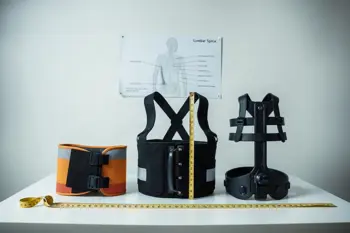
Soft belts usually rely on elastic or breathable textile panels and adjustable straps. Semi-rigid designs add stays, reinforcing panels, or lumbar pads to increase stability while preserving some movement. Rigid or custom-molded braces are a different clinical category and may be used for fracture management, postoperative stabilization, substantial instability, or selected deformities under professional direction. 1
| Category | Typical construction | Most relevant consideration |
|---|---|---|
| Soft | Elastic or mesh fabric | Comfort and light compression |
| Semi-rigid | Stays, panels, or lumbar pads | Greater stability with retained mobility |
| Rigid | Structured or custom-molded shell | Medical supervision and restricted motion |
Product specifications illustrate this range. The Breg Lumbar Support Brace uses dual-pull tension, reinforced support panels, breathable moisture-wicking material, and sizes from XS through 2XL. The Brace Direct Core model combines elastic mesh, compression pull tabs, integrated aluminum stays, and waist coverage listed from 30 to 55 inches. These specifications describe construction, not guaranteed pain relief. 5 7
Features that affect everyday usability
Adjustability is important because compression must be firm enough to feel supportive without restricting breathing, digging into the ribs or hips, or causing numbness. Breathable fabric can make extended wear more tolerable, while low-profile construction may reduce interference with clothing. Stays should provide stability without creating concentrated pressure points when sitting, bending, driving, or walking.
Several products use different approaches to these requirements. Copper Fit’s X-Back lists power X compression straps, four flexible stabilizing supports, a lumbar panel, and vented lightweight fabric. Mueller’s Adjustable Back Brace is described as a one-size-fits-most design with breathable fabric, adjustable straps, and support intended for movement during lifting. Product ratings, including Copper Fit’s displayed 4.3 rating from 813 reviews and Mueller’s displayed 4.8 rating from 57 reviews, are consumer feedback indicators rather than clinical outcome measures. 6 8
Fit, sizing, and maintenance realities
Accurate measurement is central to brace performance. Sizing systems differ considerably: Breg lists waist ranges from 20 to 56 inches across six sizes, while the Core Lumbar Support Brace lists five sizes covering waist measurements from 30 to 55 inches. Other designs use weight ranges, universal sizing, or one-size-fits-most construction. A measurement taken according to the manufacturer’s instructions is more reliable than choosing a size based only on clothing size. 5 7
Maintenance also affects comfort and service life. Some textile braces require hand washing with mild detergent, while others specify machine washing and low-temperature drying. Regular inspection is necessary for stretched elastic, damaged hook-and-loop closures, bent stays, frayed stitching, or skin irritation. A brace that repeatedly shifts, rolls, or causes pressure marks may be poorly fitted even if its listed features appear appropriate.
Risks, limitations, and warning signs
Prolonged reliance on a brace can encourage excessive restriction of movement and may distract from active rehabilitation. Most episodes of acute low-back pain improve within several weeks, and the NHS recommends remaining active where possible. A brace that causes worsening pain, numbness, skin breakdown, or new leg symptoms should be removed and reassessed rather than tightened further. 2
Urgent medical evaluation is warranted when back pain occurs with new bowel or bladder problems, saddle numbness, progressive leg weakness, fever, or major trauma. People with osteoporosis, recent surgery, suspected fracture, persistent pain, or neurological symptoms should ask a clinician or physical therapist to determine the brace type and wearing schedule. Rigid support selected without diagnosis may be unsuitable or may conceal a condition requiring different treatment. 1 5
How to match support to the situation
For short-term everyday support during work, walking, lifting, or prolonged sitting, an adjustable soft or semi-rigid model with breathable material and controllable compression is the category most consistent with practical use. NEENCA’s HY008, for example, describes a pulley system, dual lumbar support pads, memory-aluminum stabilizers, flexible springs, and air-mesh construction. Those features indicate structured support, but they do not establish that the product is appropriate for a particular diagnosis. 9
Medical guidance becomes more important when the goal is structural stabilization rather than comfort or activity support. Johns Hopkins notes that prescribed braces may limit motion and support healing in selected spinal conditions, while orthopedic guidance emphasizes that treatment depends on the underlying diagnosis. The most defensible selection process therefore starts with the condition, identifies the required degree of restriction, confirms measurements, and sets a limited wearing plan alongside active care. 1 5
Sources
- Cleveland Clinic, https://my.clevelandclinic.org/health/treatments/22167-back-brace
- NHS, https://www.nhs.uk/conditions/back-pain/
- PubMed systematic review, https://pubmed.ncbi.nlm.nih.gov/19445775/
- Cochrane Library, https://www.cochranelibrary.com/cdsr/doi/10.1002/14651858.CD001823.pub3/full
- Brace Direct Breg Lumbar Support Brace, https://bracedirect.com/products/breg-lumbar-support-brace-with-adjustable-side-pulls
- Copper Fit X-Back, https://copperfitusa.com/products/x-back
- Brace Direct Core Lumbar Support Brace, https://bracedirect.com/products/brace-direct-core-lumbar-support-brace-for-lower-back-pain-relief-breathable-l0628-back-support-belt
- Mueller Adjustable Back Brace, https://www.muellersportsmed.com/b2c-us/en/Open-Catalogue/By-Body-Part/Back-Support-Braces/Adjustable-Back-Brace/p/6711
- NEENCA HY008 Lower Back Brace, https://neenca.com/products/neenca-lower-back-brace-with-bionic-lumbar-support-hy008
Authored by 24Trendz team