Ways to manage leg ulcers at home: A clinically grounded care guide
Why the cause must be identified first
A leg ulcer is an open wound on the lower leg or foot that does not heal normally. Poor venous circulation is common, but arterial disease, diabetes, injury, infection, and other circulation problems can also contribute. Location, appearance, swelling, skin changes, and pain may provide clues, yet testing is needed before treatment decisions are made. Venous ulcers often occur near the inner ankle, while arterial ulcers may affect the toes, foot, heel, or outer ankle. 1
Home care should therefore support, rather than replace, clinical assessment. A wound that persists for weeks, enlarges, becomes deeper, exposes bone or tendon, or causes severe pain needs professional evaluation. Diabetes, smoking history, kidney disease, neuropathy, prior blood clots, and limited mobility can complicate healing, making an individualized plan important. Treating only the visible sore may not resolve the circulation problem that caused it. 2
Cleaning, covering, and dressing the wound
Keeping an ulcer clean and covered helps protect fragile tissue and manage drainage. Dressings are selected according to the amount of fluid, comfort, and the condition of the surrounding skin. Dressing changes should follow instructions from a clinician or wound-care professional rather than relying on a complicated routine. The goal is protection and moisture management, while the underlying venous, arterial, diabetic, or other cause is addressed separately. 3
Harsh substances can irritate tissue and may interfere with healing. Hydrogen peroxide, rubbing alcohol, and other strong antiseptics should not be applied unless specifically instructed by a qualified healthcare professional. Routine topical antibiotics or antiseptics are not generally appropriate without clinical guidance, particularly when infection has not been diagnosed. Increasing drainage, odor, redness, warmth, swelling, or pain should prompt medical assessment rather than repeated changes to household remedies. 4
Compression and leg elevation
Compression therapy is central to many venous leg-ulcer plans because it can reduce swelling and support the return of blood through the veins. It may involve a bandage or hosiery prescribed and fitted through a clinical service. Compression should not be started blindly, because significant arterial disease can make it unsafe. A pulse check and, when indicated, formal vascular assessment help determine whether compression is suitable and how strong it should be. 5
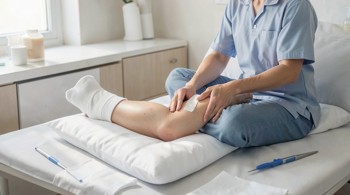
Leg elevation can support venous circulation by reducing the pressure and fluid accumulation associated with dependent swelling. Elevating the leg while resting is commonly included in care plans, but it does not correct arterial narrowing or replace wound treatment. If elevation causes marked pain, or if the foot is cold, pale, or increasingly numb, the symptoms require assessment rather than more elevation or compression. Mixed venous and arterial disease needs especially careful management. 6
Movement, nutrition, and daily habits
Walking and ankle exercises may help circulation in people with suitable venous ulcers, provided movement is safe and does not worsen pain. Regular activity can reduce prolonged sitting or standing and support the calf-muscle pump that assists blood return. Exercise should be adapted to mobility, wound location, pain, and clinician advice. A sudden increase in pain during walking, pain at rest, or a markedly cold foot can indicate reduced arterial flow and warrants evaluation. 7
Healing also depends on general health. A balanced diet with adequate protein, vitamins, and fluids supports tissue repair and immune function. Adequate sleep, smoking cessation, blood-sugar control, and management of blood pressure and cholesterol may reduce factors that interfere with healing. These measures support treatment but are not substitutes for wound assessment, appropriate dressings, or treatment of circulation disease. People with diabetes should inspect the feet and legs daily and avoid walking barefoot. 8
Monitoring for infection or deterioration
Monitoring should include the wound and the surrounding skin. Important changes include increasing pain, spreading redness, warmth, swelling, new or worsening drainage, unpleasant odor, fever, or red streaks. Infection may develop even when a wound initially appears stable, and systemic symptoms can signal a more serious problem. A soaked dressing, rapidly enlarging ulcer, or new difficulty walking should be reported to a clinician rather than managed solely through home dressing changes. 9
Urgent medical care is particularly important when the foot becomes cold or pale, tissue turns black, pain becomes severe, or the ulcer exposes deeper structures. Arterial ulcers can be painful and may reflect inadequate blood supply, while diabetes-related wounds may be less painful because of neuropathy. A non-healing wound should not be assumed to be a routine venous ulcer. Early assessment can help distinguish infection, arterial disease, venous disease, and mixed causes. 10
What home care cannot safely replace
Home measures can reduce swelling, protect the wound, and support healthy routines, but they cannot determine the ulcer type or measure arterial blood flow. A clinician may need to examine pulses, skin temperature, swelling, discoloration, pain patterns, and wound characteristics. Specialist referral is appropriate when the diagnosis is uncertain, the ulcer is large or complex, healing is delayed, arterial or mixed disease is suspected, or the ulcer repeatedly returns. 1
Long-term management often requires maintenance after the wound closes. Venous ulcers can recur if swelling and the underlying vein problem remain untreated, while diabetes, smoking, limited mobility, and vascular disease can continue to impair skin health. Compression, when clinically approved, may remain part of prevention, alongside movement, skin care, monitoring, and management of contributing conditions. Any new break in the skin should be assessed promptly, especially in diabetes or known circulation disease. 5
Sources
- Acibadem Hospitals Group, Leg Ulcers: Causes, Symptoms And Treatment, https://acibademinternational.com/health-library/leg-ulcers-explained-by-medical-evidence-not-myths/
- Dominion Mobile Wound Care, Treating Leg Ulcers at Home: What Works and What Does Not, https://dominionmwc.com/2025/12/23/treating-leg-ulcers-at-home-what-works-and-what-does-not/
- MedlinePlus, Leg Ulcers, https://medlineplus.gov/legulcers.html
- Iatrox, Venous Leg Ulcer: Compression, Refer, https://www.iatrox.com/guidelines/venous-leg-ulcer-management
- Mölnlycke, How to support healing of a venous leg ulcer, https://www.molnlycke.com/en-ca/knowledge/insights/wound-care/venous-leg-ulcers/what-can-i-do-to-support-my-venous-leg-ulcer/
- Center for Vein Restoration, Caring for Venous Ulcer Wounds, https://www.centerforvein.com/blog/caring-venous-ulcer-wounds
- Mölnlycke, What can I do to heal my venous leg ulcer?, https://www.molnlycke.com/en-gb/knowledge/insights/wound-care/what-can-i-do-to-heal-my-venous-leg-ulcer/
- American Academy of Dermatology, Leg Ulcers Treatment, https://www.aad.org/public/diseases/a-z/leg-ulcers-treatment
- Healthdirect Australia, Leg ulcers, https://www.healthdirect.gov.au/leg-ulcers
- Mayo Clinic, Venous ulcers: Symptoms and causes, https://www.mayoclinic.org/diseases-conditions/venous-ulcers/symptoms-causes/syc-20378451
Authored by 24Trendz team