Best antifungal nail polish for treating fungal nails: Evidence, limitations, and treatment choices
The search for the best antifungal nail polish for treating fungal nails requires separating prescription medicines from over-the-counter products and cosmetic polishes. Nail discoloration, thickening, crumbling, or distortion can result from fungus, but trauma, psoriasis, eczema, bacterial infection, and other nail conditions may look similar, so treatment selection should follow a reliable diagnosis rather than appearance alone. 1
What antifungal nail polish can and cannot do
Fungal nail infection, medically called onychomycosis, develops within or beneath the nail plate, which creates a significant barrier for topical medicines. Drugs.com reports that many over-the-counter products treat fungus on surrounding skin more effectively than fungus established in the hard nail itself. This limitation is why topical products generally work best when disease is mild, limited, and not involving the nail growth center. 2
Prescription topical treatments are different from ordinary nail polish because they contain evaluated antifungal medicines and have defined indications. U.S. labeling identifies ciclopirox 8% nail lacquer for mild-to-moderate fingernail or toenail onychomycosis without lunula involvement caused by Trichophyton rubrum. Even with an appropriate medicine, treatment may require many months while uninfected nail grows out. 3
Prescription lacquer and solution options
Three prescription topical categories identified in the research are efinaconazole 10% solution, tavaborole 5% solution, and ciclopirox 8% nail lacquer. Efinaconazole and tavaborole are applied once daily for 48 weeks for toenail onychomycosis, while ciclopirox is also used daily and can require treatment for up to 48 weeks. These regimens demand consistent use rather than occasional cosmetic application. 4
Ciclopirox has additional maintenance requirements. The DailyMed labeling describes daily application as part of a broader nail-management program that includes weekly trimming and periodic removal of unattached infected nail by a healthcare professional. The regimen illustrates a central practical issue with medicated lacquers: the product is only one component of treatment, and missed applications or inadequate nail care can reduce the usefulness of therapy. 3
How nonprescription medicated lacquers compare
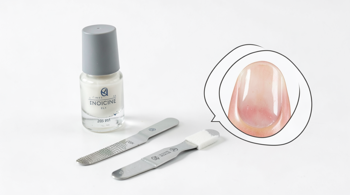
Schollmed Once Weekly Fungal Nail Treatment is described as a 5% medicated lacquer intended for weekly use. Its kit includes a 2.5-milliliter lacquer, nail files, cleaning swabs, and reusable applicators. The stated process involves filing infected areas, cleaning the nail, applying the lacquer across the nail, and allowing approximately three minutes for drying. The manufacturer describes the product as clinically proven to penetrate the nail. 5
Shape lists Dr.ʼs Remedy Enriched Nail Polish as an antifungal nail-polish category pick, but product visibility in a beauty-oriented review should not be confused with U.S. prescription approval or equivalent clinical evidence. The available research does not establish that every cosmetic polish marketed with antifungal language can treat infection inside the nail. Ingredient identity, regulatory status, directions, and evidence should therefore be assessed separately. 6
Why diagnosis matters before choosing a polish
Several nail disorders resemble fungal infection, and treating the wrong condition can allow the actual problem to persist. Verywell Health notes that clinicians may use nail clippings, culture, microscopic examination, or a potassium hydroxide test to confirm onychomycosis. This diagnostic step can also help distinguish bacterial infection from fungal disease and may identify the type of fungus involved. 1
The American Academy of Dermatology and the FDA both describe prescription treatment selection as dependent on the infection and the patient. Factors include the number of affected nails, the extent of nail involvement, whether the matrix is affected, other health conditions, and potential medicine risks. A topical lacquer is therefore not automatically the appropriate choice simply because the nail appears yellow or thickened. 7
Expected timelines, effectiveness, and recurrence
Nail fungus treatment is slow because visible improvement depends on healthy nail replacing damaged nail. Mayo Clinic reports that prescription treatment may continue for weeks or months, while the nail can take substantially longer to regain a normal appearance. A lack of immediate cosmetic change does not necessarily mean that the medicine has failed, but continuing deterioration warrants professional reassessment. 8
Topical treatments generally have lower complete-cure rates than oral terbinafine, particularly when infection is extensive or reaches the matrix. The American Family Physician review and Cochrane evidence describe topical therapy as most suitable for limited disease and emphasize the prolonged courses required. Recurrence is also possible, especially when athleteʼs foot remains untreated or moisture and exposure continue. 9
When a lacquer may not be enough
Oral terbinafine is generally more effective than topical therapy for extensive toenail disease, but it requires medical evaluation because of potential drug interactions and liver-related risks. Topical treatment may be less suitable when many nails are involved, the infection extends to the nail matrix, the nail is severely thickened, or symptoms are painful. These decisions require clinical assessment rather than product-label comparisons alone. 10
People with diabetes should not rely on self-treatment for suspected nail fungus, according to podiatry guidance included in the research. Professional evaluation is also appropriate when the diagnosis is uncertain, the nail is painful, the infection is widespread, or there is no improvement after approximately eight to twelve weeks of correctly performed care. Treating athleteʼs foot at the same time can reduce a continuing source of reinfection. 11
Practical criteria for evaluating a nail polish
A medically responsible comparison should begin with the active ingredient, approval or regulatory status in the relevant country, intended nail condition, and application schedule. It should also examine whether filing, cleaning, lacquer removal, nail trimming, or professional debridement is required. Claims such as “natural,” “invisible,” or “deep penetrating” describe marketing or formulation characteristics, not proof that a product will clear a confirmed infection. 5
The most defensible conclusion is that there is no universally best antifungal nail polish. Prescription efinaconazole, tavaborole, and ciclopirox have defined medical indications, while nonprescription lacquers vary in active ingredients and supporting evidence. Diagnosis, disease severity, adherence, nail growth, recurrence prevention, and safety considerations determine whether a polish is reasonable or whether oral or professionally supervised treatment is more appropriate. 2
Sources
- American Academy of Dermatology, Nail Fungus Treatment: https://www.aad.org/public/diseases/a-z/nail-fungus-treatment
- Drugs.com, What Is the Best Over-the-Counter Nail Fungus Treatment?: https://www.drugs.com/medical-answers/best-over-counter-nail-fungus-treatment-3564243/
- DailyMed, Ciclopirox Topical Solution Label: https://dailymed.nlm.nih.gov/dailymed/search.cfm?query=ciclopirox%2Btopical%2Bsolution
- FDA, Fungal Nail Infections: https://www.fda.gov/consumers/consumer-updates/fungal-nail-infections
- Dr. Schollʼs UK, Schollmed Once Weekly Fungal Nail Treatment: https://drscholls.co.uk/products/schollmed-once-weekly-fungal-nail-treatment-5-w-v-medicated-nail-lacquer/
- Shape, The Best Toenail Fungus Treatments: https://www.shape.com/lifestyle/beauty-style/best-nail-fungus-treatment
- American Academy of Dermatology and FDA treatment guidance, cited through the supplied research summary
- Mayo Clinic, Nail Fungus Diagnosis and Treatment: https://www.mayoclinic.org/diseases-conditions/nail-fungus/diagnosis-treatment/drc-20353300
- Cochrane, Treatments for Fungal Infections of the Toenails: https://www.cochrane.org/CD010031/SKIN_treatments-for-fungal-infections-of-the-toenails
- MedlinePlus, Fungal Nail Infections: https://medlineplus.gov/ency/article/001330.htm
- Foot and Ankle Centers, Over-the-Counter Treatments for Onychomycosis: https://footnanklecenters.com/over-the-counter-treatments-for-onychomycosis/
Authored by 24Trendz team