Early signs of rheumatoid arthritis in hands: Clinical patterns and evaluation
Early signs of rheumatoid arthritis in hands often involve subtle but persistent changes in pain, stiffness, swelling, warmth, tenderness, and hand function. Recognizing these patterns can help distinguish inflammatory arthritis from occasional overuse or other joint conditions, although symptoms alone cannot establish a diagnosis.
Persistent pain, swelling, and tenderness
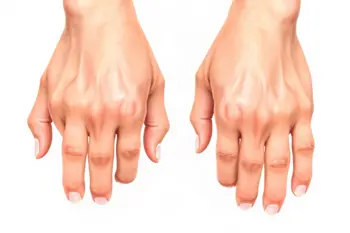
Rheumatoid arthritis is an autoimmune disease in which the immune system attacks the synovium, the lining of a joint. In the hands, early inflammation may cause ongoing pain in the knuckles, middle finger joints, or wrists, rather than discomfort limited to one brief episode. Inflamed joints can look puffy, feel warm, and become tender when pressed or moved. Symptoms may continue for weeks and may involve several joints at once. 1
Swelling caused by synovitis may make rings feel tighter or give the fingers a visibly enlarged appearance. Pain can range from soreness to sharper discomfort and may interfere with gripping or precise movements. The presence of swelling is clinically important because rheumatoid arthritis can damage cartilage, bone, and joint function over time, while early treatment is associated with reduced symptoms and less progression of joint damage. 2
Morning stiffness and symptoms after rest
Morning stiffness lasting more than 30 minutes is a common inflammatory pattern, and some people experience stiffness for an hour or longer. Hands may feel difficult to open or close after waking, with movement gradually improving flexibility. Stiffness can also return after sitting still or resting. This duration and recurrence help distinguish rheumatoid inflammation from ordinary brief stiffness, although no single symptom proves that RA is present. 4
The mechanism is inflammation within the joint lining, not simply mechanical wear. A person may need time to loosen the fingers before buttoning clothing, holding a cup, or using a keyboard. Symptoms that repeatedly follow the same pattern, especially when accompanied by visible swelling or warmth, provide more useful information for a clinician than an isolated episode of hand pain. 6
Symmetry and the hand joints commonly involved
Rheumatoid arthritis characteristically affects corresponding joints on both sides of the body. In the hands, that can mean similar knuckles, finger joints, or wrists becoming painful and swollen in both hands. Symmetry is a useful clinical clue, but it is not an absolute rule, because RA can begin unevenly or involve different joints as the condition develops. 3
The metacarpophalangeal joints, which form the knuckles, and the proximal interphalangeal joints, located in the middle of the fingers, are commonly involved. The distal interphalangeal joints nearest the fingernails are generally less typical sites for RA. Joint distribution helps clinicians compare RA with osteoarthritis and other inflammatory conditions, but examination is required because patterns can overlap. 7
Changes in grip and fine-motor function
Hand inflammation can affect function before obvious deformity develops. Early difficulties may include making a full fist, gripping an object, turning a key, opening a container, or completing fine-motor tasks such as fastening buttons. Reduced grip strength may reflect pain, swelling, tenderness, or limited movement rather than permanent damage. Tracking which activities become difficult can give a clinician a practical description of changing hand function. 5
Persistent loss of function deserves assessment even when swelling appears modest. Rheumatoid arthritis can progressively impair how joints work, and untreated inflammation may lead to structural damage and reduced mobility. A symptom diary can document morning stiffness duration, affected joints, swelling, hand dominance, and tasks that are becoming harder. Such observations do not diagnose RA, but they can make the clinical history more precise. 8
Symptoms beyond the hands
Rheumatoid arthritis is systemic, meaning inflammation can affect more than joints. Alongside hand symptoms, some people report fatigue, malaise, reduced appetite, low-grade fever, sweats, or unexplained weight loss. These features are not specific to RA and can occur with other illnesses, but their combination with persistent, symmetrical hand swelling or prolonged morning stiffness strengthens the reason for medical evaluation. 2
RA may also affect tissues and organs outside the joints, including the eyes, skin, heart, nerves, blood, or lungs. This broader potential explains why the condition is evaluated as an autoimmune disease rather than only a hand disorder. Symptoms outside the hands should be reported during an assessment, particularly when they occur with continuing joint pain, swelling, warmth, or loss of function. 9
How clinicians evaluate suspected RA
There is no single test that confirms or rules out rheumatoid arthritis. Diagnosis is primarily clinical and combines the symptom history with a physical examination for synovitis, tenderness, swelling, warmth, and restricted function. Blood tests may include rheumatoid factor and anti-CCP antibodies, while erythrocyte sedimentation rate and C-reactive protein help assess inflammation. Results must be interpreted in context because abnormal values can occur in other conditions. 5
A negative blood test does not exclude RA, and a positive rheumatoid factor does not establish it by itself. Imaging may be used when needed to assess joints and identify structural changes. Clinical guidance emphasizes referral when synovitis is present, regardless of how long symptoms have lasted, because delayed recognition can permit irreversible joint damage. Persistent hand swelling or stiffness lasting six weeks warrants professional assessment. 4
Distinguishing warning patterns from other causes
Rheumatoid arthritis differs from osteoarthritis in typical cause and distribution. RA is an autoimmune inflammatory disease that attacks the joint lining, whereas osteoarthritis is associated with degeneration of joint tissues. RA more often produces prolonged morning stiffness, warmth, swelling, tenderness, and symmetrical involvement of small hand joints. These distinctions are patterns rather than self-diagnostic rules, since individuals may have overlapping conditions or atypical presentations. 2
Hand pain after a specific injury, brief stiffness that resolves quickly, or symptoms isolated to a single joint may have explanations other than RA. However, persistent or recurring swelling, difficulty moving the fingers, symmetrical symptoms, and declining grip function should not be dismissed as normal aging. A clinician can determine whether the findings suggest RA, another form of arthritis, or a non-joint condition. 10
Sources
- Pacific Arthritis Care, “Rheumatoid Arthritis Symptoms in Hands: What to Look For”
- MedlinePlus, “Rheumatoid Arthritis”
- Merck Manual Professional Edition, “Rheumatoid Arthritis”
- Manchester University NHS Foundation Trust, “Prioritising Clinical Suspicion and Early Referral in Rheumatoid Arthritis Diagnosis”
- Arthritis Foundation, “Testing for Rheumatoid Arthritis”
- Mayo Clinic, “Rheumatoid Arthritis: Symptoms and Causes”
- Johns Hopkins Arthritis Center, “Rheumatoid Arthritis”
- Centers for Disease Control and Prevention, “Rheumatoid Arthritis”
- National Institute of Arthritis and Musculoskeletal and Skin Diseases, “Rheumatoid Arthritis”
- Cleveland Clinic, “Rheumatoid Arthritis”
Authored by 24Trendz team