Plantar Fasciitis Relief: Evidence, Treatment Options, and Safety Considerations
Recognizing plantar fasciitis and plantar heel pain
Plantar fasciitis relief is generally sought for stabbing or aching pain beneath the heel, often most noticeable during the first steps after waking or after prolonged sitting. The plantar fascia is a connective-tissue band extending from the heel toward the toes, supporting the foot during weight bearing and movement. Diagnosis is mainly clinical, while imaging is usually reserved for atypical symptoms, suspected alternative conditions, or pain that does not improve with conservative care. 2
The condition is linked with repeated loading and shortening or contracture of the Achilles tendon and plantar fascia. Risk factors described in clinical references include prolonged standing or walking on hard surfaces, running, dancing, limited ankle flexibility, high or low arches, high-heel use, obesity, and some inflammatory or rheumatologic disorders. The term plantar fasciosis is also used because degenerative changes may occur without conventional inflammation. 2
Early measures that may reduce symptoms
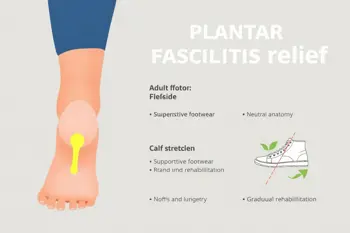
Initial management commonly focuses on reducing activities that aggravate heel pain while maintaining tolerable movement. Supportive shoes, avoidance of barefoot walking on hard surfaces, gentle stretching, and ice are frequently included in conservative care guidance. Over-the-counter nonsteroidal anti-inflammatory drugs may provide short-term pain relief for people who can use them safely, but medication suitability depends on individual medical history and should not be assumed. 8
Footwear changes are intended to reduce mechanical stress during walking and standing. Clinical guidance describes shoes with appropriate heel elevation as one treatment component, alongside Achilles tendon and plantar soft-tissue stretching. Orthoses may help some patients, particularly when combined with stretching and other measures, but available evidence does not establish them as universally effective when used alone. 2
Stretching and progressive strengthening
Stretching programs often target both the calf or Achilles tendon and the plantar fascia. A randomized trial indexed in PubMed evaluated plantar-fascia-specific stretching and lower-leg stretching as relevant conservative approaches, while physical-therapy guidance supports stretching, manual therapy, and strengthening within rehabilitation. Symptoms can persist for several months, so exercises are generally considered part of a progressive management plan rather than a single-session remedy. 9
Recent physiotherapy research has examined whether combining active and passive techniques improves outcomes. A 2026 randomized trial included 48 adults aged 40 to 60 years and compared conventional rehabilitation with a multimodal program involving low-dye tape, short-foot exercise, and unilateral heel raises, in addition to stretching and joint mobilization. Both programs were delivered three times weekly for eight weeks, making the findings relevant to structured rehabilitation rather than occasional exercise. 4
Taping, night splints, and assistive devices
Assistive devices can be considered when symptoms remain troublesome during walking or when morning pain is prominent. Night splints are used to maintain a lengthened position during sleep, while taping can temporarily alter foot support and loading. The Norwegian Institute of Public Health rapid review found that physiotherapy and assistive devices, including taping and splints, may provide little or no pain reduction compared with control, indicating that these methods should not be presented as reliable stand-alone solutions. 1
A systematic review and meta-analysis of 11 randomized controlled trials found that low-dye taping improved pain and quality of life compared with placebo, but did not show advantages over other treatments. The review characterized taping as potentially useful as an adjunctive therapy and noted that the included studies were limited and varied in quality. Skin irritation, incorrect application, and dependence on temporary support are practical considerations when taping is used. 6
Shockwave therapy and injection-based treatments
Extracorporeal shockwave therapy has comparatively encouraging evidence among nonoperative interventions. The 2026 NIPH rapid review assessed three systematic reviews published in 2023, covering 46 primary studies, and concluded that shockwave therapy probably reduces pain somewhat compared with control. The review also emphasized moderate methodological quality and continuing uncertainty across many treatment comparisons, so the result supports measured expectations rather than a guaranteed outcome. 1
A 2026 network meta-analysis included 63 randomized controlled trials and 4,170 participants. It reported broad efficacy for shockwave therapy across pain, function, and follow-up periods, while identifying different apparent strengths for botulinum toxin A, prolotherapy, corticosteroid injections, and platelet-rich plasma. These comparative rankings require clinical interpretation because treatment effects, symptom duration, follow-up, and study designs differed across trials. 3
Chronic cases, risks, and clinical evaluation
Injection and surgical options require particular caution. The NIPH review found uncertain evidence for pharmacological treatments, including botulinum toxin and steroid injections, as well as for surgery, regarding pain and physical function. A separate 2026 randomized trial of chronic cases unresponsive to six months of conservative treatment compared corticosteroid injection, shockwave therapy, and radiofrequency thermal lesioning. At 12 months, radiofrequency treatment showed better function-related outcomes than some comparison groups, but the sample sizes were small. 7
Persistent, severe, or atypical heel pain should be assessed by a healthcare professional because stress fracture, nerve entrapment, inflammatory disease, and other causes can resemble plantar fasciitis. Clinical evaluation is especially important when pain disrupts walking, sleep, or usual activity, or when a carefully followed conservative program fails to improve symptoms. The overall evidence supports a staged approach centered on load modification, stretching, supportive footwear, and individualized rehabilitation before invasive care is considered. 10
Sources
- Norwegian Institute of Public Health, Treatment of Plantar Fasciitis: a rapid review for patient decision aid
- MSD Manual Professional Edition, Plantar Fasciitis
- Scientific Reports, Comparative effectiveness of minimally invasive therapies for plantar fasciitis
- BMC Musculoskeletal Disorders, The effect of multimodal rehabilitation program on pain, functional outcomes, and plantar fascia thickness
- Europe PMC, Effect of Different Physiotherapeutic Interventions in Plantar Fasciitis
- PubMed, Effectiveness of low-dye taping in the treatment of patients with plantar fasciitis
- BMC Musculoskeletal Disorders, Comparative efficacy of corticosteroid injection, extracorporeal shock wave therapy, and radiofrequency ablation
- National Health Service, Plantar fasciitis
- PubMed, Plantar-fascia-specific stretching and lower-leg stretching research
- MedlinePlus, Heel pain
Authored by 24Trendz team