Top natural tips for better posture: A practical evidence-informed guide
Top natural tips for better posture begin with simple, equipment-free habits that support the muscles of the core, shoulders, and neck. Good posture is not a rigid military stance: it is an adaptable alignment that balances the body with minimal strain while preserving comfortable movement.
1. Understand what healthy posture means
Healthy posture generally places the body’s weight over the hips while allowing the spine to retain its natural curves. Ideal alignment is individual because pelvic structure and spinal shape differ, so forcing the chest outward or pinning the shoulders back can create unnecessary tension. The practical goal is to reduce avoidable effort and structural strain, not to maintain one fixed position all day. Neck stiffness, back discomfort, fatigue, and frequent fidgeting can indicate that a posture pattern is becoming difficult to sustain. 12
- Keep the head balanced over the shoulders rather than jutting forward.
- Allow the shoulders to rest comfortably instead of pulling them forcefully backward.
- Change position regularly because no single sitting or standing posture is ideal indefinitely.
2. Build strength in the muscles that support alignment
Long-term improvement depends on training the muscles that help keep the body upright. Physical therapist Lesley Rajan identifies the core, shoulders, and neck as key areas for posture support. Shoulder squeezes are one equipment-free exercise: sit upright with feet flat, gently draw the shoulder blades together, hold for five seconds, and relax. A suggested set is 10 to 15 repetitions, with up to three sets across the day. The movement should remain controlled and comfortable rather than forceful. 3
- Scapular retractions target the muscles between the shoulder blades.
- Planks and bird-dogs can train trunk stability and spinal control.
- Chin tucks encourage awareness of a neutral head position and reduce forward-head habits.
3. Stretch the areas tightened by prolonged sitting
Strength alone may not address posture if the chest, upper back, or hip flexors remain tight. Daily mobility work can counter the rounded-shoulder and forward-leaning patterns associated with desk work and prolonged device use. Chest-opening movements, including a gentle door-frame stretch, create an opportunity to practice a more comfortable shoulder position. Hip-flexor stretches can also support a neutral pelvic position, which reduces the tendency to overarch or collapse through the lower back. Stretching should be gradual and should not produce sharp pain or numbness. 45
- Use slow breathing during chest and hip-flexor stretches.
- Combine mobility work with strengthening rather than treating flexibility as the only solution.
- Yoga and Pilates may improve flexibility and body awareness when practiced consistently.
4. Adjust sitting, standing, and device habits
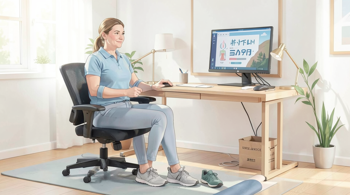
Posture is shaped by the environments used for much of the day. A computer monitor positioned near eye level helps limit repeated downward neck flexion, while a chair that supports the lower back can reduce slumped sitting. The hips, knees, and elbows are commonly positioned near right angles in an ergonomic workstation arrangement, although comfort and individual anatomy still matter. Phones should be raised toward the face when practical instead of held low for long periods. 67
- Place frequently used items within easy reach to reduce forward leaning.
- Alternate sitting and standing rather than treating a standing desk as a permanent posture correction.
- Use reminders or visual cues to perform brief posture checks throughout the day.
5. Use walking and movement to build endurance
Walking provides a practical way to rehearse postural control under normal weight-bearing conditions. A useful walking pattern keeps the head lifted, the shoulders relaxed, and the trunk gently engaged without bracing rigidly. Alternating positions during the day can reduce stiffness associated with prolonged sitting and gives the postural muscles repeated opportunities to work. Regular movement also makes posture less dependent on a single exercise session. The emphasis should be on endurance and coordination, since alignment that cannot be maintained comfortably during ordinary activity is unlikely to become a lasting habit. 89
- Take brief walking intervals between extended periods of sitting.
- Practice relaxed head, shoulder, and pelvis alignment while walking.
- Progress gradually, especially when posture-related fatigue or discomfort is already present.
6. Recognize risks and maintenance requirements
Posture correction has limits and potential risks. A slouched position has been associated with pain, nerve-root irritation, numbness or tingling, and possible effects on breathing and digestion, but posture is not the only possible cause of these symptoms. Rigid braces may reduce reliance on the body’s own postural muscles and contribute to muscle atrophy when used inappropriately. Persistent pain, neurological symptoms, or a visible structural change warrants assessment by a qualified clinician rather than self-directed correction alone. 101
- Stop an exercise that causes sharp pain, progressive weakness, numbness, or tingling.
- Expect gradual adaptation; posture changes require repeated practice and ongoing awareness.
- Use professional guidance when symptoms persist or normal movement becomes restricted.
Sources
- Oprah Daily, “Physical Therapist Tips for Better Posture”
- The National, “How to fix your posture to beat fatigue, improve longevity and boost self-esteem”
- PostureTips.com, “How to Improve Your Posture: Complete Evidence-Based Guide”
- Martha Stewart, “15 Simple Ways to Improve Your Posture”
- Everyday Health, “How to Improve Bad Posture”
- Marie Claire UK, “How To Improve Your Posture: 6 Simple Tips, From A Top Pro”
- Prague Physical Therapy, “How to Improve Your Posture: A Physiotherapist’s Guide”
- Science of People, “How to Fix Your Posture in 5 Minutes”
- Pouted, “How To Improve Posture Naturally”
- Arogyasense, “How to Improve Posture Naturally”
Authored by 24Trendz team