Symptoms of hyperhidrosis excessive sweating: Clinical signs and when to seek assessment
What excessive sweating means
Hyperhidrosis is sweating that exceeds the body’s cooling needs and may occur during rest, in comfortable temperatures, or with little physical activity. Sweating normally responds to heat, exercise, and emotions such as anxiety, but hyperhidrosis is disproportionate to the situation and can become a persistent physical and social problem. It may be focal, affecting selected areas, or diffuse, involving much of the body. 1
The condition is not defined only by the visible amount of perspiration. Repeated dampness, dripping sweat, or difficulty completing ordinary tasks can be clinically important even when the affected area is relatively small. Primary focal hyperhidrosis commonly involves the palms, soles, underarms, face, scalp, or a combination of these locations. Secondary sweating may be widespread and can reflect a medical condition, hormonal change, or medication effect. 2
Common body areas and visible signs
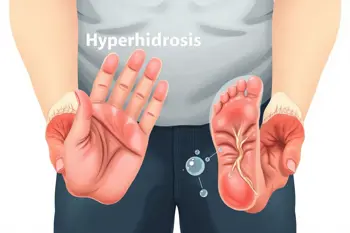
The most recognizable symptoms occur where sweat glands are concentrated or where moisture interferes with movement and contact. Underarm sweating may soak through clothing, while sweaty hands can make objects slippery or make writing difficult. Sweaty feet can dampen socks and footwear. Facial or scalp sweating may be especially noticeable during conversations, work, or other situations in which visible perspiration causes concern. 3
- Persistently wet or clammy palms
- Sweat marks or soaked fabric beneath the arms
- Moist, slippery feet or damp footwear
- Visible sweating on the face, scalp, or forehead
- Moisture affecting more than one body site
Primary focal symptoms are often bilateral, meaning that both hands, both feet, or both underarms are affected in a similar pattern. The sweating can be triggered by stress, excitement, exercise, hot weather, or spicy food, although it may also occur without an obvious trigger. 3
Primary focal hyperhidrosis
Primary hyperhidrosis usually begins during childhood or adolescence and is not explained by another illness or medication. It often affects specific, symmetrical areas rather than the entire body. A family history is reported in some cases, and the condition may improve with age, although symptoms can continue into adulthood. The pattern is generally consistent over time, with episodes recurring in familiar locations such as the hands, feet, underarms, face, or scalp. 2
A characteristic feature is that primary focal hyperhidrosis commonly stops during sleep. Symptoms may appear at least weekly and can be intensified by emotional stress. Anxiety about visible sweating can then increase distress and make the experience feel more disruptive. This cycle can affect confidence, social contact, school participation, and workplace performance even when the person is otherwise healthy. 3
Secondary generalized sweating
Secondary hyperhidrosis differs because it may begin at any age, affect larger areas of the body, and arise from an underlying condition or medicine. Potential associations described in clinical sources include infections, hormonal conditions such as menopause or an overactive thyroid, diabetes, some antidepressants, and, rarely, nerve damage. Generalized sweating does not establish a particular diagnosis, but a new or changing pattern warrants clinical consideration. 2
Sweating during sleep is more concerning for a secondary cause than the usual pattern of primary focal hyperhidrosis. Night sweating, whole-body perspiration, or a sudden change from a person’s previous pattern should be discussed with a healthcare professional, particularly when accompanied by other symptoms. Assessment may include a medical history, medication review, examination, and tests for an underlying cause when compatible findings are present. 4
Effects on skin and everyday function
Excess moisture can soften or macerate the skin, especially on the feet, hands, and areas where skin touches skin. Repeated dampness may contribute to irritation and secondary skin infections. Perspiration can also damage clothing or create persistent wet patches, while damp footwear may make walking uncomfortable. These physical effects are not necessarily dangerous by themselves, but they can reinforce avoidance and reduce day-to-day comfort. 5
Functional symptoms can be as significant as the sweating itself. Wet hands may interfere with writing, gripping tools, handling devices, driving, or shaking hands. Underarm sweating may lead a person to alter clothing choices or avoid raising the arms. Social and occupational effects can include embarrassment, reduced participation, anxiety about odor or stains, and withdrawal from close contact. 7
When sweating needs medical attention
Medical evaluation is appropriate when sweating is persistent, unexplained, widespread, newly developed, or disruptive to normal activities. A clinician will generally consider whether the pattern is focal or generalized, whether both sides are affected, when symptoms began, whether sweating occurs during sleep, and whether medicines or other health changes could be involved. These details help distinguish primary hyperhidrosis from secondary sweating. 8
Sudden sweating with chest pain, shortness of breath, dizziness, nausea, or cold clammy skin can signal a serious medical problem and requires urgent evaluation. Sweating alone is not a reliable indicator of an emergency, but these accompanying symptoms should not be attributed automatically to hyperhidrosis. A new generalized pattern, unexplained night sweating, or symptoms linked to illness also deserves timely medical review. 10
How symptoms are described during assessment
Symptom descriptions are more useful when they specify location, frequency, triggers, timing, and functional consequences. A record of whether sweating occurs at rest, during sleep, or only with heat can clarify the pattern. It is also relevant to note whether the hands, feet, underarms, face, scalp, or multiple regions are affected and whether symptoms occur symmetrically. 6
- When the sweating began and whether it is worsening
- Which body regions are affected
- Whether episodes occur during sleep
- Possible links with heat, exercise, stress, food, or medicines
- Skin irritation, odor, peeling, or recurrent infections
- Specific effects on writing, work, school, clothing, or social contact
There is no single visible sign that confirms every case of hyperhidrosis. Diagnosis is usually clinical, while testing is reserved for situations in which an underlying disorder is suspected. Clear symptom history can therefore help clinicians determine whether the presentation is primary focal hyperhidrosis, secondary generalized sweating, or ordinary sweating intensified by a particular environment or emotion. 1
Sources
- MSD Manual Professional Edition, Hyperhidrosis: https://www.msdmanuals.com/professional/dermatologic-disorders/sweating-disorders/hyperhidrosis
- British Skin Foundation, Hyperhidrosis: https://www.britishskinfoundation.org.uk/conditions/hyperhidrosis
- Pharmacy Today, Hyperhidrosis: When sweating is more than a cooling mechanism: https://www.pharmacytoday.co.nz/article/educate/healthcare-handbook/hyperhidrosis-when-sweating-more-cooling-mechanism
- Medicine Today, Hyperhidrosis: diagnosis, assessment and stepwise management: https://medicinetoday.com.au/mt/2026/may/feature-article/hyperhidrosis-diagnosis-assessment-and-stepwise-management
- Acibadem International, Hyperhidrosis Symptoms, Causes and Treatment: https://acibademinternational.com/diseases/hyperhidrosis/
- Mayo Clinic, Hyperhidrosis symptoms and causes: https://www.mayoclinic.org/diseases-conditions/hyperhidrosis/symptoms-causes/syc-20367152
- American Academy of Dermatology, Hyperhidrosis overview: https://www.aad.org/public/diseases/a-z/hyperhidrosis-overview
- NHS, Excessive sweating and hyperhidrosis: https://www.nhs.uk/conditions/excessive-sweating-hyperhidrosis/
- MedlinePlus, Hyperhidrosis: https://medlineplus.gov/ency/article/007259.htm
- Mount Sinai, Hyperhidrosis: https://www.mountsinai.org/health-library/diseases-conditions/hyperhidrosis
Authored by 24Trendz team