Warning signs of osteoporosis: Clinical findings and screening evidence
The warning signs of osteoporosis are often absent in the early stages, which is why the condition is widely described as a silent disease. Bone loss may continue unnoticed until a fracture occurs, but changes such as height loss, a stooped posture, back pain, or a break after a minor fall can provide important clinical clues.
Why osteoporosis is often difficult to detect
Osteoporosis develops when bone breakdown occurs faster than bone rebuilding, causing bones to become thinner, weaker, and more porous. The disease commonly affects the hip, wrist, and spine, yet the internal changes generally cannot be felt while they are developing. Many people learn they have osteoporosis only after a fracture or a bone-density examination. 1
Low bone density below the osteoporosis threshold is called osteopenia. It is not the same diagnosis, but it indicates reduced bone strength and can progress to osteoporosis. Bone density typically increases until about age 25, remains relatively stable through much of adulthood, and often declines more rapidly after age 50, particularly around menopause. 2
Loss of height and posture changes
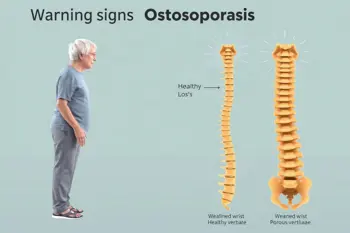
A noticeable reduction in height can indicate compression fractures in the vertebrae. Penn Medicine reports that some people may lose as much as six inches when spinal shrinkage accumulates, while other clinical guidance identifies a loss of about 1.5 inches as a meaningful warning sign. Height loss can occur gradually, so comparing current height with earlier medical measurements may reveal a change. 1
Vertebral fractures can also alter posture. Kyphosis, sometimes described as a hunched or dowager’s-hump appearance, results from changes in the shape or collapse of spinal bones. A forward curve in the upper back may become more visible over time and can affect balance, movement, and daily activities. Posture change is not proof of osteoporosis by itself, because other spinal conditions can produce similar findings. 6
Back pain and vertebral fractures
Back pain is one of the more recognizable symptoms that may occur after osteoporosis has weakened the spine. Small breaks or compression fractures can build up over time and cause persistent discomfort. Sudden, severe pain in the back, especially after lifting, bending, a minor impact, or an ordinary movement, warrants medical assessment because a vertebral fracture may be involved. 2
Early osteoporosis itself generally does not cause pain. Pain tends to appear when weakened bone fractures, particularly in the spine. A vertebral fracture can reduce height, contribute to kyphosis, and cause pain that may extend around the torso. Repeated spinal fractures can also limit mobility and make routine activities more difficult, even when no major accident has occurred. 4
Fragility fractures as a major warning sign
A fracture after a minor fall, bump, sudden movement, or routine activity is a central warning sign of low bone strength. Osteoporotic fractures most often involve the hip, spine, or wrist, although any bone can be affected. A break that seems disproportionate to the force involved should be discussed with a healthcare professional because it may reveal previously undiagnosed osteoporosis. 5
Wrist fractures may be an early indication in people younger than 65, while hip fractures can have serious consequences for independence and health. Johns Hopkins Medicine reports that after age 50, weakened bones contribute to fractures in about one in two women and one in five men. These figures describe population-level risk, not an individual prediction, but they show why a low-impact fracture deserves broader bone-health evaluation. 2
Other clues and associated risk factors
Dental findings may sometimes accompany skeletal bone loss. Loose teeth, gum disease, or receding gums can reflect reduced bone support in the jaw, although these problems also have many local dental causes. Weakened grip strength has been associated with lower bone density in the forearm and with frailty in older adults, but it is not a standalone diagnostic test for osteoporosis. 1
Risk is higher with increasing age, menopause, a family history of osteoporosis, low body weight, smoking, and certain medicines or medical conditions. Female bones are typically smaller and less dense, and bone loss can accelerate when estrogen levels fall at menopause. Men can also develop osteoporosis, particularly later in life or when medicines such as long-term steroids affect bone health. 7
How osteoporosis is confirmed
Because symptoms are frequently absent, physical appearance and pain cannot reliably confirm or exclude osteoporosis. The principal diagnostic tool is a dual-energy X-ray absorptiometry scan, commonly called a DEXA scan. It measures bone mineral density and is usually performed at the lumbar spine, hip, and femoral neck. The procedure generally takes about five minutes and uses approximately one-tenth of the radiation exposure of a standard chest X-ray. 3
DEXA testing can identify low bone density before a fracture occurs and distinguish osteopenia from osteoporosis. Screening decisions depend on factors such as age, sex, fracture history, medical conditions, and medication exposure. A bone-density result should therefore be interpreted with the person’s overall fracture risk rather than treated as an isolated number. A prior low-impact fracture, sudden back pain, or substantial height loss is particularly relevant clinical information. 8
What the warning signs mean in practice
No single warning sign establishes an osteoporosis diagnosis. Height loss may result from spinal fractures, but posture changes can have other causes; gum disease may be dental rather than skeletal; and grip weakness can reflect general frailty. The strongest clinical signals are a fracture after minimal trauma, unexplained vertebral pain, progressive height loss, or a combination of these findings with recognized risk factors.
Medical evaluation can determine whether a DEXA scan, imaging, or additional assessment is appropriate. Bone-health management may involve calcium and vitamin D guidance, weight-bearing exercise, fall prevention, and medicines that slow bone loss or build bone, depending on individual findings. The central limitation is that osteoporosis can remain clinically silent, so waiting for pain or a visible posture change may delay detection and treatment.
Sources
- Penn Medicine, “Osteoporosis: Symptoms and Causes”
- Johns Hopkins Medicine, “Osteoporosis: What You Need to Know as You Age”
- Harvard Health, “How to Know If Your Bones Are Thinning”
- GoodRx, “What Are the Early Signs of Osteoporosis?”
- Mayo Clinic, “Osteoporosis: Symptoms and Causes”
- Cleveland Clinic, “Osteoporosis”
- National Institute of Arthritis and Musculoskeletal and Skin Diseases, “Osteoporosis”
- Bone Health and Osteoporosis Foundation, “Bone Density Exam”
Authored by 24Trendz team