Early symptoms of PCOS you should know: A clinical guide to early warning patterns
Early symptoms of PCOS you should know include irregular or missed periods, persistent acne, unwanted facial or body hair, scalp hair thinning, unexplained weight changes, and certain skin changes. These signs can appear during adolescence or early adulthood, but they vary considerably and may overlap with other health conditions. 1
Menstrual changes are often an early clue
Irregular, infrequent, or absent periods are among the most recognizable early signs of polycystic ovary syndrome. Cycles may become unpredictable, occur fewer than eight times a year, or be separated by more than 35 days. Some people experience prolonged gaps followed by heavier bleeding. These changes commonly reflect irregular ovulation, although stress, thyroid disorders, pregnancy, changes in eating or exercise, and other conditions can also affect menstruation. 2
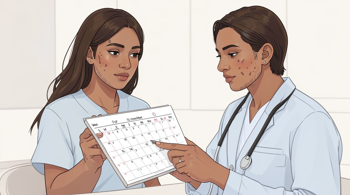
A change in menstrual pattern is more informative when it persists rather than occurring once. Tracking the first day of bleeding, the length of each cycle, missed periods, and unusual spotting can provide useful information for a clinical assessment. Irregular cycles soon after the first menstrual period can have several explanations, so age, developmental stage, medication use, and the overall pattern must be considered before PCOS is suspected. 3
Excess androgen signs affect skin and hair
Higher androgen activity may produce new or worsening coarse hair on the chin, upper lip, chest, abdomen, or other areas. This pattern is called hirsutism. Persistent oily skin and acne, particularly acne that continues beyond the teenage years or concentrates around the jawline and chin, may also be associated with androgen effects. These findings can develop gradually, and their severity differs substantially among people with PCOS. 4
Scalp hair changes can occur alongside increased hair growth elsewhere. A widening part, reduced density, increased shedding, or thinning near the temples may resemble male-pattern hair loss linked to androgen sensitivity. Hair growth and acne can also result from medication, inherited traits, adrenal conditions, or other hormonal disorders. Sudden or rapidly progressing hair growth deserves medical attention because it may not follow the typical gradual pattern associated with PCOS. 5
Weight and insulin-related skin changes
Some people with PCOS gain weight, particularly around the abdomen, or find weight management more difficult than previously. However, body size does not determine whether PCOS is present. The condition can affect people who are thin, average weight, or larger, and weight change alone cannot establish a diagnosis. Metabolic features may include insulin resistance, which means the body responds less effectively to insulin and may require greater insulin production. 6
Darkened, thickened, or velvety skin in folds such as the neck, underarms, or groin can be associated with insulin resistance. Skin tags may also occur in people with metabolic problems, although neither finding is specific to PCOS. Persistent sugar cravings, tiredness after meals, or difficulty changing weight are sometimes reported, but they are not diagnostic signs. These symptoms should be interpreted with menstrual and androgen-related findings rather than treated as standalone proof. 8
Fertility changes may reveal irregular ovulation
Difficulty becoming pregnant can be an early indication of PCOS because irregular ovulation reduces the number of opportunities for conception. Some people discover the condition only after attempting pregnancy, while others notice years of unpredictable periods beforehand. Irregular ovulation does not mean pregnancy is impossible, but it can make fertile timing harder to identify. Fertility concerns should therefore be discussed in the context of cycle history, age, medications, and other reproductive factors. 7
Not everyone with PCOS experiences fertility problems, and not everyone with irregular periods has PCOS. Some people mainly notice acne or hair changes, while others have menstrual irregularity without visible excess hair or persistent skin symptoms. PCOS may become more noticeable during adolescence, after weight changes, or when pregnancy is desired. The absence of ovarian cyst-like findings on an ultrasound also does not automatically exclude the condition. 1
One symptom cannot confirm PCOS
PCOS is a pattern-based diagnosis rather than a conclusion drawn from one symptom. Clinicians generally review menstrual regularity, signs of excess androgen activity, medical history, physical findings, and relevant blood tests. Ultrasound may be considered when appropriate, but the appearance of small ovarian follicles is not required in every case. Similar symptoms can arise from thyroid disease, elevated prolactin, medication effects, congenital adrenal conditions, or other causes that need separate evaluation. 2
The term “polycystic” can create confusion because PCOS does not mean that large ovarian cysts are necessarily present. The condition involves ovulation, reproductive hormones, and metabolic health, with symptoms differing in number and intensity. A person may meet clinical criteria with only a limited number of visible symptoms, while another may have acne, hair growth, irregular cycles, and weight changes without having PCOS. Professional assessment helps distinguish these possibilities. 3
When medical assessment is appropriate
Assessment is appropriate when periods repeatedly disappear, become highly unpredictable, occur very far apart, or are unusually heavy. Medical advice is also relevant when facial or body hair increases noticeably, acne persists despite routine care, scalp thinning progresses, or pregnancy does not occur as expected. The purpose of evaluation is not only to identify PCOS, but also to investigate other explanations and address potential reproductive, metabolic, and long-term health concerns. 4
Clinical care may include a detailed cycle history, examination, laboratory testing, and ultrasound when indicated. Ongoing management depends on symptoms, metabolic findings, reproductive plans, and other health needs, because PCOS is a chronic condition rather than a short-lived menstrual problem. Persistent irregular ovulation can affect fertility, while insulin resistance may carry broader metabolic implications. A structured medical review provides safer guidance than self-diagnosis based on online checklists or a single physical change. 5
Sources
- National Institute of Child Health and Human Development, “PCOS”
- U.S. Office on Women’s Health, “Polycystic Ovary Syndrome”
- MedlinePlus, “Polycystic Ovary Syndrome”
- National Health Service, “Polycystic ovary syndrome”
- Mayo Clinic, “PCOS: Symptoms and causes”
- Cleveland Clinic, “Polycystic Ovary Syndrome”
- American College of Obstetricians and Gynecologists, “Polycystic Ovary Syndrome”
- World Health Organization, “Polycystic ovary syndrome”
Authored by 24Trendz team