Warning signs of eczema: A clinical guide to symptoms, flares, and infection risks
Recognizing the earliest warning signs
Eczema commonly begins with persistent itching, dryness, and irritation rather than a clearly defined rash. Atopic eczema is a long-term inflammatory condition associated with a weakened skin barrier, allowing irritating substances to enter more easily and contributing to inflammation. 1 Itching may be intense, recurrent, and particularly disruptive at night, while the affected skin can feel rough, tight, sensitive, or swollen. 2
Visible changes vary according to skin tone, age, body site, and the stage of a flare. On lighter skin, inflammation may appear red, while deeper skin tones can show brown, gray, violet, purple, or ashen discoloration. 5 Early patches may be dry and mildly discolored, then become more inflamed, scaly, cracked, or swollen as symptoms continue. 2 Because several skin conditions resemble eczema, appearance alone cannot confirm a diagnosis. 5
Changes in texture and surface
Dry, flaky, scaling, or cracked skin is among the most recognizable physical signs. The British Skin Foundation describes eczema as skin that may become dry, red, scaly, crusty, thickened, blistered, cracked, or weeping. 1 Cracks can make the skin sore and sensitive, especially on the hands, feet, wrists, ankles, neck, and areas exposed to repeated washing or friction. 6 Persistent scratching can damage the surface further and intensify irritation. 9
Long-standing eczema may produce lichenification, meaning the skin becomes noticeably thicker, rougher, and more leathery. This change develops in connection with repeated inflammation and scratching rather than appearing only during a brief episode. 11 Small raised bumps or fluid-filled blisters may also occur, particularly during an active flare. Scratching these areas can cause leakage, bleeding, crusting, or raw skin. 4
Where eczema commonly appears
Eczema can occur almost anywhere on the body and may be widespread, although certain locations are frequently reported. Common sites include the hands, feet, chest, neck, eyelids, wrists, ankles, and skin creases. 4 Symptoms may be concentrated in folds such as the backs of the knees or fronts of the elbows, especially in older children and adults. 10 The distribution can change over time as flares recur or triggers vary.
Age affects the typical pattern. In infants, eczema often begins on the scalp and cheeks before appearing elsewhere. 8 Babies and young children may develop dry, itchy, cracked, or sore areas, while teenagers and adults can continue to experience recurring patches. 3 Atopic eczema often runs in families, particularly where asthma or hay fever is also present, although the condition is not contagious. 1
Signs of an active flare-up
A flare-up is a period when one or more affected areas suddenly become more inflamed, itchy, or uncomfortable. Reported flare signs include red, gray, or brown patches, extreme itching, flaky or cracked skin, blistering, bleeding, and small bumps that crust or leak fluid. 4 Symptoms may intensify after exposure to individual triggers, and common irritants include soaps, detergents, fragrances, chemicals, pollen, and dust. 1
Recurring flares are an important warning pattern because eczema tends to alternate between more active and quieter periods. Cleveland Clinic notes that moderate-to-severe atopic dermatitis can involve repeated flares lasting from days to weeks, depending on severity. 4 Severe itching may affect sleep and daily functioning, while scratching can increase skin damage and make the next flare more difficult to control. 7 A record of timing, location, exposures, and symptoms can help a clinician assess possible triggers.
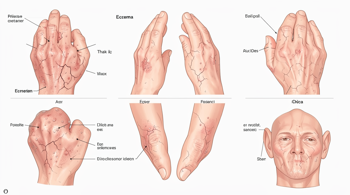
Warning signs of infection or severe irritation
Broken skin caused by cracking or scratching can increase vulnerability to bacteria and viruses because the protective skin barrier is weakened. 1 Possible warning signs of infection include yellow or honey-colored crusts, pus, increasing tenderness, worsening swelling, spreading redness or discoloration, and fever. 12 These findings are different from ordinary dryness and warrant medical assessment, particularly when symptoms are rapidly worsening.
Pain can also be significant when eczema is severely inflamed, raw, or infected. A painful cluster of similar-looking blisters is an especially concerning change identified in eczema symptom guidance because it may represent eczema herpeticum, which requires urgent medical attention. 5 Medical review is also appropriate when a rash is widespread, interferes with sleep, remains painful, or does not improve with gentle skin care. 2
When the rash may not be eczema
Itching and discoloration are important clues, but they are not exclusive to eczema. Other conditions can produce similar symptoms, and clinicians generally consider the rash’s border, surface, distribution, timing, triggers, and personal or family history. 5 A poorly defined patch that fades gradually into surrounding skin is described as a typical eczema pattern, whereas ringworm may have an advancing scaly ring and a clearer center. 5
Scabies can also be confused with eczema, particularly when itching is prominent or worse at night. HarlanMD identifies household spread and thin burrow-like tunnels as clues that can distinguish scabies from eczema. 5 Because treatments differ between these conditions, self-diagnosis from photographs is unreliable. A clinician can examine the skin and evaluate symptom patterns, possible irritants, and relevant medical or family history before confirming the likely cause. 2
Practical interpretation of symptoms
The combination of persistent itch and visible inflammation is more suggestive of eczema than mild, temporary dryness alone. Dry skin commonly causes limited flaking, tightness, roughness, and mild irritation, while eczema is more likely to involve intense persistent itching, swelling, discoloration, crusting, cracking, or oozing. 2 Symptoms can vary in intensity, so a relatively quiet patch does not rule out a chronic relapsing condition.
Gentle skin care can reduce irritation while medical advice is arranged, especially when symptoms recur or interfere with ordinary activities. Regular moisturization is described as central to restoring the skin barrier, while avoiding known irritants may reduce flare triggers. 4 However, increasing pain, fluid, crusting, fever, rapidly spreading changes, or severe sleep disruption should not be treated as routine dryness. These developments indicate a need for professional evaluation rather than relying solely on home observation. 122
Sources
- British Skin Foundation, Eczema: https://www.britishskinfoundation.org.uk/conditions/eczema
- Cleveland Clinic, Eczema vs. Dry Skin: https://health.clevelandclinic.org/eczema-vs-dry-skin
- Healthier Together NHS, Eczema: https://www.healthiertogether.nhs.uk/young-person/eczema
- Cleveland Clinic, Eczema Flare-Ups: https://health.clevelandclinic.org/managing-eczema-flare-ups
- HarlanMD, Eczema Symptoms and Eczema Rash: https://harlanmd.com/blogs/smartlotion-blog/eczema-symptoms
- Mayo Clinic, Atopic Dermatitis Symptoms and Causes: https://www.mayoclinic.org/diseases-conditions/atopic-dermatitis/symptoms-causes/syc-20353273
- National Eczema Association, Atopic Dermatitis: https://nationaleczema.org/eczema/atopic-dermatitis/
- American Academy of Dermatology, Childhood Eczema Symptoms: https://www.aad.org/public/diseases/eczema/childhood/symptoms
- WebMD, Eczema Overview: https://www.webmd.com/skin-problems-and-treatments/eczema/ss/slideshow-eczema-overview
- NHS, Atopic Eczema Symptoms: https://www.nhs.uk/conditions/atopic-eczema/symptoms/
- MedlinePlus, Eczema: https://medlineplus.gov/ency/article/000853.htm
- Medical News Today, Eczema: https://www.medicalnewstoday.com/articles/14417
Authored by 24Trendz team