Low Impact Cardio Routines: Evidence, Formats, and Safety Considerations
A 15-minute low impact cardio workout can use bodyweight-only movements, 40 seconds of work, and 20 seconds of recovery to raise heart rate while keeping movement gentle on the joints. Marching in place, step touches, controlled punches, and similar exercises allow participants to adjust pace, knee height, and range of motion rather than treating the routine as an all-or-nothing test. 1
What low impact cardio means
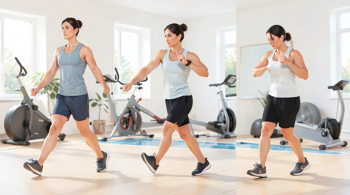
Low impact cardio generally keeps at least one foot on the floor or maintains contact with a machine, reducing the repeated landing forces associated with running and jumping. It can still be demanding because intensity describes how hard the heart and muscles work, while impact describes the force transferred through the body. A no-jumping session may therefore be moderate or vigorous when pace, arm movement, resistance, or incline increases. 4
Common formats include brisk walking, marching, step touches, cycling, swimming, water aerobics, rowing, elliptical training, low step-ups, dancing without jumps, and shadow boxing without bouncing. Yoga or Pilates can also become cardiovascular when transitions are made more continuous and athletic, although the training effect depends on pace and sustained effort rather than the label attached to the session. 4 9
Bodyweight routines at home
A structured home circuit can provide a clear workload without equipment. Joe Wicks’s 15-minute example uses 40 seconds per movement followed by 20 seconds of recovery, beginning with marching on the spot and allowing participants to slow down or increase speed. The stated objective is to increase heart rate and engage muscles while keeping the routine gentle on the joints. That format is adaptable because work intervals can be performed at a personally controlled pace. 1
Longer sessions may combine low-impact jacks, reverse lunges, side lunges, knee raises, walk-out planks, mobility exercises, and bodyweight strength work. A documented 30-minute routine uses 45-second exercise intervals and includes a mat, with no warm-up and a stretch at the end. Its reviewer described steady-state cardiovascular effort alongside metabolic calisthenics, rather than treating every movement as conventional cardio. 2
Equipment-based options
Stationary cycling places the user on a stable machine and emphasizes repetitive leg movement, with the quadriceps and hamstrings contributing to the workload. Elliptical machines mimic aspects of running while removing the repeated foot-strike impact of pavement. Rowing machines coordinate the legs, back, arms, and core in a non-impact movement pattern, although technique and resistance selection affect how demanding the session becomes. 6 5 7
Swimming and water aerobics use buoyancy and water resistance to support the body while creating cardiovascular demand. The reduced load on the hips, knees, and ankles makes aquatic exercise a relevant option for people managing joint discomfort, although access to a pool, swimming ability, and facility conditions can limit practicality. Nordic walking adds poles and coordinated upper-body movement to walking, increasing muscular involvement without requiring running or jumping. 6 8
Intervals, steady state, and PHA formats
Steady-state cardio maintains a relatively consistent effort, making it useful for recovery-oriented sessions and for people learning to regulate pace. One reviewed 30-minute low-impact workout produced time in heart-rate Zones 2, 3, and 4 according to the reviewer’s Apple Watch, with equal time reported in each zone and approximately 250 calories recorded. Such wearable results are individual observations, not universal calorie expectations. 2
Low-impact HIIT changes the effort pattern without requiring jumps. A rebounder session described two blocks of 10 moves, with 30 seconds of work and 10 seconds of recovery, while another PHA routine alternates upper-body strength, lower-body strength, and cardio. The PHA structure uses five sets of four exercises, 20 seconds of work, 10 seconds of rest, and 30 seconds between sets. 3 10
Building a practical routine
A routine can be selected according to available space, equipment, impact tolerance, and desired duration. Beginners may start with marching, step touches, controlled knee lifts, and shadow boxing, then add wider arm movements or longer work periods. A brisk walking session can provide a simple outdoor or treadmill alternative, while cycling, swimming, rowing, and elliptical training offer machine-based options with different muscular demands. 4 6
| Goal or constraint | Potential format | Key consideration |
|---|---|---|
| Short home session | Marching and bodyweight intervals | Adjust pace and knee height |
| Consistent endurance work | Brisk walking or cycling | Maintain a sustainable effort |
| Supported movement | Swimming or water aerobics | Use buoyancy and water resistance |
| Full-body machine work | Rowing or elliptical training | Prioritize technique and controlled resistance |
For general health, the American Heart Association recommends at least 150 minutes of moderate-intensity aerobic activity each week, together with two days of strength training. That weekly target can be distributed across multiple low-impact sessions rather than completed in one long workout. The appropriate amount depends on current fitness, symptoms, recovery, and medical guidance, particularly after injury or when chronic conditions affect exercise tolerance. 8
Risks, modifications, and safety
Low impact reduces mechanical stress but does not eliminate risk. Lunges, squats, planks, rowing, and unstable-surface movements can still challenge balance, muscles, and connective tissues. Rebounder guidance emphasizes a stable setup, soft knees, engaged posture, and permission to pause or modify movements. A mat, secure footwear, clear floor space, and controlled transitions can reduce avoidable hazards during home sessions. 10
Joint-friendly should not be interpreted as suitable for every person or every condition. Pain, dizziness, unusual breathlessness, loss of balance, or worsening symptoms are reasons to stop and seek appropriate professional advice. People returning after injury or managing a medical condition may need changes to range of motion, resistance, duration, or exercise selection. The main practical distinction is that low impact changes force exposure, not the requirement to monitor effort and recovery.
Progression can occur through frequency, duration, pace, arm involvement, resistance, or incline rather than jumping. A participant might first complete short marching intervals, then extend total work time, introduce alternating upper- and lower-body exercises, or move to cycling and rowing. Consistency remains central because a manageable routine that can be repeated supports more reliable weekly activity than an excessively difficult session that interrupts recovery.
Sources
- Joe Wicks Workouts, “15 Minute LOW IMPACT Cardio Workout”
- 2 Lazy 4 the Gym, “30 MIN Low Impact Cardio”
- Get Fit With Ashley, “25-Minute PHA & Low-Impact Cardio”
- Fitnoova, “Low Impact Cardio Workout for Beginners”
- REP Fitness, “Low Impact HIIT Workout”
- Healthline and WebMD, low-impact cardio references
- Verywell Fit, low-impact cardio exercise references
- American Heart Association, physical activity recommendations
- Shape, power yoga and Pilates cardio references
- Leaps and Rebounds, rebounder workout guidance
Authored by 24Trendz team