Warning signs of adrenal fatigue: A clinical evidence review
Warning signs of adrenal fatigue often include persistent exhaustion, brain fog, poor stress tolerance, sleep disruption, salt cravings, lightheadedness, and unexplained weight changes. However, “adrenal fatigue” is not a recognized medical diagnosis, and these symptoms can also signal treatable conditions such as anemia, thyroid disease, sleep disorders, depression, medication effects, or adrenal insufficiency. 1
What the term adrenal fatigue means
The term “adrenal fatigue” describes a popular theory that prolonged stress causes the adrenal glands to become unable to produce enough cortisol. Major endocrine organizations do not recognize this theory as a clinical disease, and available reviews have found no reliable evidence that ordinary psychological stress exhausts the adrenal glands in this way. 5 8
The symptoms associated with the label may still be genuine and disabling. Research and clinical discussion more often relate stress-linked patterns to regulation of the hypothalamic-pituitary-adrenal, or HPA, axis, which coordinates signals between the brain and adrenal glands. Altered timing, amplitude, or feedback sensitivity of cortisol release may be discussed in this context, but that concept is different from adrenal gland failure. 1 2
Commonly reported warning signs
People commonly use the term when experiencing fatigue that does not improve with rest, difficulty waking, afternoon energy crashes, evening alertness, disrupted sleep, reduced concentration, memory lapses, irritability, anxiety, reduced libido, or dependence on caffeine. Salt or sweet cravings, digestive complaints, and a perceived inability to cope with ordinary stress are also frequently reported. None of these findings alone confirms an adrenal disorder. 1 4
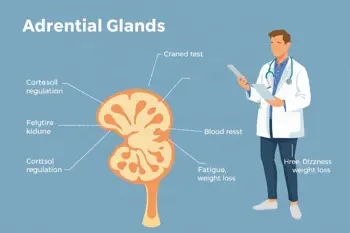
Physical signs deserve particular attention when they are persistent, progressive, or accompanied by measurable changes. Low blood pressure, dizziness after standing, muscle weakness, poor appetite, abdominal pain, nausea, vomiting, diarrhea, low blood glucose, and unexplained weight loss are recognized features of adrenal insufficiency rather than proof of adrenal fatigue. Darkening of the skin, especially in scars, skin folds, pressure points, lips, or the mouth, can occur in Addison’s disease. 3
Symptoms that require medical evaluation
Persistent fatigue with weight loss, worsening weakness, low blood pressure, repeated dizziness, fainting, abdominal symptoms, or skin darkening warrants evaluation by a qualified health professional. Adrenal insufficiency can develop gradually and may be mistaken for other illnesses, while an acute adrenal crisis can present with severe symptoms. The risk is not that stress has simply “used up” the glands, but that a genuine hormone deficiency may go unrecognized. 3 4
Urgent assessment is particularly important for fainting, severe vomiting, confusion, marked weakness, or very low blood pressure. These findings may indicate a serious medical problem requiring prompt treatment. A history of long-term corticosteroid use is also relevant because suddenly stopping corticosteroids is identified as the most common overall cause of adrenal insufficiency. 3 4
Conditions that can look similar
Fatigue and poor concentration are nonspecific symptoms. Sleep apnea and other sleep disorders can fragment restorative sleep; anemia can reduce energy; thyroid disease can alter mood and metabolism; depression and anxiety can affect sleep, motivation, and stress tolerance; and medication effects can produce weakness or daytime drowsiness. Treating the wrong explanation may delay identification of the actual cause. 6 7
Other possibilities include nutritional problems, persistent infection, blood-glucose abnormalities, and overtraining, although the supplied evidence does not establish a single diagnostic checklist for these conditions. A clinical assessment should therefore consider symptom timing, medication history, blood pressure, weight change, menstrual history where relevant, sleep quality, and accompanying gastrointestinal or psychological symptoms rather than relying on an online symptom list. 1 3
How genuine adrenal insufficiency is investigated
Recognized adrenal insufficiency may be primary, as in Addison’s disease, or secondary, when problems affecting the pituitary reduce stimulation of the adrenal glands. Evaluation can include blood measurements of cortisol and adrenocorticotropic hormone, along with sodium and potassium testing. An ACTH stimulation test is described as the confirmatory approach for assessing whether the adrenal glands respond appropriately. 1 4
Salivary cortisol panels are often marketed within functional medicine as a way to map daily cortisol rhythms, but they do not have the same validation as established endocrine testing for diagnosing adrenal insufficiency. A single cortisol result can also be difficult to interpret without clinical context. Unvalidated testing may create false certainty, encourage unnecessary supplements, or mask another medical condition. 1 9
Treatment claims, safety, and practical next steps
There is no standardized medical treatment for “adrenal fatigue” because the label is not an established diagnosis. Hydrocortisone or other corticosteroids should not be used without confirmed hormone deficiency: unnecessary exposure can suppress the adrenal system and carries risks including bone loss. Supplements marketed for adrenal support are not established treatments for hormonal imbalance, and dietary products may have variable quality, dosing, and safety oversight. 1 5
For stress-related exhaustion after medical causes have been considered, evidence-informed care generally focuses on regular sleep, consistent circadian cues, stress-reduction methods, moderate activity, and gradual recovery rather than extreme exercise or hormone products. The central warning sign is not a particular symptom but persistent or worsening impairment. A clinician-led workup can distinguish ordinary burnout, HPA-axis concerns, and true adrenal insufficiency while reducing the risk of delayed diagnosis. 1 2
Sources
- Telehealth Ally, “Adrenal Fatigue: Evidence on HPA Axis and Cortisol,” https://telehealthally.com/guides/adrenal-fatigue-evidence-guide
- Seralene, “Adrenal fatigue: is it real? What the science says in 2026,” https://seralene.com/nervous-system/adrenal-fatigue
- National Institute of Diabetes and Digestive and Kidney Diseases, “Symptoms & Causes of Adrenal Insufficiency & Addison’s Disease,” https://www.niddk.nih.gov/health-information/endocrine-diseases/adrenal-insufficiency-addisons-disease/symptoms-causes
- Merck Manual Consumer Version, “Adrenal Insufficiency,” https://www.merckmanuals.com/home/hormonal-and-metabolic-disorders/adrenal-gland-disorders/adrenal-insufficiency
- Endocrine Society, “Adrenal Fatigue,” https://www.endocrine.org/patient-engagement/endocrine-library/adrenal-fatigue
- Harvard Health Publishing, “Is adrenal fatigue real?” https://www.health.harvard.edu/blog/is-adrenal-fatigue-real-2018022813344
- Mayo Clinic, “Adrenal fatigue: What causes it?” https://www.mayoclinic.org/adrenal-fatigue/expert-answers/faq-20058368
- BMC Endocrine Disorders, systematic review of adrenal fatigue, https://bmcendocrdisord.biomedcentral.com/articles/10.1186/1472-6823-16-48
- Cleveland Clinic, “Is adrenal fatigue real?” https://health.clevelandclinic.org/is-adrenal-fatigue-real/
Authored by 24Trendz team