Early symptoms of Eczema you should know: A Clinical Guide to Recognizing Initial Signs
Early symptoms of Eczema you should know often begin with persistent itching, dry or rough skin, and mild discoloration before a more obvious rash develops. Because eczema can appear differently according to age, body area, and skin tone, early recognition depends on both how the skin looks and how it feels. 1
Persistent itching may appear first
Itching is frequently the earliest noticeable symptom of atopic dermatitis, the most common form of eczema, and it may become prominent before visible inflammation. The sensation can be stronger than the rash appears, particularly at night, and repeated scratching can intensify irritation. This creates an itch-scratch cycle in which mechanical damage increases inflammation and raises the possibility of skin thickening or infection. 2
Early itching does not prove that a person has eczema, because several skin conditions can cause pruritus. However, itching that repeatedly affects the same areas, interferes with sleep, or accompanies persistent dryness is more consistent with an inflammatory skin problem than with brief, ordinary dryness. A history of recurring flares, allergies, asthma, or eczema in the family can provide useful diagnostic context. 3
Dryness, roughness, and scaling
Persistent dryness is a central early clue because eczema involves a weakened skin barrier that loses moisture more readily and allows irritants to penetrate. The affected skin may feel rough, tight, sensitive, flaky, or scaly before it becomes visibly inflamed. Small patches can appear relatively minor while still producing substantial discomfort, especially on the hands, face, elbows, knees, or neck. 4
Texture often changes as a flare continues. A short-lived episode may produce dry, mildly raised or scaly skin, while repeated scratching and chronic inflammation can make the area thicker and more pronounced. This progression is one reason early evaluation matters when gentle skin care does not improve symptoms, when patches keep returning, or when dryness expands beyond a small localized area. 1
Discoloration varies by skin tone
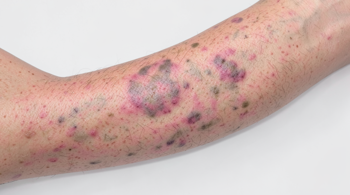
Eczema does not always appear bright red. On lighter skin, inflammation may look pink or red, while on deeper skin tones it may appear brown, purple, gray, ashen, or noticeably lighter or darker than the surrounding skin. The change can be subtle, so comparing the affected area with nearby skin and noting differences in warmth, texture, swelling, and itch can be informative. 5
Color alone is not a reliable way to identify eczema. A clinician generally considers the appearance together with symptoms, timing, location, triggers, and personal or family history. Recognition across diverse skin tones is important because relying only on redness can cause early inflammation to be overlooked, particularly when the first sign is roughness or itch rather than a strongly contrasting patch. 6
Common early locations and patterns
Atopic eczema can develop anywhere, but common locations include the hands, elbows, knees, face, scalp, and neck. In children, the face and scalp are frequent sites, while flexural areas such as the inner elbows and behind the knees are often involved in older children and adults. Recurrent patches in the same places can be a meaningful pattern, especially when they worsen during identifiable exposures. 2
Heat, humidity, sweat, pollen, mold, harsh weather, soaps, detergents, and fragranced products are among the triggers described in the research material. Skin that reacts easily after contact with a new cleanser, laundry product, or cosmetic may reflect irritation or contact dermatitis rather than atopic eczema, so the trigger pattern should not be used as a substitute for diagnosis. 7
Signs of an active or progressing flare
As inflammation becomes more active, eczema may produce small raised bumps, swelling, tiny fluid-filled blisters, oozing, bleeding, cracking, or crusting. Scratched areas can leak fluid and later form a crust. These features can occur during a flare, but they are not unique to eczema and may overlap with other inflammatory or infectious conditions. 8
Possible infection requires particular attention. Pain, warmth, swelling, pus-filled spots, honey-colored crust, rapidly expanding inflammation, sudden worsening, fever, or feeling generally unwell are reasons to seek medical advice. Painful clusters of uniform blisters can represent a serious complication known as eczema herpeticum. Such warning signs differ from the usual early pattern of itch and dryness and should not be managed as routine irritation. 9
When assessment is appropriate
A healthcare professional usually diagnoses eczema by examining the skin and asking when symptoms began, whether they recur, what may trigger them, and whether eczema or related allergic conditions occur in the family. There is no single visual description that confirms every case, because eczema can resemble contact dermatitis, psoriasis, fungal infection, or other rashes. Persistent or uncertain symptoms therefore warrant clinical assessment. 2
Medical review is particularly appropriate when itching disrupts sleep, the rash is widespread, painful, infected, rapidly changing, or not improving with gentle skin care. Mild, short-lived dryness may have another explanation, but repeated flares can lead to thickened skin, bleeding, sleep disturbance, and secondary infection. Diagnosis helps distinguish eczema from similar conditions and supports a plan focused on barrier protection, inflammation control, and trigger management. 1
Sources
- Acibadem Hospitals Group, “What Does Eczema Look Like? Here Is What the Evidence Says”
- NHS inform, “Atopic eczema”
- American Academy of Dermatology, “Eczema types: Atopic dermatitis overview”
- Mayo Clinic, “Atopic dermatitis: Symptoms and causes”
- American Academy of Dermatology, “Skin care tips for eczema”
- HarlanMD, “Eczema Symptoms: How to Recognize Them by Type & Severity”
- Mid-County Dermatology, “Early Eczema Clues a St. Louis Dermatologist Looks For Early Treatment”
- Cleveland Clinic, “Eczema Flare-Ups: Common Triggers and Relief”
- National Eczema Association, “Atopic Dermatitis”
Authored by 24Trendz team