Train journeys across the American Southwest: Routes, landscapes, and practical distinctions
Train journeys across the American Southwest include daily long-distance travel between Chicago and Los Angeles, three-day service between New Orleans and Los Angeles, and scenic excursions through Arizona, Colorado, New Mexico, Nevada, and Utah. The defining experience is the gradual movement through prairie, mountain, canyon, desert, and historic railroad landscapes rather than a sequence of road-trip stops.
Long-distance routes across the Southwest
Amtrak’s Southwest Chief runs daily between Chicago and Los Angeles, crossing eight states: Illinois, Iowa, Missouri, Kansas, Colorado, New Mexico, Arizona, and California. The approximately 2,265-mile journey takes about 43 hours and includes major Southwest stops such as Kansas City, Albuquerque, Flagstaff, and Los Angeles. Its route combines Great Plains scenery with Raton Pass, New Mexico desert formations, red-rock country, and sections paralleling the historic Route 66 corridor. 1
The Sunset Limited follows a more southerly alignment between New Orleans and Los Angeles through Louisiana, Texas, New Mexico, Arizona, and California. It operates three days per week, with a journey lasting approximately 46 to 48 hours. The route passes through or near Tucson, El Paso, and San Antonio, changing from Louisiana bayous to broad desert landscapes before reaching Southern California. Seasonal onboard interpretation may address the geology and history of areas along the line. 2
Southwest Chief landscapes and timing
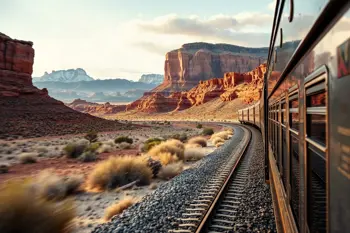
The Southwest Chief’s most concentrated scenic section lies between northern New Mexico and Southern California, according to route guidance based on passenger observations. Raton Pass and the Sangre Cristo Mountains introduce elevated mountain views, while Apache Canyon narrows the corridor before the train continues through New Mexico’s desert. The western half also follows portions of historic Santa Fe Trail and Route 66 landscapes, contrasting with the flatter farmland and prairie views found farther east. 3
Westbound travel is described as particularly useful for viewing the Sangre Cristo Mountains in daylight and entering the desert during sunset. Raton, New Mexico, provides a focused starting point for the mountainous and desert segment, while Kansas City can serve travelers seeking a longer western journey with broader transport connections. Coach seating, sleeping accommodations, traditional dining, and a Sightseer Lounge are identified as principal features of the full Southwest Chief experience. 4
Canyon Spirit and the Colorado-Utah corridor
Canyon Spirit’s Rockies to the Red Rocks route provides a separate three-day rail journey between Denver and Salt Lake City. The itinerary uses daylight-only travel and includes overnight stops in Moab and Glenwood Springs. An expanded version allows the trip to begin or end in Salt Lake City rather than Moab, and selected itineraries include excursions to Arches National Park. The route passes through Colorado canyons, Utah’s red-rock country, and gateway communities associated with national park travel. 5
The corridor has an industrial history predating its current passenger use. Sections were developed by the Denver and Rio Grande Western Railroad in the late nineteenth century to connect mining regions, agricultural centers, and cities while carrying coal, timber, and other goods. Its engineering moved directly through difficult mountain terrain instead of avoiding it, creating a rail alignment where scenery appears continuously through train windows. The route therefore combines historic infrastructure with a contemporary luxury travel format. 6
Rail access to the Grand Canyon and Arizona canyons
Grand Canyon Railway operates passenger trains between Williams, Arizona, and Grand Canyon National Park’s South Rim. The National Park Service identifies the railway as an access option for reaching Grand Canyon Village and the South Rim. This service differs from a long-distance intercity train because the journey is organized around a national park gateway and a dedicated rail corridor rather than a multistate overnight itinerary. 7
Arizona also has heritage and scenic rail options that focus on regional landscapes. Verde Canyon Railroad operates excursions from Clarkdale along the Verde River and through the Verde Canyon area, while the Arizona Railway Museum in Chandler preserves railroad equipment and presents state railway history. These experiences place greater emphasis on interpretation, historic equipment, and canyon scenery than on intercity transportation between major metropolitan areas. 8
Mountain railways in Colorado and New Mexico
The Durango and Silverton Narrow Gauge Railroad runs between Durango and Silverton through Colorado’s San Juan Mountains. Its identity is tied to mountainous scenery and narrow-gauge railway operations, making it distinct from Amtrak’s broad regional and national network. The Cumbres and Toltec Scenic Railroad operates between Chama, New Mexico, and Antonito, Colorado, using historic narrow-gauge equipment. Both routes are heritage-oriented journeys through high-country terrain rather than ordinary commuter services. 9
New Mexico’s Rail Runner Express supplies a different type of rail journey in the Rio Grande corridor. The regional service connects Albuquerque, Santa Fe, and intermediate communities, making it relevant for linking urban and cultural destinations within central New Mexico. Unlike the Southwest Chief or a narrow-gauge excursion, Rail Runner is structured as regional passenger transportation. Its value lies in corridor connectivity, while the longer routes emphasize overnight travel or uninterrupted landscape viewing.
Utah, Nevada, and broader regional connections
Utah Transit Authority’s FrontRunner provides regional passenger rail along the Wasatch Front, including service among Ogden, Salt Lake City, and Provo. It can be considered alongside Canyon Spirit when planning a broader Utah rail itinerary, although its function is regional rather than scenic luxury travel. The distinction matters because a commuter corridor, a heritage excursion, and a multiday intercity route involve different schedules, station patterns, and expectations about onboard facilities. 10
The California Zephyr connects the San Francisco Bay Area with Chicago through Reno, Salt Lake City, and Denver. This route can serve as a rail framework for reaching the broader Southwest from the north, while the Southwest Chief approaches from the central United States and the Sunset Limited from the southern corridor. Nevada Northern Railway, based in Ely, offers heritage excursions through historic mining country, adding a specialized Nevada option outside the principal intercity network.
How the journeys differ in practical terms
Travelers comparing these routes should first distinguish transportation purpose. The Southwest Chief and Sunset Limited are long-distance trains with overnight travel, while Canyon Spirit is a daylight-focused, multiday journey with hotel-based overnight stops. Grand Canyon Railway, Verde Canyon Railroad, Durango and Silverton, Cumbres and Toltec, and Nevada Northern Railway are primarily scenic or heritage experiences. Rail Runner and FrontRunner are regional services intended to connect communities rather than provide a destination-centered sightseeing circuit.
Operational limitations also shape the experience. The Southwest Chief’s reported 2024 on-time performance was 33 percent, indicating that schedule reliability can be a significant friction point on long-distance rail travel. The route’s maximum speed is identified as 90 miles per hour, yet total travel time remains more than 40 hours because of distance, infrastructure, and operating conditions. Long journeys require tolerance for delays, overnight movement, and changing onboard routines rather than expectations associated with air travel. 4
Choosing a route by landscape and journey format
Mountain scenery is most closely associated with the Durango and Silverton, Cumbres and Toltec, Southwest Chief, California Zephyr, and Canyon Spirit corridors. Red-rock and desert views are central to Canyon Spirit, the western Southwest Chief, Sunset Limited, and Verde Canyon Railroad. National park access is especially relevant to Grand Canyon Railway and selected Canyon Spirit itineraries, while urban and cultural movement through New Mexico is better represented by Rail Runner. These distinctions allow landscape, duration, and purpose to guide comparison.
The broadest view of the American Southwest comes from combining route types rather than treating every train as interchangeable. Long-distance services reveal how deserts and mountain regions connect to national rail networks; regional trains link population centers; and heritage railways preserve specialized corridors built for mining, freight, or local development. The principal risks are delays, limited frequency on some services, overnight fatigue, and confusion between a scenic excursion and practical transportation. Route schedules and operating details should therefore be checked with the relevant operator before planning.
Sources
- Amtrak, Southwest Chief train
- Travel + Leisure, Amtrak Sunset Limited route
- US Train Travel Guide, scenic section of the Southwest Chief
- Travels with Kev, Southwest Chief schedule and route guide
- Condé Nast Traveler, Canyon Spirit Rockies to the Red Rocks route
- National Geographic, historic rail corridor through Colorado and Utah
- National Park Service and Grand Canyon Railway, South Rim rail access
- Verde Canyon Railroad and Arizona Railway Museum
- Durango and Silverton Narrow Gauge Railroad; Cumbres and Toltec Scenic Railroad
- Utah Transit Authority, FrontRunner
Authored by 24Trendz team