Ways to manage tendonitis at home: Evidence-based guidance for pain relief and recovery
Understanding tendonitis and its usual pattern
Tendonitis, also called tendinopathy in some long-lasting cases, affects the tough tissue connecting muscle to bone. Pain commonly worsens with movement, and stiffness, swelling, warmth, or difficulty moving a joint may occur. Repetitive exercise, sudden sharp movements, sports, poor technique, and repetitive work tasks are recognized contributors. A physical examination is often sufficient for diagnosis, although ultrasound, X-rays, or MRI may be used when another condition or a more significant tendon problem needs consideration. 1 2 3
Mild tendonitis may improve with home care over approximately two to three weeks, but recovery is not uniform. Mayo Clinic notes that full recovery can take several months, particularly when symptoms are persistent or the tendon has been repeatedly overloaded. The term tendonitis suggests inflammation, while some chronic tendon pain involves deterioration or altered tendon structure rather than active inflammation. That distinction matters because long-term recovery often depends on progressive rehabilitation, not simply prolonged rest. 1 3 7
Reduce aggravating activity without complete shutdown
The initial home measure is to stop or reduce the movement that provokes pain. Health Service Executive guidance advises avoiding tendon movement for two to three days after a mild injury, while Mayo Clinic emphasizes changing the activities associated with irritation. This may involve pausing running, throwing, heavy lifting, strong gripping, twisting, or overhead work, depending on the affected tendon. Rest should be targeted rather than interpreted as weeks of total inactivity, because prolonged immobilization can contribute to stiffness and weakness. 1 2
As pain settles, gentle movement can help preserve joint mobility. HSE guidance recommends continuing to move the injured area when it can be done without pain, while avoiding sports until the tendon has recovered. A practical approach is to substitute activities that do not reproduce symptoms, then reintroduce the provoking movement gradually. Increasing exercise volume, intensity, or frequency suddenly can contribute to recurrence, so training load, work technique, posture, equipment, and recovery intervals all warrant review. 2 8
Use ice, compression, and elevation carefully
For a sudden tendon injury or a painful flare, an ice pack or a bag of frozen peas wrapped in a cloth can be placed over the area for up to 20 minutes every two to three hours. Ice should not be applied directly to the skin. The purpose is symptom control, particularly pain and swelling, rather than a guarantee of faster tendon repair. Cold is most relevant during the early phase or after an activity that causes a clear flare. 2 5
An elastic bandage, tube bandage, soft brace, or splint may support the tendon and reduce strain during aggravating activities. Support must remain comfortable and should not cause numbness, color changes, increased pain, or other signs of impaired circulation. HSE advises removing a bandage or brace before sleep and avoiding a tight wrap. Elevating a swollen limb when practical can also be included in short-term symptom management, although support does not replace activity modification or rehabilitation. 2 6
Consider pain medicines and their limitations
Acetaminophen, also called paracetamol, may reduce pain without serving as an anti-inflammatory medicine. Nonsteroidal anti-inflammatory drugs, including ibuprofen and naproxen sodium, may also lessen pain and irritation for some people. Mayo Clinic lists these medicines among treatment options, and HSE advises discussing suitable products with a pharmacist. Medication should be taken only according to the product label or individualized professional advice, especially when other medicines or health conditions are present. 1 2
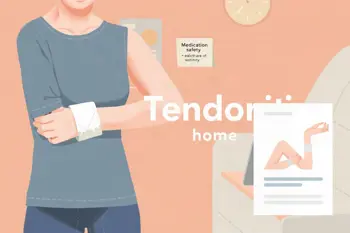
NSAIDs have important safety limitations. The U.S. Food and Drug Administration identifies potential gastrointestinal, kidney, cardiovascular, allergic, and medication-interaction risks. A pharmacist or clinician should be consulted before using them when there is a history of stomach bleeding, kidney disease, cardiovascular disease, allergy, or concurrent medication use. Pain relief can make movement feel easier, but it should not be used to push through an activity that continues to overload the tendon. Topical pain-relieving creams or gels are another option listed by Mayo Clinic, subject to label directions. 1 7
Progress from mobility to strengthening
Gentle range-of-motion work is appropriate when it does not reproduce pain and can help prevent stiffness. Once everyday movement becomes more comfortable, stretching and strengthening should be introduced progressively rather than performed forcefully at the outset. Physical therapy exercises are designed to improve the strength and capacity of the muscle-tendon unit, and resistance exercises may be useful for long-lasting tendon conditions. The correct exercise depends on the tendon involved, so generic routines may not suit shoulder, elbow, wrist, knee, or Achilles symptoms equally. 1 4
For ongoing Achilles tendon problems, Mayo Clinic identifies resistance exercises using heavier loads, such as weighted heel raises, as potentially helpful when prescribed within rehabilitation. A shoe insert or heel wedge may also reduce strain in selected Achilles cases, but support devices are not universally appropriate. Exercises should be increased in small steps while monitoring pain and function. Persistent symptoms, reduced strength, or difficulty performing normal movements are reasons to obtain an assessment rather than repeatedly escalating home exercises. 4 1
Prevent recurrence and recognize warning signs
Prevention centers on correcting the exposure that irritated the tendon. Useful areas to review include exercise technique, workplace posture, gripping or lifting mechanics, footwear or other equipment, rest intervals, and the speed at which training is increased. Repetitive tasks and sudden activity increases are established causes of tendon symptoms, while gradual loading and adequate recovery can reduce overuse risk. Returning to sport before recovery is complete can prolong symptoms, so activity should resume in stages based on pain-free movement and function. 2 8
Home care is not suitable for every tendon complaint. Medical evaluation is appropriate for severe or sudden pain, a snapping or popping sensation, major swelling or bruising, loss of movement or strength, numbness, fever, or symptoms that worsen or fail to improve. Persistent pain may require examination and, when indicated, imaging such as ultrasound or MRI. Corticosteroid injections can provide short-term relief in selected conditions but may weaken tendons, so injection decisions require clinical assessment rather than self-treatment. 1 3 7
Sources
- Mayo Clinic, Tendinitis: Diagnosis and treatment
- Health Service Executive, Tendonitis: symptoms, causes, diagnosis and treatments
- MSD Manual Consumer Version, Tendinopathy
- Mayo Clinic, Achilles tendinitis: Diagnosis and treatment
- NHS, Tendonitis
- MedlinePlus, Tendon injuries and related care
- U.S. Food and Drug Administration, Nonsteroidal anti-inflammatory drugs
- American College of Sports Medicine, training load and overuse injury prevention
Authored by 24Trendz team