Effective ways to manage muscle tension naturally: Evidence, methods, and safety considerations
Effective ways to manage muscle tension naturally include gentle movement, heat for established stiffness, hydration, breathing exercises, and techniques that calm the nervous system. The most suitable approach depends on whether tension follows stress, prolonged sitting, exercise, dehydration, or a recent injury.
Why muscles become tense
Muscle contraction depends on calcium entering muscle fibers, while relaxation requires calcium to return to storage and adenosine triphosphate, or ATP, to allow the fibers to detach. Dehydration and depletion after exercise can disrupt this chemical environment and contribute to cramping. The nervous system also matters: stress, poor posture, and repetitive movement can continue sending contraction signals after the original physical demand has ended. 1
Common patterns include neck and shoulder tightness after computer work, stiffness after unfamiliar exercise, and generalized tension during prolonged stress. A practical response therefore combines local measures, such as heat or massage, with broader measures, such as improved movement habits and relaxation training. Persistent tension should not automatically be treated as a nutrient deficiency or a condition suitable for self-care alone.
Heat, cold, and gentle stretching
Heat can increase blood flow and make surrounding connective tissue more pliable. A warm, damp towel, heat pack, or bath may be used for about 15 to 20 minutes, with fabric separating the heat source from the skin. Heat is generally more relevant to established stiffness than to a newly injured area. 1 Cleveland Clinic guidance similarly distinguishes heat for tightness from cold for acute pain and irritation. 4
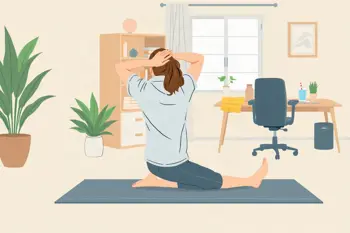
Stretching should be slow, controlled, and comfortable rather than forceful. Gentle yoga movements, mobility exercises, and light walking can support circulation and flexibility. Cat-cow movements, a comfortable child’s pose, or carefully performed shoulder and hip mobility work may be appropriate when they do not increase pain. Bouncing, forcing a joint beyond its range, or stretching a suspected strain aggressively can worsen symptoms.
Breathing and progressive muscle relaxation
Deep breathing can reduce the physical effects of stress by encouraging a shift away from the fight-or-flight response. Slow abdominal breathing is particularly useful when tension is concentrated in the jaw, shoulders, neck, or upper back. The American Psychological Association identifies breathing and mindfulness practices as tools for managing stress-related physical tension. 7 A short routine can involve relaxed inhalation, a slower exhalation, and attention to areas that remain clenched.
Progressive muscle relaxation, or PMR, involves deliberately tensing and then releasing muscle groups in sequence. The contrast helps identify unnoticed bracing and gives the nervous system a structured relaxation signal. Harvard Health Publishing lists progressive muscle relaxation among recognized approaches for reducing stress. 3 The technique should use moderate tension only, not painful contraction, and should be adapted or avoided in areas affected by acute injury.
Hydration, food, and magnesium
Hydration supports normal muscle function, while fluid and electrolyte imbalance can contribute to cramps, particularly after exertion or sweating. Water intake should be considered alongside the circumstances causing fluid loss. Foods containing magnesium, potassium, calcium, and sodium can contribute to normal physiological function, but cramps have multiple possible causes and do not always indicate a single mineral deficiency. 6
Magnesium is involved in muscle contraction and relaxation and helps regulate calcium-related signaling. Magnesium-rich foods include leafy greens, nuts, seeds, and whole grains. The National Institutes of Health lists 350 milligrams per day as the tolerable upper limit for magnesium from supplements and medications in adults, excluding magnesium naturally present in food. 2 Supplements can interact with medicines or cause adverse effects, so “natural” does not mean universally appropriate or risk-free.
Massage, foam rolling, and regular movement
Massage and self-massage can reduce perceived tightness and soreness while encouraging attention to a tense area. Fingers may be suitable for small regions, while a foam roller or massage ball can apply broader pressure. Pressure should remain tolerable, and direct work over a fresh injury, swollen tissue, numb area, or unexplained painful lump should be avoided. Evidence summarized by the National Center for Complementary and Integrative Health supports massage as an approach for some forms of soreness and physical tension. 8
Regular aerobic activity, flexibility work, yoga, and tai chi can reduce the stiffness associated with inactivity and improve general movement tolerance. Johns Hopkins Medicine identifies yoga-related movement and flexibility as contributors to physical well-being. 5 Short movement breaks are often more sustainable than occasional strenuous sessions, especially when tension is linked to prolonged sitting or repetitive tasks.
Sleep and ergonomic prevention
Sleep is part of muscle recovery because insufficient sleep is associated with greater pain sensitivity and may make ordinary tension feel more severe. 9 A consistent sleep routine, a comfortable position, and attention to evening stress can support recovery, although sleep changes alone may not resolve a mechanical problem such as poor workstation setup.
Ergonomic adjustments address the causes of recurring strain rather than only its symptoms. A workstation should allow a neutral posture, reduced sustained shoulder elevation, and regular changes in position. The Occupational Safety and Health Administration identifies ergonomics as relevant to preventing repetitive muscular strain. 10 Useful prevention also includes alternating tasks, taking movement pauses, and avoiding long periods in one posture.
| Pattern | Approaches commonly aligned with it |
|---|---|
| Stress-related tension | Breathing, PMR, mindfulness, gentle movement, and sleep support |
| Established stiffness | Heat, light stretching, walking, and cautious self-massage |
| Post-exercise tightness | Hydration, gradual mobility, recovery sleep, and moderate massage |
| Recent injury or swelling | Use caution with heat and seek assessment if symptoms persist or worsen |
Safety limits and when to seek care
Heat should not be applied during the first 48 hours after a new strain because it may increase swelling; cold is generally the more relevant option during that early inflammatory period. 1 Heating devices can burn skin if placed directly against it or used for too long. Stretching, rolling, and massage should stop when pain becomes sharp, symptoms spread, or weakness, numbness, or loss of function appears.
Recurring cramps, unexplained widespread tension, severe pain, or symptoms that do not improve with sensible self-care warrant professional evaluation. Medical review is especially important when muscle symptoms follow an injury, occur with marked swelling, or interfere with normal movement. Supplements and herbs may carry interaction risks, and targeted advice from a qualified clinician is more appropriate than assuming magnesium or another remedy is the cause or solution.
Sources
- ScienceInsights, “How to Relax a Muscle: Heat, Stretching & More”
- National Institutes of Health, “Magnesium: Fact Sheet for Consumers”
- Harvard Health Publishing, “Six Relaxation Techniques to Reduce Stress”
- Cleveland Clinic, “Should You Use Ice or Heat for Pain Relief?”
- Johns Hopkins Medicine, “9 Benefits of Yoga”
- Mayo Clinic, “Muscle Cramp: Symptoms and Causes”
- American Psychological Association, “Stress Tips”
- National Center for Complementary and Integrative Health, “Massage Therapy: What You Need to Know”
- Sleep Foundation, “How Sleep Affects Pain”
- Occupational Safety and Health Administration, “Ergonomics”
Authored by 24Trendz team