Eczema Skin Care Solutions: Evidence, Daily Routines, and Treatment Considerations
Eczema Skin Care Solutions generally begin with restoring the skin barrier, reducing exposure to irritants, and managing inflammation during flares. Clinical guidance emphasizes regular fragrance-free moisturization, short lukewarm bathing, and treatment choices matched to age, body location, severity, infection risk, and previous response. 1
Why the skin barrier matters
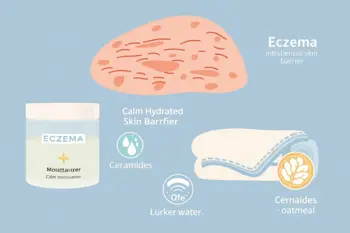
Atopic eczema involves a disturbed skin barrier that allows moisture to escape and can increase sensitivity to irritants. The European Dermatology Forum guideline summary identifies liberal, frequent daily use of emollients as the foundation of care. It also describes a “soak and seal” approach: bathe or shower, gently pat the skin, then apply moisturizer while the skin remains moist. 2
Moisturizers do not all work identically, and evidence does not establish one universally superior formulation. However, creams and ointments are generally preferred over lotions for eczema-prone dryness because they provide more substantial barrier support. The Cochrane evidence review found that moisturizers can improve eczema severity and reduce flares or the need for topical corticosteroids, while individual tolerability remains important. 3
Building a practical bathing routine
Short baths or showers in moderately warm or lukewarm water are generally preferred to prolonged exposure or hot water. Gentle cleansers with a pH between 5 and 6 may be used, while alkaline soaps and harsh cleansing products can aggravate dryness. The guideline summary specifically cautions against pure oils such as olive oil because they may increase water loss rather than reliably supporting the barrier. 2
After bathing, the application method can matter as much as the product category. Skin should be softly patted rather than rubbed, followed by a generous layer of emollient. The guideline gives an adult reference of approximately 250 grams of emollient per week and describes one fingertip unit, about 0.5 grams, as covering an area equivalent to two adult palms. These figures are general guidance rather than a substitute for individualized instructions. 2
Ingredients and product categories
Ingredient labels can help identify products suited to sensitive skin, although “eczema-prone” labeling does not guarantee that every person will tolerate a formulation. Fragrance-free creams and ointments are central options. Some commercial formulations use glycerin, squalane, dimethicone, beta-glucan, ceramide NP, colloidal oatmeal, hyaluronic acid, sodium PCA, urea, or other moisturizing and barrier-supporting ingredients. Individual ingredients can still cause stinging or contact allergy. 1
Colloidal oatmeal is used in some eczema preparations as a skin protectant for minor irritation. One reviewed product identifies 5% colloidal oatmeal as its active ingredient, while another product description lists colloidal oatmeal, three essential ceramides, glycerin, urea, hyaluronic acid, and sodium PCA in a therapy kit. These descriptions report formulation details, not proof that a particular commercial product will outperform other moisturizers. 45
Managing active inflammation
Topical corticosteroids are commonly used during eczema flares, but strength, application frequency, treatment duration, and body location should follow a clinician’s instructions. Mayo Clinic lists moisturizers, topical corticosteroids, calcineurin inhibitors, phototherapy, and systemic medicines among treatment options. When basic care and prescribed topical treatment are insufficient, clinicians may consider escalation based on severity and treatment history. 6
Crisaborole, marketed in the United States as Eucrisa, is a prescription ointment for mild to moderate atopic dermatitis. The Mayo Clinic information states that its safety and effectiveness have not been established in children younger than 3 months. The Eczema Society of Canada describes the 2% ointment as a steroid-free topical PDE4 inhibitor applied twice daily to affected areas in patients aged 3 months and older, with care taken to avoid direct application into the eyes, mouth, or vagina. 7
Triggers, infection risks, and testing
Commonly reported aggravating exposures include fragrances, harsh soaps, detergents, wool, overheating, sweat, and other individual triggers. Avoidance is not identical for everyone, so persistent or worsening symptoms after a new cosmetic, preservative, or personal-care product may warrant assessment for allergic contact dermatitis. Patch testing is used by specialists to identify allergic reactions to substances such as fragrances and preservatives. 8
Infection requires a different response from routine dryness. Increasing redness, warmth, swelling, drainage, crusting, pain, pus, fever, or blistering can indicate secondary infection or another complication and should prompt medical evaluation. Dilute bleach baths may be recommended for some people with moderate-to-severe eczema and recurrent bacterial skin infections, but they require precise dilution and medical guidance rather than informal experimentation. 910
Maintenance realities and limits of self-care
Eczema care is usually an ongoing maintenance process rather than a single-product solution. Emollients may need to be applied daily and whenever the skin feels dry, including during periods when visible inflammation has improved. Treatment plans may also need revision when age, pregnancy, breastfeeding, occupation, seasonal conditions, body site, or infection risk changes. The guideline summary includes special recommendations for children, adolescents, pregnancy, breastfeeding, and occupational circumstances. 2
Product claims about microbiome balance, redness reduction, rapid relief, or bacterial targeting should be interpreted according to the evidence supporting the specific formulation. For example, one hydrogel description reports that its patented enzyme targets eczema-associated Staphylococcus aureus, while another lotion reports a National Eczema Association Seal of Acceptance. Such statements describe product features or certifications, not universal clinical superiority, and they do not replace diagnosis or prescribed treatment. 1112
Questions to discuss with a clinician
- Whether symptoms represent atopic eczema, allergic contact dermatitis, infection, or another condition. 8
- Which moisturizer texture and ingredients are appropriate for the affected body site.
- How long and how often a prescribed anti-inflammatory should be used. 6
- Whether recurrent infections justify medically supervised antimicrobial measures. 9
Sources
- American Academy of Dermatology and Cleveland Clinic guidance on eczema skin care
- European Dermatology Forum guideline summary via Medscape
- Cochrane review on moisturizers for eczema
- Murad, Quick Relief Colloidal Oatmeal Treatment product information
- Hypothesis Bio, Eczema Precision Kit product information
- Mayo Clinic, Eczema diagnosis and treatment
- Mayo Clinic and Eczema Society of Canada, crisaborole information
- American Contact Dermatitis Society, patch testing information
- American Academy of Dermatology, dilute bleach bath guidance
- Johns Hopkins Medicine, eczema infection warning signs
- Hypothesis Bio, Eczema Precision Hydrogel product information
- Treats Lab, ABC Microbiome Calming Lotion product information
Authored by 24Trendz team