14 days sailing the Mediterranean: An itinerary and planning analysis
A 14 days sailing the Mediterranean itinerary can mean either a privately chartered yacht journey or a 14-night cruise linking several national coastlines. Published examples show routes departing from Civitavecchia, Barcelona, Malta, Venice, and Croatia, with schedules combining historic ports, island stops, and days at sea. The central planning question is whether the priority is frequent shore excursions, independent sailing, or a balance between navigation and time ashore.
What a 14-day Mediterranean route can cover
Two weeks allows a route to concentrate on one region or cross several Mediterranean zones. A Western itinerary aboard Holland America Line’s Zuiderdam is listed as a 14-night voyage from Civitavecchia to Lisbon, with calls including Portofino, Livorno, Marseille, Valencia, and Cádiz. Another Holland America itinerary runs from Civitavecchia to Piraeus, combining Italy, France, Spain, Malta, and the Greek Isles. These examples show how port density can vary considerably between journeys. 1
Other published itineraries emphasize the eastern basin. Sun Princess is described as a 14-night voyage from Civitavecchia visiting Greece, Turkey, and the Adriatic, with 11 ports and four sea days. A separate Princess route from Barcelona to Athens is presented as a 15-day, 14-night journey featuring Ibiza, La Spezia, Chania, Santa Margherita, Genoa, and the Amalfi Coast. The number of destinations therefore depends on the ship’s speed, port restrictions, and overnight arrangements. 2 3
Western Mediterranean and Iberian options
The Western Mediterranean generally links the Italian and French Rivieras with Spain and, on longer repositioning schedules, Portugal. Civitavecchia provides access to Rome, while Portofino represents a smaller Italian Riviera call and Livorno functions as a gateway to Florence, Pisa, or Tuscany. Marseille adds a major French port, while Valencia and Cádiz extend the route toward the Iberian Peninsula. Such an itinerary offers architectural, culinary, and historical variety rather than a single sailing environment. 1
Seabourn’s listed 14-night French Yacht Harbors voyage illustrates a more intimate version of the same region. The itinerary uses Seabourn Ovation and identifies Barcelona, Portofino, and Calvi among its destinations, with Southern France, Spain, and Italy forming the geographic frame. The published description emphasizes yacht harbors and smaller port towns, contrasting with the larger passenger capacity and more structured port rhythm of mainstream cruise ships. 4
Eastern Mediterranean, Adriatic, and island routes
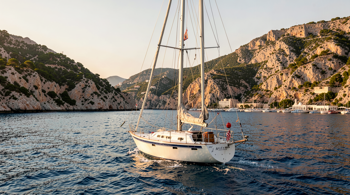
The Adriatic and Aegean offer a different pattern, with closely spaced islands, fortified towns, and passages shaped by local wind systems. Croatia’s Dalmatian Coast is identified as a leading region for a two-week sailing itinerary, particularly around destinations such as Split and Dubrovnik. The Maestral is a commonly referenced daytime wind on the Croatian coast, but conditions still require route planning, anchorage assessment, and attention to local forecasts. 5
The Greek Cyclades are suited to island-hopping but can be more demanding than sheltered coastal routes. The Meltemi may become strong during summer, with research guidance noting that it can reach Force 7 to 8 in the Aegean. A route involving Mykonos, Santorini, Paros, or nearby islands therefore cannot be planned solely around distance. Crew experience, harbor availability, and the ability to shorten or alter a passage are material considerations. 6
Timing, licenses, and operational requirements
May, June, and September are commonly identified as useful months for balancing weather, wind, and visitor numbers. July and August can bring intense heat and heavier demand at popular ports, while the Aegean may also experience stronger Meltemi conditions in mid-summer. These are planning tendencies rather than guarantees. Wind direction, forecast changes, swell, visibility, and local harbor rules can alter the suitability of a route on any given day. 12
Bareboat charters generally require recognized nautical certification, and the Royal Yachting Association is cited in the research as a reference for RYA or International Certificate of Competence requirements. Charterers without the necessary credentials may use a professional skipper, a model described by Sunsail as a separate form of skippered charter. Eligibility can also depend on yacht size, insurance conditions, prior experience, and the charter company’s acceptance of a particular certificate. 7 9
Provisioning, marinas, and daily sailing logistics
Mediterranean coastal geography makes resupply relatively accessible, with coastal towns and grocery outlets often allowing provisions to be replenished every two or three days. That convenience does not remove the need for planning. Fresh food, drinking water, fuel, medications, weather contingencies, and dietary requirements should be considered before leaving a marina, especially when a route includes smaller islands or remote anchorages. Provisioning guidance also treats storage capacity and refrigeration as practical constraints. 13
Mooring fees are a normal expense in developed Mediterranean marinas and vary according to vessel size, season, location, and proximity to a town center. A crew may also encounter different procedures for reservations, shore power, water, waste disposal, and overnight anchoring. Noonsite is cited as a reference for marina and cruising information, but local harbor authorities remain the relevant source for current restrictions. Anchoring outside designated areas can create both legal and safety problems. 10
Safety, schedules, and choosing between formats
Safety equipment is a core distinction between imagining a route and operating one. The research identifies life jackets, VHF radios, visual distress signals, and life rafts among the equipment associated with international maritime safety requirements for chartered yachts. A competent crew must also understand emergency procedures, communication protocols, weather monitoring, and the limits of the vessel. Regulatory expectations can differ by flag, country, yacht type, and operating area, so documentation should be checked before departure. 11
A cruise ship provides a fixed schedule, hotel-style accommodation, onboard dining, entertainment, and organized access to many ports, but shore time is constrained by arrival and departure windows. Published examples include Sun Princess voyages with four or five sea days, while a Viking itinerary from Venice to Barcelona lists 15 days and 14 nights with stops in Croatia, France, Italy, and Spain. An independent yacht offers more control, but weather, mooring availability, maintenance, and crew workload become central realities. 2 8
Sources
- World of Cruising
- CruiseCaptain.ai
- Global Journeys
- Seabourn itinerary information via Crui.se
- Visit Croatia
- Greece Travel Secrets
- Royal Yachting Association
- Spain.info
- Sunsail
- Noonsite
- International Maritime Organization
- Yacht Charter Fleet
- Cruising World
Authored by 24Trendz team