Natural remedies for managing dry eyes: Evidence, limits, and safe home care
Natural remedies for managing dry eyes generally mean practical ways to support the eye’s own tear film, rather than a homemade lubricant placed directly on the eye. Current clinical guidance emphasizes warm compresses, eyelid hygiene, blinking, humidity control, and reducing tear evaporation, while cautioning against cooking oils, herbal preparations, and other unapproved substances used in the eye. 1
Why dry eyes develop
Dry eye is not always caused by an absence of tears. The tear film contains a watery layer, an oily layer, and a mucus layer. The oily layer, produced by the meibomian glands in the eyelids, slows evaporation. When these glands are blocked or inflamed, tears may disappear too quickly even when the eyes produce some fluid. 2
Common contributors include prolonged screen use, aging, contact lenses, smoke, wind, dust, air-conditioning, and dry climates. Screen viewing can reduce blink frequency, while direct airflow can increase evaporation. Persistent symptoms may also be associated with medication effects or medical conditions, so the apparent trigger does not always identify the underlying cause. 4
Warm compresses and eyelid hygiene
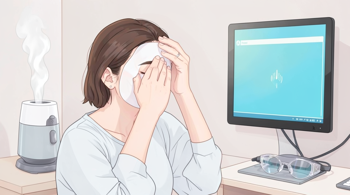
A comfortably warm compress over closed eyelids for about 10 to 15 minutes may soften thickened oils and support the function of the meibomian glands. The cloth should be clean, tested against the skin first, and warm rather than hot. Pacific Eye Institute reports that consistent use may be associated with improvement over two to four weeks, although individual response varies. 3
Gentle eyelid cleaning can remove debris and reduce irritation around the lid margins. The American Academy of Ophthalmology and National Eye Institute include warm compresses and eyelid washing among supportive measures for dry-eye symptoms. Eyelid massage should remain gentle because forceful pressure can irritate the skin or ocular surface, and worsening redness or pain is a reason to stop self-care. 5
Blending, screens, and the surrounding air
Conscious blinking and regular breaks can help redistribute tears across the eye surface during computer or phone use. MedlinePlus describes frequent blinking, breaks from screens, and humidifier use as measures that may reduce discomfort. These steps address tear-film disruption but do not establish that screen exposure is the only cause of symptoms. 8
A humidifier may help when indoor air is dry, while avoiding direct fan or air-conditioning flow can reduce evaporation. Smoke, dust, wind, and very dry environments are recognized irritants. Wraparound protective eyewear outdoors may reduce exposure to moving air and particles, but it cannot correct gland dysfunction, inflammation, infection, or a medication-related cause. 6
Hydration, food, and supplements
Adequate fluid intake supports general health, but hydration alone is not an established treatment for dry-eye disease. Dietary changes may contribute to overall eye health, yet omega-3 supplements have not produced consistent symptom improvement. A large randomized trial found daily marine omega-3 supplementation was no better than olive-oil placebo for moderate-to-severe dry eye. 9
Evidence for oral vitamins is also limited. A 2026 systematic review assessed 13 studies involving vitamins A, B1, B12, and D; 61.5% examined vitamin D, 23% vitamin A, and 15.5% combined vitamin B1 and mecobalamin. None of the studies were judged high quality, so supplementation should not replace assessment of diet, deficiency, medication use, or ocular-surface disease. 15
What natural remedies cannot safely replace
There is no proven household substance that safely reproduces the complete tear film. Cooking oils, herbal products, honey, tea preparations, and other non-sterile materials can introduce contaminants or irritants and should not be placed directly in the eye without professional direction. When lubrication is needed, preservative-free artificial tears are generally preferred for frequent use because preservatives may irritate the ocular surface. 1 11
Redness-relief drops that constrict blood vessels do not treat the mechanisms of dry eye and may cause rebound redness with repeated use. Contact-lens wearers may need shorter wearing periods or a product review if lenses cause irritation, fluctuating vision, or worsening dryness. These practical limits show why a natural routine may support management without being a complete treatment plan. 10
Emerging evidence and clinical follow-up
Natural or non-drug approaches remain an area of study. A 2026 review of meibomian gland dysfunction discussed dietary supplements and naturally derived topical formulations, but emphasized that examination should precede treatment and that efficacy, duration, and safety must be considered. The review does not establish that every listed therapy is effective or suitable for unsupervised use. 14
A 12-week randomized trial of Jyothi Trataka yoga included 49 adults aged 20 to 40 with mild-to-moderate dry eye, with 25 assigned to yoga and 24 to control; three participants discontinued. This small study examined yoga as an adjunct, not a replacement for eye care. Persistent pain, marked redness, light sensitivity, discharge, or vision changes warrant professional evaluation rather than continued home treatment. 16 12
Practical expectations and safety boundaries
Supportive care is most plausible when symptoms are mild and linked to identifiable triggers such as dry air, reduced blinking, or eyelid oil blockage. Improvement is not guaranteed, and a routine may require continued maintenance. The NHS and American Optometric Association both describe environmental control, screen breaks, blinking, warm compresses, and appropriate lubrication as components of symptom management rather than permanent cures. 7 10
Professional assessment becomes especially important when symptoms persist, interfere with reading or driving, or occur with contact-lens use. An eye-care clinician can distinguish evaporative dry eye from inadequate tear production, allergy, eyelid disease, infection, or systemic illness. That distinction determines whether home measures are sufficient or whether prescription treatment and monitoring are needed. 13
Sources
- WebEyeClinic, “What Is the Best Natural Lubricant for Dry Eyes?”
- Pristine Eye Hospital, “Natural Dry Eye Remedies That Actually Work”
- Pacific Eye Institute, “10 Effective Dry Eyes Natural Remedies for Immediate Relief”
- National Eye Institute, “Dry Eye”
- American Academy of Ophthalmology, “What Is Dry Eye?”
- Mayo Clinic, “Dry Eyes: Diagnosis and Treatment”
- NHS, “Dry Eyes”
- MedlinePlus, “Dry Eyes”
- New England Journal of Medicine, marine omega-3 randomized clinical trial
- American Optometric Association, “Dry Eye”
- American Academy of Ophthalmology, “Are Preservatives in Artificial Tears Bad?”
- National Eye Institute, dry-eye evaluation guidance
- NCBI Bookshelf, clinical review of dry-eye syndrome
- Cooper et al., “Pharmacological, Natural and Emerging Therapies for Meibomian Gland Dysfunction”
- Ophthalmic and Physiological Optics, “The Efficacy of Oral Vitamin Supplementation in Dry Eye Disease”
- Frontiers in Medicine, “Yoga as a cost-effective adjunct therapy for dry eye”
Authored by 24Trendz team