Northern lights cruises from US ports
Northern lights cruises from US ports represent a specialized and growing segment of the cruise industry, appealing to travelers who want to chase the aurora borealis without the complexity of booking a separate transatlantic flight to a European embarkation point. The reality, however, is nuanced: direct sailings from the American mainland to prime aurora territory are rare, and understanding the available options, their trade-offs, and their seasonal constraints is essential before committing to an itinerary.1
How US-Based Departures Fit Into the Aurora Borealis Landscape
The vast majority of dedicated Northern Lights cruises depart from European homeports such as Bergen, Oslo, Southampton, or Reykjavik, placing them immediately within range of the auroral oval.2 For American travelers, the two most realistic pathways to aurora viewing by ship are Alaska-based sailings and transatlantic repositioning voyages that cross into high-latitude Arctic waters. Alaska, as the northernmost American state, sits directly beneath the auroral oval, making it one of the few places on Earth where aurora displays are frequent and vivid rather than a rare event.3
Repositioning voyages, which move ships between seasonal deployment regions, occasionally route through Iceland, Greenland, or Norwegian waters. These itineraries are not marketed as dedicated Northern Lights observation tours, but they create viewing opportunities depending on the season and precise routing.4 Travelers must weigh the transit time involved: sailings from East Coast ports toward European Arctic destinations can involve multi-week itineraries simply to account for the Atlantic crossing.
Alaska: The Primary US Departure Hub for Aurora Cruising
Seattle and Anchorage function as the principal US ports for itineraries with realistic Northern Lights potential. Norwegian Cruise Line operates Alaska sailings roundtrip from Seattle, with the Norwegian Joy and Norwegian Encore serving itineraries of 7 to 9 nights that call at Juneau, Skagway, Glacier Bay, and Ketchikan.5 Royal Caribbean's Anthem of the Seas operates northbound Alaska itineraries from Vancouver, connecting to Seward, with passages through the Inside Passage. While summer departures dominate Alaska cruise schedules, September itineraries are particularly notable because the autumnal equinox is associated with heightened geomagnetic activity, which increases aurora probability.6
The confirmed optimal window for a Northern Lights Alaska cruise runs from late August through late April, when nights are sufficiently long and dark for aurora displays to be visible.7 This creates a structural tension for major cruise lines, which typically operate Alaska routes from May through September for weather and tourism reasons. Travelers prioritizing aurora sightings should examine shoulder-season and late-season Alaska departures rather than peak summer schedules, accepting that other onboard amenities and port experiences may differ from high-season offerings.
Notable Itineraries Featuring Arctic and Norwegian Waters
Holland America Line offers some of the most prominent US-adjacent Northern Lights itineraries. Its Voyage of the Vikings, departing roundtrip from Boston aboard ms Volendam, reaches Greenland, Iceland, and Norwegian ports without requiring passengers to fly internationally to board.8 The 35-night sailing scheduled for July 2027 includes overnight stays in Reykjavik and passages through Prince Christian Sound, with interior stateroom pricing starting from approximately $11,569 per person including taxes, fees, and port expenses. Holland America also operates itineraries featuring overnight port stays in Alta and Tromso specifically to maximize Northern Lights chase opportunities.
For expedition-class travelers, AdventureSmith Explorations offers the Northern Lights Explorer aboard the 132-guest Sylvia Earle or the 154-guest Douglas Mawson, routing from Tromso, Norway, to Reykjavik, Iceland, across 16 to 18 days and priced from $15,971 USD per person.9 These smaller-vessel sailings access remote fjords, Jan Mayen Island (home to the world's northernmost active volcano), Iceland's Westfjords, and Greenland's Scoresbysund. While embarkation is in Tromso rather than a US port, the itinerary structure represents what many aurora-focused travelers ultimately seek when researching US-originating options.
Hurtigruten and Specialist Norwegian Coastal Voyages
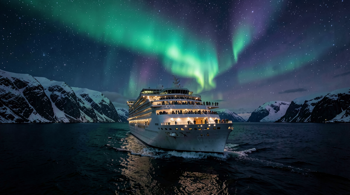
Hurtigruten is widely regarded as the benchmark operator for authentic Norwegian coastal Northern Lights experiences. Its North Cape Line roundtrip voyage runs from Oslo to Honningsvaag and back aboard MS Trollfjord, spanning 15 days with 13 port stops and all meals plus unlimited select drinks included.10 Historical pricing for the December 2026 sailing has been listed from approximately $3,341 per person. Hurtigruten offers a notable guarantee: if the aurora does not appear within sight of the ship on voyages of 11 days or more, passengers receive a complimentary 6 or 7-day voyage, valid for departures from September 20 through March 31. US-based travelers accessing Hurtigruten sailings typically fly to Oslo or Bergen to embark.
The operator's departure ports of Bergen and Oslo do not constitute US ports, but Hurtigruten actively markets to American audiences and partners with US-based travel agencies for group bookings.11 Key ports of call on its Northern Lights itineraries include Tromso (widely described as the gateway to the Arctic and home to the Arctic Cathedral), Alta (referred to as the City of Northern Lights, featuring the world's first Northern Lights observatory), Narvik, and the North Cape plateau, where cliffs descend directly into the Arctic Ocean.
Key Destinations Along Northern Lights Cruise Routes
Regardless of whether a voyage originates from a US or European port, the destinations that define Northern Lights cruise itineraries share common geographic characteristics. All require positioning within or near the auroral oval, the band encircling the polar regions where solar particle interactions with Earth's magnetic field produce visible aurora displays most reliably.12 The following destinations appear consistently across the spectrum of relevant itineraries:
- Tromso, Norway: Positioned in the middle of the auroral oval, offering both aurora hunting and daytime cultural experiences including museums, cuisine, and the Arctic Cathedral.
- Alta, Norway: Site of the world's first Northern Lights observatory and prehistoric UNESCO-listed petroglyphs; features overnight ship stays on select Holland America sailings.
- Kirkenes, Norway: Near the Russian border, known for king crab safaris and minimal light pollution.
- Reykjavik and Iceland's Westfjords: Accessible via repositioning or direct European departures, with strong aurora activity September through March.
- Fairbanks and Denali region, Alaska: Accessible via US-port sailings with overland extensions, beneath the auroral oval with reliably dark winter skies.
- Svalbard: Reached by expedition operators, featuring extreme high-latitude positioning for maximum aurora probability.
Planning Realities, Costs, and Risk Factors
Pricing for Northern Lights cruise itineraries varies substantially by operator category. Mass-market Alaska sailings from Seattle typically begin around $2,000 to $3,000 per person for 7-night itineraries.13 Premium European-routed coastal voyages such as Hurtigruten's North Cape Line run from approximately $3,341 per person for 15 nights, while expedition-class operators like AdventureSmith and Lindblad Expeditions can price from $15,971 to well above $58,000 per person for longer Arctic crossings. Holland America's 35-night Boston-roundtrip Viking voyage starts near $11,569 per person in interior categories.
Several risk factors should inform any booking decision. Aurora visibility is never guaranteed: it depends on solar activity levels measured by the Kp index, cloud cover, and precise ship positioning relative to the auroral oval.14 Weather conditions in Arctic regions can change rapidly, and some itinerary ports may be inaccessible due to ice or sea state. Multi-week itineraries from US ports carry higher opportunity costs and total expenditure. Travelers should also account for the reality that Alaska cruise season runs May through September, meaning the optimal aurora window (late August onward) only partially overlaps with standard summer deployment. Those committed to maximizing aurora probability are generally advised by travel specialists to fly to a European hub such as Oslo or Tromso and board a dedicated coastal voyage, accepting that US-port origination involves meaningful geographic compromise.15
Sources
- Cruise Critic – cruisecritic.com
- Viking Cruises – vikingcruises.com
- Undiscovered America TV – undiscoveredamerica.tv
- Travel + Leisure – travelandleisure.com
- Global Journeys / Norwegian Cruise Line – globaljourneys.com
- Royal Caribbean Cruises – royalcaribbean.com
- Undiscovered America TV – undiscoveredamerica.tv
- Cruise and Travel Experts – cruiseandtravelexperts.com
- AdventureSmith Explorations – adventuresmithexplorations.com
- Hurtigruten US – hurtigruten.com
- AAA Trip Canvas – aaa.com
- CruiseLine.com – cruiseline.com
- Forbes Advisor – forbes.com
- Princess Cruises Blog – princess.com
- Travel Weekly – travelweekly.com
Authored by 24Trendz team