Registered Nurse pay by entry-level and major cities: Analyzing Market Compensation Trends
Understanding the current compensation landscape for registered nurses requires a multifaceted look at regional economic factors, experience levels, and market-specific dynamics. In 2026, the national average for a registered nurse is approximately $94,319, though this figure shifts significantly based on geographical location and years of professional experience 1. For those entering the field, salary expectations are often anchored by the 10th percentile of wage data, which serves as a primary benchmark for new graduate pay across diverse healthcare environments 2.
National Trends for Entry-Level Nursing Compensation
New graduate registered nurses typically start within a specific salary band that reflects their lack of clinical tenure. Nationally, the average entry-level salary is estimated at $81,192 per year, or approximately $39.03 per hour 2. While these figures provide a baseline, they are subject to consistent growth; historical data shows a positive trend with starting salaries rising from $52,080 in 2019 to an estimated $72,601 in 2026, projected to reach $76,456 by 2027 2. This trajectory is driven by ongoing market shortages and the increased demand for BSN-credentialed professionals in acute care settings 2.
- National 10th percentile (Entry-Level): $61,474 1.
- National 50th percentile (Median): $94,319 1.
- National 90th percentile (Senior/Experienced): $136,629 1.
Geographic Influence on Compensation
Geography acts as the most dominant variable in determining both entry-level and experienced nurse pay. Compensation frameworks are often heavily influenced by state-mandated nurse-to-patient ratios and the prevalence of collective bargaining agreements 4. For instance, California consistently reports among the highest compensation levels in the United States, with a state-wide median annual salary of $140,270 3. In contrast, states with lower costs of living may feature lower nominal starting salaries, though this does not always translate to reduced purchasing power for the individual clinician 4.
Highest Paying Metropolitan Areas
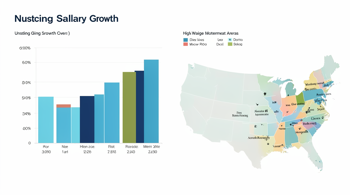
Major metropolitan hubs, particularly those on the West Coast and in the Northeast, lead the nation in nominal nursing pay. San Jose, California, holds a top position with a median salary of $130,316, representing a 39.2% premium over the national average 1. Other significant urban centers also command high wages, though these are frequently tempered by the local cost of living. When adjusting for expenses such as housing and taxes, the actual purchasing power of these salaries varies significantly across different regions 1.
| Rank | Metro Area | Median Salary | vs National Avg |
|---|---|---|---|
| 1 | San Jose, CA | $130,316 | +39.2% |
| 2 | San Francisco, CA | $127,084 | +35.8% |
| 3 | Seattle, WA | $112,456 | +20.1% |
| 4 | New York, NY | $110,570 | +18.1% |
| 5 | Boston, MA | $109,058 | +16.5% |
The Impact of Experience and Specialization
As nurses gain tenure, their salary progression follows a predictable upward curve. The transition from entry-level to mid-career status involves an average growth of approximately $32,845, or a 53% increase from the starting baseline 1. Further advancement to senior or 90th percentile levels can add another $42,310 to annual compensation 1. This growth is often accelerated by attaining specialized certifications and choosing high-acuity units, such as Intensive Care Units (ICU) or specialized surgical environments, which frequently pay premiums compared to standard floor nursing 4.
Regulatory and Market Friction Points
While nominal salary figures are helpful for general research, they do not account for the entirety of a professional's financial reality. Factors such as state income tax, local rent costs, and the presence of union-negotiated benefits create a complex environment for prospective nurses 4. In some markets, such as Florida or Texas, the absence of state income tax can effectively increase the net pay of a nurse even when the base salary appears lower than in high-cost cities like New York or San Francisco 4. Furthermore, new graduate residency programs may offer lower starting pay in exchange for structured clinical mentorship and training 4.
Evaluating Purchasing Power in High-Cost Markets
For those considering positions in high-paying metros, it is essential to calculate the ratio of salary to the local cost of living. In cities such as New York or San Francisco, where the 10th percentile for new graduates starts around $79,760 to $101,260 respectively, the high cost of housing requires a strategic approach to compensation evaluation 3, 7. A high nominal salary is only as effective as the local economy allows, making it necessary to weigh gross income against regional expense benchmarks before committing to a specific urban employment path 4.
Sources
- SalaryMetro: Registered Nurse Salary 2026 Data
- RNWages: Entry Level Registered Nurse Salary Guide
- Rippling: Registered Nurse Salary in California (2026)
- NurseSalaryIntel: New Grad RN Salary by State 2026
- Rippling: Registered Nurse Salary in the US (2026)
- Nurse.org: Highest Paying Cities for Nurses in 2026
- Rippling: Registered Nurse Salary in New York (2026)
- RegisteredNursing.org: RN Salary Trends 2026
- Indeed: Registered Nurse Salary in United States 2026
Authored by 24Trendz team