Warning signs of gout: A clinical guide to symptoms and escalation
Warning signs of gout typically appear as a sudden attack of intense joint pain, swelling, redness, warmth, and tenderness. The first flare often develops at night, may affect the big toe, and can become severe enough that light contact from bedding feels painful. Recognizing the pattern is important because untreated or recurring attacks may last longer, involve additional joints, and contribute to joint damage or firm deposits under the skin. 1
Sudden pain is often the first warning
Gout commonly changes from little or no joint discomfort to severe pain over a few hours. The pain frequently begins overnight and is often most intense during the first 8 to 12 hours. Although the big toe is the best-known location, an attack can involve one or more joints, including the ankle, knee, elbow, wrist, or fingers. The affected area may feel burning, throbbing, crushing, or excruciating rather than mildly sore. 1 5
- Sudden pain in the big toe or another peripheral joint. 4
- Pain that develops during the night or rapidly over several hours. 4
- Extreme tenderness, including discomfort from a bedsheet or blanket. 1
Heat, swelling, and skin changes
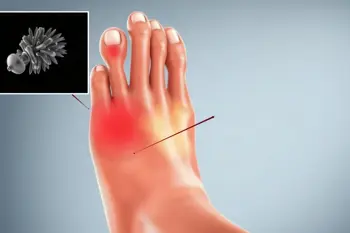
Inflammation is another central warning sign. A gout-affected joint commonly becomes visibly swollen, hot, tender, and red, while the overlying skin can appear shiny. Redness may be more difficult to see on Black or brown skin, so warmth, swelling, and tenderness remain important observations even when color changes are subtle. These signs reflect inflammation caused by uric acid crystals lodged in and around the joint. 1 8
- Swelling in and around one joint, especially the big-toe joint. 8
- Localized heat and marked sensitivity to touch. 4
- Red, shiny, or visibly discolored skin over the joint. 4
How a flare typically progresses
Gout attacks are episodic, meaning symptoms can appear, ease, and return after a period without symptoms. Attacks commonly peak within 12 to 24 hours and may last from several days to about 10 days. After the worst pain subsides, discomfort can persist for days or weeks. A joint may gradually return toward normal after a flare, but repeated episodes can become more frequent, last longer, affect more joints, and cause increasingly severe symptoms when not treated. 3 4
- A rapid onset followed by severe symptoms during the first day. 3
- Residual tenderness or discomfort after peak pain improves. 1
- Flares recurring every few months or years, with frequency potentially increasing over time. 4
Movement problems and recurring attacks
Reduced movement is a warning that inflammation is interfering with normal joint function. As swelling and pain continue, bending or using the joint may become difficult. Recurrent attacks are clinically important because later episodes may involve multiple joints rather than a single site. The Arthritis Foundation reports that subsequent attacks can last longer and become more severe, while NHS inform notes that repeated flares may eventually contribute to persistent pain and joint deformities. 1 3 4
- Difficulty walking when the toe, foot, ankle, or knee is affected. 1
- Reduced ability to bend or use the inflamed joint normally. 1
- Attacks that spread to additional joints or recur more often. 3
Tophi and signs of longer-term disease
Firm lumps under the skin, known as tophi, can indicate a buildup of uric acid crystals associated with long-term or poorly managed gout. Tophi are often described as hard or firm masses around joints or in soft tissues and may initially be painless. Their presence differs from the sudden pain of an acute flare, but it signals that crystal deposits have persisted. Chronic inflammation, recurring attacks, and tophi are reasons for medical evaluation rather than symptoms to dismiss between flares. 1 3
- Firm bumps near joints or beneath the skin. 1
- Persistent inflammation between attacks. 3
- Progressive joint pain, stiffness, or deformity after repeated flares. 4
When symptoms may indicate something more serious
Sudden joint pain should be assessed by a healthcare professional, particularly when it is a first episode because gout symptoms can resemble other forms of arthritis. Severe or worsening pain and swelling accompanied by a fever of 38°C, or 100.4°F, or higher can indicate an infection inside the joint, called septic arthritis, rather than gout alone. This combination warrants urgent medical advice. Symptoms that do not begin improving within a couple of days despite usual treatment also require clinical review. 1 4
- First-time symptoms of sudden, intense joint pain. 4
- Severe, worsening swelling or pain with fever. 4
- Usual gout treatment failing to improve symptoms within a couple of days. 4
Why confirmation and follow-up matter
Gout develops when excess uric acid leads to needle-like crystals forming in joints, but symptoms alone do not establish the cause of every swollen, painful joint. Calcium pyrophosphate deposition disease, formerly called pseudogout, can produce a similar inflammatory pattern through different crystals. Healthcare professionals consider the symptoms, medical history, and examination of the affected area when evaluating a suspected case. Ongoing care is also relevant because uric acid-lowering treatment can reduce future flares for people who need it. 2 3 4
- Gout is most strongly associated with abrupt inflammation in one or a few joints. 5
- Kidney disease, diabetes, obesity, alcohol use, and some diuretic medicines are associated with increased risk. 5
- Repeated untreated attacks can lead to more extensive disease and joint damage. 1
Sources
- Mayo Clinic, Gout: Symptoms and causes, https://www.mayoclinic.org/diseases-conditions/gout/symptoms-causes/syc-20372897
- Cleveland Clinic, Gout: What It Is, Symptoms & Treatment, https://my.clevelandclinic.org/health/diseases/4755-gout
- Arthritis Foundation, Gout: Symptoms, Diagnosis, and Treatment, https://www.arthritis.org/diseases/gout
- NHS inform, Gout, https://www.nhsinform.scot/illnesses-and-conditions/muscle-bone-and-joints/leg-and-foot-problems-and-conditions/gout/
- Penn Medicine, Gout, https://www.pennmedicine.org/conditions/gout
- American Kidney Fund, Gout and kidney disease symptoms, causes and prevention, https://www.kidneyfund.org/living-kidney-disease/health-problems-caused-kidney-disease/gout
- Harvard Health, Gout, https://www.health.harvard.edu/bones-and-joints/gout-a-to-z
Authored by 24Trendz team