Early symptoms of Macular Degeneration you should know: A Comprehensive Clinical Overview
Understanding the early signs of Age-Related Macular Degeneration (AMD) is essential for those navigating potential vision changes, as early detection remains a critical factor in managing the condition 3. AMD is the most common cause of significant central vision loss among individuals aged 50 and older, primarily affecting the macula, the specialized region of the retina responsible for sharp, detailed central sight 1. Because the condition often manifests gradually, clinical awareness of subtle visual shifts can provide the best opportunity for medical intervention before irreversible damage occurs 9.
Physiological Basis of Early Vision Changes
The progression of AMD involves the macula, which contains a high density of light-sensing cells that provide the sharpest visual images 2. In the dry form of the disease, which accounts for approximately 80% to 90% of cases, the macula thins as individuals age, and small yellow deposits known as drusen accumulate beneath the retina 1, 7. These physiological changes interfere with the retina's ability to process detailed information, leading to the hallmark symptoms of central vision degradation 3. Unlike peripheral vision, which usually remains intact, the central visual field becomes progressively compromised as the light-sensitive cells break down 5, 9.
Common Visual Indicators and Symptom Presentation
Patients in the early and intermediate stages of AMD may report a range of subtle visual changes that often go unnoticed or are mistakenly attributed to normal aging 1, 3. These indicators frequently include a gradual decrease in visual acuity, making tasks like reading small print or recognizing faces increasingly difficult 4, 9. Furthermore, patients often experience challenges in low-light environments, such as difficulty navigating when moving from bright outdoors into a dimly lit interior space, as the macula struggles to adapt to changing light intensities 4.
- Blurriness or haziness that does not resolve with a standard glasses prescription update 9.
- A noticeable decline in the intensity or brightness of colors within the central field of vision.
- Difficulty identifying the fine features or expressions of faces positioned directly in front of the viewer 9.
- Increased reliance on brighter lighting to perform close-up tasks such as cooking or fine manual work 3.
Distortion and Metamorphopsia
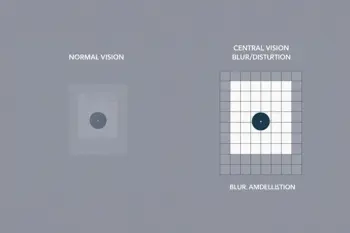
One of the most specific early symptoms of AMD is metamorphopsia, the clinical term for distorted vision where straight lines appear wavy, bent, or uneven 9. Individuals might observe this distortion when looking at door frames, blinds, or lines of text, which may seem to ripple or break 2, 9. Healthcare professionals often recommend the use of an Amsler grid, a simple tool consisting of a grid with a central dot, to help patients monitor their central vision for such irregularities at home 9. Any sudden appearance of wavy lines, particularly in wet AMD, is considered a significant sign warranting immediate professional consultation 9.
Distinguishing Between Dry and Wet AMD
The two primary forms of AMD present with different progression profiles and underlying causes 1. Dry AMD typically develops over several years, characterized by the slow, gradual loss of visual sharpness due to the accumulation of drusen and eventual atrophy of the macular tissue 3, 7. In contrast, wet AMD, also known as advanced neovascular AMD, involves the rapid growth of abnormal blood vessels beneath the retina, which leak fluid and blood into the eye 1, 3. This fluid can create dense, blind spots-or scotomas-in the center of the visual field that may develop over hours or days 9.
| Feature | Dry AMD | Wet AMD |
|---|---|---|
| Prevalence | Approximately 80-90% of cases | Less common |
| Progression | Usually slow and gradual | Often rapid and serious |
| Mechanism | Macular thinning and drusen | Leaking abnormal blood vessels |
| Visual Impact | Central blurriness/haze | Central blind spots/distortion |
Risk Factors and Preventive Considerations
While the exact cause of AMD remains a subject of ongoing research, clinical data indicates that several factors contribute to the risk of developing the condition 1. Age is the most prominent factor, with risk increasing significantly for those over 50 1, 2. Lifestyle and systemic health factors are also correlated with the incidence and progression of the disease 2. Patients are often advised to monitor these risks, as managing them may help protect the remaining vision in patients with established disease 3.
Key risk factors documented in clinical studies include:
- A family history of macular degeneration 2.
- Tobacco use, which is strongly associated with higher risk levels 1.
- Cardiovascular conditions, including high blood pressure and atherosclerosis 1, 2.
- Nutritional factors, specifically diets low in omega-3 fatty acids and dark green leafy vegetables 2.
Clinical Importance of Regular Screening
Given that early-stage AMD may not present with noticeable symptoms, clinical guidance emphasizes the importance of routine eye examinations, particularly for those in the high-risk demographic 1, 6. Specialized instruments allow eye care professionals to identify signs of retinal stress or damage before a patient becomes aware of functional impairment 2. Early diagnosis enables the implementation of strategies to manage lifestyle risks, such as smoking cessation or dietary adjustments, which may help support long-term ocular health 6. Professional assessment is required to distinguish AMD from other vision-related conditions 9.
Sources
- Johns Hopkins Medicine - Age-Related Macular Degeneration (AMD)
- MSD Manual Consumer Version - Age-Related Macular Degeneration (AMD or ARMD)
- UAMS News - Age-related Macular Degeneration
- Healio - Signs and Symptoms: Age-related Macular Degeneration
- Acibadem Hospitals Group - Macular Degeneration: Signs, Stages, Vision Changes
- Acibadem Hospitals Group - Macular Degeneration: An Evidence-Based Guide
- HealthCentral - What Does Vision Look Like With Macular Degeneration?
- Merck Manual Consumer Version - Age-Related Macular Degeneration (AMD or ARMD)
- Rhode Island Eye Institute - Macular Degeneration Symptoms: What to Watch For
- Wikipedia - Macular Degeneration
Authored by 24Trendz team