Stroke Warning Signs: A Clinical Guide to Recognition and Emergency Response
Stroke warning signs are sudden changes such as facial weakness, arm numbness, speech difficulty, vision loss, dizziness, or an unexplained severe headache. A suspected stroke is an emergency because brain cells can begin to die within minutes when oxygen-rich blood flow is interrupted. 1
What a Stroke Does to the Brain
A stroke, sometimes called a brain attack, occurs when blood supply to part of the brain is blocked or when a blood vessel ruptures and causes bleeding. Ischemic strokes, caused by a blockage, account for about nine in 10 strokes described by Penn Medicine, while hemorrhagic strokes result from bleeding. Both types can cause permanent disability or death and require emergency medical assessment. 2
The effects depend partly on the brain region affected, so symptoms differ among individuals. A person may lose control of an arm or leg, have difficulty communicating, or develop problems with walking, vision, balance, or coordination. Symptoms commonly begin suddenly, although the exact combination and severity can vary. 3
Using the BE FAST Warning-Sign Framework
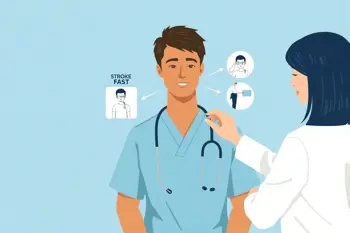
BE FAST expands the familiar FAST test by adding balance and eye symptoms. The framework is a recognition aid, not a diagnostic test. The presence of even one sudden sign should be treated as a possible stroke rather than evaluated at home, because emergency clinicians must determine the cause and the appropriate treatment window. 4
B, Balance: sudden dizziness, loss of balance, difficulty walking, or reduced coordination.
E, Eyes: sudden blurred, double, dim, or absent vision in one or both eyes.
F, Face: one side of the face droops or feels numb when the person smiles.
A, Arms: one arm becomes weak or numb, or drifts downward when both arms are raised.
S, Speech: speech becomes slurred, unusual, difficult to produce, or difficult to understand.
T, Time: call the local emergency number and record when symptoms began or when the person was last known well. 2
Additional Symptoms That Can Occur Suddenly
FAST and BE FAST do not capture every presentation. Johns Hopkins Medicine lists sudden weakness or numbness of the face, arm, or leg, usually on one side; difficulty speaking or understanding; visual changes; dizziness; movement or walking problems; fainting; seizure; and a severe headache with no known cause. These signs can occur alone or alongside facial, arm, and speech changes. 1
Other reported symptoms include sudden confusion, memory changes, nausea or vomiting not explained by a viral illness, and loss or alteration of consciousness. A sudden, very severe headache is particularly important because bleeding-type strokes can present with intense headache, although headache alone does not establish the diagnosis. Emergency assessment is needed to distinguish stroke from other conditions with similar symptoms. 5
What to Do When Warning Signs Appear
If any possible stroke symptom appears, call 911 or the applicable local emergency number and state that a stroke is suspected. Note the time symptoms started, or the last time the person was observed without symptoms. This timing helps medical personnel evaluate treatment options. A person with suspected stroke should not drive, because emergency transport allows monitoring and communication with the receiving hospital. 2
While waiting for emergency help, keep the person comfortable and supported, and monitor responsiveness. Do not give food or drink because swallowing may be impaired and choking can occur. If the person becomes unresponsive and is not breathing normally, emergency guidance calls for CPR. These first-aid measures do not replace hospital evaluation or neurological testing. 5
Why a TIA Still Requires Emergency Attention
A transient ischemic attack, or TIA, produces stroke-like symptoms when blood flow to part of the brain is temporarily disrupted. Symptoms may resolve within minutes or hours and fully disappear within 24 hours, but the temporary nature does not make the event harmless. NHS inform advises calling 999 immediately when a TIA or stroke is suspected and advises against driving. 7
A TIA is a warning that a permanent stroke may follow and requires urgent medical evaluation. Johns Hopkins Medicine describes urgent assessment within 24 hours as standard because short-term stroke risk is high. UNC Health reports that nearly one in five people who experience a TIA go on to have a stroke within 90 days, reinforcing why resolved symptoms still warrant emergency care. 1 8
Limits of Symptom Recognition and Medical Evaluation
Stroke symptoms can overlap with other neurological or medical conditions, and not every person shows the classic face, arm, and speech pattern. A person may have only sudden vision loss, imbalance, confusion, or severe headache. The absence of a complete BE FAST pattern does not rule out stroke, so the safest interpretation of a new, sudden neurological change is to seek emergency assessment. 6
At the emergency department, clinicians use examination and diagnostic imaging to determine whether a vessel is blocked or bleeding and to guide treatment. The treatment window is narrow, and earlier medical attention can improve the chance of limiting brain injury and supporting recovery. Delays caused by waiting for symptoms to disappear, contacting a routine clinic first, or attempting self-diagnosis can interfere with evaluation. 6
Reference Summary for Recognition
The central pattern is sudden onset combined with a focal neurological change: one-sided facial, arm, or leg weakness; impaired speech or comprehension; sudden visual disturbance; or new balance and coordination problems. Severe unexplained headache, seizure, fainting, nausea, and confusion broaden the symptom range. Symptoms may be mild, severe, or brief, and their disappearance does not remove the need for evaluation. 1 3
The practical sequence is recognition, emergency notification, timing, and supportive observation. BE FAST can help a bystander identify a possible event, but only trained medical professionals can determine whether the cause is ischemic stroke, hemorrhagic stroke, TIA, or another condition. Treating every suspected stroke as time-sensitive supports faster triage and reduces the risk of overlooking a potentially disabling neurological emergency. 4 7
Sources
- Johns Hopkins Medicine, Stroke
- Penn Medicine, Stroke: Symptoms and Causes
- Family Doctor, Stroke
- Scripps Health, Stroke Symptoms: Know the BE FAST Warning Signs
- St John Ambulance, Stroke Symptoms and First Aid
- IU Health, Stroke: Symptoms and Treatment Options
- NHS inform, Transient Ischaemic Attack
- UNC Health Talk, Heed the Warning of a TIA
Authored by 24Trendz team