How to do squats with bad knees safely: A clinical safety analysis
How to do squats with bad knees safely depends on the cause, severity, and pattern of symptoms. Knee pain may relate to weakness, movement mechanics, tendon irritation, arthritis, or an injury involving cartilage or ligaments, so a single technique cannot suit everyone. Physical therapists generally emphasize controlled loading and individualized modification rather than automatically eliminating the squat. Sharp, worsening, or persistent pain is a reason to stop and seek assessment rather than push through it. 1
When squatting may be appropriate
Squatting is part of ordinary activities such as sitting down, standing up, climbing stairs, and lifting from the floor. When performed with suitable technique and gradually increased resistance, it can strengthen the quadriceps, hamstrings, glutes, and core, which help absorb force and support balance. However, clearance from a healthcare professional or physical therapist is particularly important after surgery, a significant injury, or when pain is accompanied by weakness or instability. The appropriate depth and load vary between individuals. 1 6
- Begin only at a symptom level that remains controlled during and after the exercise.
- Use a stable support, such as a chair or rack, when balance is uncertain.
- Stop for sharp pain, increasing swelling, locking, or a feeling that the knee may give way.
Start with depth and support modifications
Partial squats, chair squats, and box squats can limit depth while allowing the legs to practice the movement. A chair also provides a consistent target and can reduce fear during the descent. These modifications are not a permanent requirement, but they can make early training more manageable while strength and confidence improve. Some clinical guidance recommends beginning shallow and progressing only when the current range is comfortable and controlled. 1 2 11
- Place the chair behind the body and lightly touch it rather than dropping onto it.
- Keep the movement within the depth that avoids sharp or escalating symptoms.
- Progress by increasing range before adding substantial external resistance.
Use alignment and posture to control stress
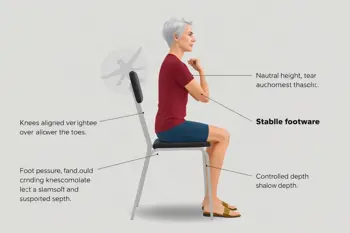
During a squat, the knees should generally track in the same direction as the toes rather than collapsing inward. A neutral spine, engaged trunk, and weight distributed through the whole foot help the hips, knees, and ankles share the task. Knee position should not be forced into one rigid stance because hip structure, ankle mobility, and symptom response differ. A slightly wider stance or a comfortable toe angle may improve control, but any adjustment should be tested gradually. 1 5 15 16
- Keep the heel, base of the big toe, and base of the little toe connected to the floor.
- Allow the knees to move in line with the toes without deliberately forcing them outward.
- Maintain a steady torso instead of collapsing forward or twisting.
Choose controlled tempo and suitable variations
Slow, controlled squats reduce the likelihood of dropping rapidly into the bottom position and make compensations easier to identify. A goblet squat can encourage a more upright torso because the weight is held in front of the chest. Isometric options such as wall sits can train the quadriceps with limited movement, while glute and hamstring strengthening may reduce the compensatory workload placed on the knee. These options should complement, not replace, individualized rehabilitation. 1 6 12 13 14 17
- Try a three-second lowering phase followed by a controlled rise.
- Use a goblet hold only when the added weight does not change alignment or pain.
- Choose wall sits or other isometric work when repeated bending is poorly tolerated.
Address hips, ankles, and the posterior chain
The knee operates between the ankle and hip, so restrictions or weakness above and below it can change squat mechanics. Limited ankle dorsiflexion may alter shin movement and encourage compensations, while weak glutes may contribute to inward knee movement. Strengthening the hips, glutes, and hamstrings, alongside appropriate ankle mobility work, is therefore commonly included in rehabilitation plans. Supportive footwear with a stable base may also improve balance and consistency, although footwear cannot correct an underlying injury or replace assessment. 5 7 16 20
- Use calf and ankle mobility exercises that do not provoke symptoms.
- Include hip-strengthening movements selected for the individual pain pattern.
- Build posterior-chain strength gradually rather than compensating with heavier loads.
Manage pain, volume, and progression
Knee tolerance depends not only on technique but also on how much work is performed and how quickly it increases. A sudden rise in repetitions, depth, frequency, or resistance can aggravate an irritated joint or tendon. Gradual progression is repeatedly emphasized in exercise guidance, with tempo control and isometric training serving as ways to develop capacity before more demanding variations. The practical test is whether symptoms remain stable rather than becoming progressively worse during the session or afterward. 2 3 4 18 19
- Change one variable at a time: depth, repetitions, frequency, or resistance.
- Record symptoms and movement quality to identify patterns across sessions.
- Reduce the challenge when pain persists, worsens, or alters the movement.
Recognize risks and seek clinical guidance
“Bad knees” is not a diagnosis, and the same squat modification may be suitable for one person but inappropriate for another. Front-of-knee pain, tendon symptoms, arthritis, postoperative limitations, ligament injuries, and cartilage problems can require different loading strategies. A professional assessment can examine movement compensations, strength, mobility, and the relevant medical history. Squatting should be paused and evaluated when symptoms include substantial swelling, locking, instability, acute injury, or persistent pain that does not settle with modification. 1 2 3 6
- Do not use pain tolerance as proof that a damaged structure is safe to load.
- Follow surgical or medical restrictions even if a variation feels comfortable.
- Expect ongoing maintenance through sensible strength, mobility, and workload management.
Sources
- Transitions Physical Therapy, “Can You Squat with Knee Pain?”
- Benchmark Physio, “How to Squat Safely with Knee Pain”
- Total Pursuit Physical Therapy, “Knee Pain When Bending”
- Ascend Physical Therapy, “Knee Pain with Squats”
- Shari Miller, PT, DPT, “The 7 Best Squat Variations for Knee Pain”
- GMB, “How To Squat With Bad Knees”
- PoinT GO Research, “How to Fix Knee Pain When Squatting”
- LiftStrong, “Knee Pain When Squatting”
- True North Physical Therapy, “Knee Pain When Squatting”
- Lift5x5, “Squat Knee Pain”
- Healthline, “Squats with Bad Knees”
- WebMD, “How to Do Squats with Bad Knees”
- Men’s Health, “How to Do a Goblet Squat”
- Verywell Fit, “How to Squat If You Have Knee Pain”
- Cleveland Clinic, “How to Do a Squat Without Hurting Your Knees”
- NASM, “The Importance of Ankle Mobility for Squats”
- PubMed, “Isometric Training and Painful Joints”
- ACE Fitness, “How to Squat Safely with Knee Pain”
- Muscle & Fitness, “How to Squat Without Knee Pain”
- Mayo Clinic, “Patellofemoral Pain Syndrome”
Authored by 24Trendz team