What factors influence assisted living facility pricing across different states? A Data-Based Analysis
What factors influence assisted living facility pricing across different states? The answer involves more than a facility’s monthly room rate. State and metropolitan differences in wages, housing, insurance, regulation, care needs, occupancy, and public benefits all affect what families may be charged and what portion they may have to pay directly.
National figures provide context, not a uniform price
National assisted living estimates vary according to the survey year, sample, room type, and methodology. The CareScout 2025 Cost of Care Survey places the national median at about $6,200 per month, or approximately $74,400 annually. SeniorLiving.org reports an estimated 2026 median of $6,313 per month, while the 2024 Genworth figure cited by another source is roughly $5,900 per month. These figures are market benchmarks rather than quotations for a particular community. 1
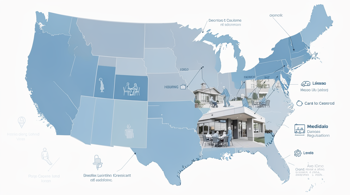
State variation can be substantial. Brevy Care reports Georgia at about $5,300 per month and Hawaii at approximately $12,096, with Hawaii near twice the national figure in that dataset. Other research identifies a broad range of roughly $3,500 to more than $8,000 per month. Differences also occur within states, since metropolitan areas often have different labor, real-estate, and operating conditions from rural communities. 2
Labor costs are a central pricing pressure
Assisted living requires personnel to provide continuous oversight, meals, housekeeping, medication assistance, and help with activities of daily living. Wage levels for personal-care and home-health workers differ by state and metropolitan area, making staffing one of the most important operating-cost variables. Minimum-wage rules, overtime requirements, recruiting conditions, and staffing shortages can further change the cost of maintaining adequate coverage. 3
Higher labor costs do not automatically produce identical resident rates because facilities use different staffing models and serve different acuity levels. However, a community that must pay more to recruit, train, schedule, and retain caregivers generally faces greater pressure to incorporate those expenses into monthly charges. The Bureau of Labor Statistics provides state and metropolitan wage information relevant to this comparison, while the Department of Labor identifies state minimum-wage requirements. 4
Housing, utilities, insurance, and taxes shape the base rate
Assisted living facilities pay for land, construction, leases or mortgages, property taxes, utilities, maintenance, liability coverage, and other fixed expenses. Regional price levels therefore influence the room-and-board portion of a resident’s bill. The Bureau of Economic Analysis uses Regional Price Parities to show that overall price levels differ among states and metropolitan areas, providing important context for why similar facilities can have different underlying costs. 5
Real-estate expenses can be especially important in high-cost housing markets, where land and building costs affect both new construction and facility leases. Property-tax differences add another state and local variable. These expenses are generally spread across occupied units, so occupancy levels can affect how much each resident must contribute to the facility’s fixed operating costs. 6
State regulation affects what facilities must provide
There is no single federal assisted living license or uniform federal definition covering every community. States use different categories, including assisted living, residential care facility, personal care home, and adult foster care. State agencies establish licensing rules, inspections, training requirements, staffing standards, building provisions, and limits on the services a facility may provide. Compliance can therefore influence both operating expenses and the types of residents a community can legally serve. 7
Regulation can also affect pricing indirectly. Requirements involving medication management, dementia care, emergency preparedness, staff qualifications, documentation, and physical plant design may require additional personnel, training, equipment, or building investment. A facility serving residents with greater medical or behavioral needs may face a more complex compliance burden than a smaller setting with lower-acuity residents, although the exact rules differ by state. 7
Care needs and fee structures change the total bill
Assisted living commonly combines housing and meals with assistance such as bathing, dressing, medication reminders, transportation, housekeeping, and activities. Facilities may use an all-inclusive structure, tiered care levels, or separate charges for individual services. A published base rate can therefore understate the actual monthly amount when a resident needs more personal assistance or medication support. 8
Memory care usually costs more because it may involve specialized staffing, secured environments, and programming designed for residents with dementia. One 2026 guide describes memory-care pricing as commonly 20% to 30% above standard assisted living and identifies potential additional charges for medication management, higher levels of personal care, therapy, and premium services. These figures are planning references, not universal statewide rules. 8
- Base charges may include room or apartment space, meals, housekeeping, activities, and routine oversight.
- Additional charges may apply to higher levels of activities-of-daily-living assistance, medication services, transportation, therapy, or memory care.
- Some communities also assess one-time community or admission fees and periodic level-of-care reassessments.
Demand, occupancy, and public coverage influence market pricing
Population structure affects the potential demand for assisted living. States with larger older-adult populations may support more communities, while local demand also depends on health needs, household resources, and the availability of alternatives. The Census Bureau publishes state population estimates by age, which can help explain why demand conditions differ across jurisdictions. 9
Supply and occupancy influence how facilities set rates. The National Investment Center for Seniors Housing and Care tracks senior-housing occupancy and market conditions, which provide context for competition and availability. A market with limited supply and strong demand may support higher rates, while weaker occupancy can create pressure for facilities to adjust pricing structures or concessions. These conditions can change by metropolitan area even when state-level averages appear stable. 10
Medicaid adds another layer of state variation. States administer home- and community-based services through state-plan and waiver authorities, and eligibility, enrollment, covered services, provider participation, and payment rules differ. Medicaid may help pay for certain care services in some circumstances, but it generally does not cover assisted living room and board in the same way across states. Medicare does not pay for assisted living room and board. 11
How to interpret state comparisons responsibly
Statewide medians are useful for identifying broad patterns, but they should not be treated as a facility quote or a guarantee of a resident’s total cost. A comparison is more meaningful when it identifies the survey year, room type, geography, care assumptions, included services, and whether the figure represents a median, average, or modeled estimate. CareScout describes its 2025 survey as based on provider-reported pricing collected across thousands of communities. 1
Families and analysts should separate the advertised base rate from recurring care charges, one-time fees, annual increases, and services that may become necessary later. Regulatory oversight, staffing continuity, occupancy risk, Medicaid eligibility, and the possibility of rising care needs are important constraints alongside the headline price. The most accurate cross-state conclusion is that assisted living pricing reflects a combination of local operating costs, state policy, market structure, and resident-specific care requirements.
Sources
- CareScout, Cost of Care Survey, https://www.carescout.com/cost-of-care/
- Brevy Care, Assisted Living by State: Costs, Rules and Medicaid Coverage, https://brevy.com/care-types/assisted-living-by-state
- U.S. Bureau of Economic Analysis, Regional Price Parities, https://www.bea.gov/data/prices-regional/regional-price-parities-state-and-metro-area
- U.S. Bureau of Labor Statistics and U.S. Department of Labor wage and minimum-wage data, https://www.bls.gov/oes/current/oes311121.htm
- U.S. Bureau of Economic Analysis, Regional Price Parities, https://www.bea.gov/data/prices-regional/regional-price-parities-state-and-metro-area
- Tax Foundation, Property Taxes by State, https://taxfoundation.org/data/all/state/property-taxes-by-state/
- National Conference of State Legislatures, Assisted Living State Regulatory Review, https://www.ncsl.org/health/assisted-living-state-regulatory-review
- AllyKin, How Much Does Assisted Living Cost in 2026?, https://allykin.com/guides/how-much-does-assisted-living-cost
- U.S. Census Bureau, Population Estimates Tables, https://www.census.gov/programs-surveys/popest/data/tables.html
- National Investment Center for Seniors Housing and Care, https://www.nic.org/
- Medicaid.gov, Home and Community-Based Services, https://www.medicaid.gov/medicaid/benefits/home-community-based-services/index.html
Authored by 24Trendz team