Early symptoms of skin cancer you should know: A clinical guide to warning signs
Early symptoms of skin cancer you should know include new, changing, bleeding, crusting, or non-healing areas of skin. A suspicious mark may resemble a mole, bump, scab, rough patch, or sore, so changes beyond existing moles also deserve attention.
Why early skin changes matter
A change in the skin is the most common sign of skin cancer. Possible warning signs include a new growth, a sore that does not heal, or a change in an existing spot, mole, or freckle. Skin cancer can develop on areas that receive substantial sunlight, but some cancers appear on skin that is not typically exposed, making regular observation important. 1
Basal cell carcinoma and squamous cell carcinoma are the most common skin cancers and often grow slowly, while melanoma is more likely to spread and is considered the most dangerous common form. Early detection and treatment can help prevent complications, but appearance alone cannot confirm a diagnosis. A healthcare professional may need to examine the area and, when appropriate, perform a biopsy. 2 3
ABCDE signs of melanoma
The ABCDE method is used to assess suspicious moles and pigmented spots. Asymmetry means one half does not match the other; an irregular or jagged border is another warning sign; uneven color can include multiple shades; diameter refers to a spot larger than a pea or about 6 millimeters; and evolving means a change in size, shape, color, or elevation over weeks or months. 1 9
Evolution is particularly important because a spot that changes may be concerning even if it is not very dark or large. The “ugly duckling” sign describes a mole or lesion that looks different from a person’s other marks. A spot that repeatedly catches attention, feels unlike nearby lesions, or becomes darker, lighter, larger, or differently shaped merits professional evaluation. 7 10
Basal cell carcinoma warning signs
Basal cell carcinoma may appear as a shiny, pearly, translucent, pink, red, or flesh-colored bump. It can also look like a pink or red scaly patch, a raised growth with a rolled edge, or a scar-like firm and pale area. Some lesions are fragile and bleed after minor scratching, shaving, or other irritation. These appearances can vary across skin tones, and darker areas may occur within a bump. 1 6
A recurring sore is another important pattern. A basal cell carcinoma may ooze, crust, or bleed, then appear to heal before reopening. Lesions are often found on sun-exposed areas such as the face, head, neck, and arms, but basal cell carcinoma can develop elsewhere. A growth that repeatedly forms a scab or fails to resolve should not be assumed to be an ordinary injury without medical assessment. 6 3
Squamous cell carcinoma warning signs
Squamous cell carcinoma commonly appears as a firm red or skin-colored bump, a rough or scaly patch, or an open sore that bleeds. The lesion may be raised, wart-like, crusted, or have a depressed center. Persistent roughness is significant when it remains in place rather than improving like temporary irritation. A red or darker scaly area can occur on different skin tones and should be considered in relation to change and persistence. 1 6
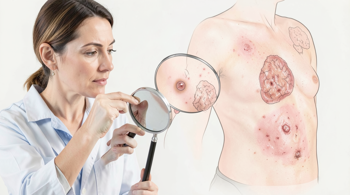
Squamous cell carcinoma frequently affects sun-exposed sites, including the nose, ears, and lips, although it is not limited to those locations. A sore that oozes, crusts, heals incompletely, or returns in the same place is a pattern that warrants evaluation. Pain, tenderness, itching, or bleeding may accompany a concerning lesion, but the absence of discomfort does not establish that a spot is harmless. 6 4
Signs that are easy to overlook
Skin cancer does not always resemble a dramatic mole. Subtle early clues can include a dry patch that persists, a shiny pink bump, a spot that looks different from surrounding skin, or a lesion that changes gradually. Persistent sores and scaly patches are sometimes mistaken for minor wounds, eczema, or irritation, which can delay assessment. The key pattern is new, changing, different, recurrent, or non-healing skin. 4 10
Itching, tenderness, pain, or another new sensation can occur in a changing mole or skin spot, although symptoms are not required for cancer to be present. Melanoma may also be pink, tan, or skin-colored rather than black. Because many ordinary skin conditions can look similar, self-identification from photographs or descriptions is unreliable. A clinician should assess a persistent or unusual change rather than relying on a single visual rule. 2 10
Where to check and when to seek care
Skin checks should include the face, ears, scalp, arms, hands, nails, fingers, chest, back, sides, buttocks, genital area, legs, feet, soles, toes, and spaces between fingers and toes. Melanoma can occur on the palms, soles, and under fingernails or toenails, including areas that receive little sun. A mirror and assistance from another person can help reveal the scalp, back, and other difficult-to-see locations. 5 8
Professional assessment is appropriate for a new growth, a changing mole, an unusual mark, repeated bleeding or crusting, or a sore that does not heal over several weeks. Monthly self-checks can help identify changes, and photographs may provide a comparison record over time. Higher-risk circumstances include substantial UV exposure, past or current tanning-bed use, a weakened immune system, and a personal history of skin cancer. 5 9
Sources
- Centers for Disease Control and Prevention, Symptoms of Skin Cancer, https://www.cdc.gov/skin-cancer/symptoms/index.html
- Mayo Clinic, Skin cancer: Symptoms and causes, https://www.mayoclinic.org/diseases-conditions/skin-cancer/symptoms-causes/syc-20377605
- Cleveland Clinic, Nonmelanoma Skin Cancer, https://my.clevelandclinic.org/health/diseases/nonmelanoma-skin-cancer
- Healthline, These Overlooked Skin Cancer Signs Could Be Easy to Miss, https://www.healthline.com/health-news/overlooked-skin-cancer-signs
- Banner Health, How to Spot Skin Cancer: Warning Signs, https://www.bannerhealth.com/healthcareblog/teach-me/how-to-spot-skin-cancer
- UPMC HealthBeat, What Does Skin Cancer Look Like?, https://share-dev.upmc.com/2026/02/skin-cancer-appearance/
- Sharecare, What to know about symptoms of skin cancer, https://askmd.sharecare.com/learn/cancer/skin-cancer/know-the-signs-skin-cancer/
- Acibadem Hospitals Group, Signs of Skin Cancer: What To Check on Your Skin, https://acibademinternational.com/health-library/signs-of-skin-cancer-what-to-check-on-your-skin/
- AdventHealth, 5 Warning Signs of Skin Cancer, https://www.adventhealth.com/blogs/5-warning-signs-skin-cancer
- Hartford HealthCare, Skin Cancer Isn’t Just Moles. Watch for These 6 Signs, https://hartfordhealthcare.org/about-us/news-press/news-detail?articleId=74937
Authored by 24Trendz team