How to crack your back safely: A clinical guide to gentle movement and warning signs
How to crack your back safely is mainly a question of how to reduce stiffness without forcing the spine. An occasional, painless pop during ordinary movement is commonly harmless, while hard twisting, repeated self-manipulation, or asking another person to apply pressure can irritate joints, muscles, and ligaments. 1
What the popping sound usually means
The sound generally comes from movement in small spinal facet joints, where pressure changes can affect gases dissolved in synovial fluid. It is not usually the sound of bones grinding or breaking. A pop also does not prove that the spine has been realigned or that an underlying cause of stiffness has been corrected. 2
Joint cavitation may produce a brief feeling of release because movement changes pressure and may temporarily reduce the sensation of stiffness. The sound itself is not a reliable measure of treatment success. If discomfort returns repeatedly, the more relevant issue may be prolonged sitting, limited mobility, muscle tightness, posture, or another source of back symptoms. 3
Lower-risk ways to ease back stiffness
The safer approach is to invite movement rather than chase a pop. Slow spinal rotation within a comfortable range, gentle cat-cow movements, walking, and controlled hip mobility can reduce the urge to wrench the back. Movement should remain smooth and easy, with no bouncing, sudden leverage, or external force. A natural pop may occur, but it should never be the objective. 4
- Change position regularly instead of remaining seated for long periods.
- Use gentle stretching and ordinary walking for mild stiffness.
- Stop any movement that produces sharp, radiating, or escalating pain.
- Prefer gradual strengthening and mobility work over repeated self-cracking.
For ordinary back pain, guidance from the NHS and the American Academy of Family Physicians emphasizes remaining active, using gentle exercise, and applying conservative care rather than prolonged inactivity. Controlled technique matters because a stretch can be useful without producing any audible crack. 5
What to avoid when attempting self-mobility
Forceful twisting, wrenching, pulling, and repeated attempts to produce the same sound can overstretch or irritate spinal joints, muscles, and ligaments. Devices, aggressive leverage, and having a friend push or step on the back create forces that are difficult to control. Temporary relief can also encourage a cycle in which symptoms are repeatedly masked instead of evaluated. 6
Frequent self-manipulation has been associated with possible muscle strain, joint irritation, and ligament laxity, although serious complications are uncommon and risks vary by technique and health status. Painless popping alone is usually not considered dangerous, but pain, numbness, tingling, weakness, dizziness, or symptoms spreading into an arm or leg are reasons to stop. 7
Who should avoid self-cracking
Self-cracking is not appropriate after a recent injury or fall, or when a person has osteoporosis, inflammatory arthritis, spinal instability, or a history of spinal surgery unless a clinician has provided specific guidance. These conditions can change the risks of loading or rotating the spine. Persistent stiffness should not automatically be described as a spinal misalignment because several different problems can produce similar sensations. 8
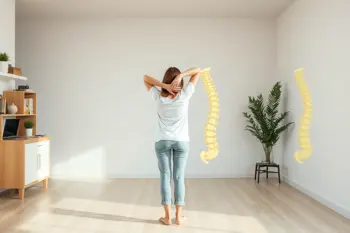
People considering professional spinal manipulation should disclose relevant medical conditions, previous operations, symptoms, and medications. Spinal manipulation involves controlled force applied to spinal joints, but suitability depends on an individual assessment. A qualified, licensed healthcare professional can determine whether such care is appropriate and can distinguish routine stiffness from symptoms requiring another form of evaluation. 9
Symptoms that require medical attention
Back popping accompanied by severe or persistent pain, numbness, weakness, fever, or pain after significant trauma should not be managed indefinitely through self-cracking. New or worsening neurological symptoms may indicate irritation or compression involving nerves. The combination of back symptoms with changes in bladder or bowel control, numbness around the groin, or major leg weakness requires urgent medical assessment. 10
- Seek urgent care for loss of bladder or bowel control.
- Seek urgent care for numbness around the groin or major leg weakness.
- Arrange medical review for fever, worsening pain, or symptoms after trauma.
- Stop self-manipulation when pain travels into an arm or leg.
Clinical evaluation normally begins with a history and physical examination. Depending on the findings, clinicians may consider imaging or nerve tests. A popping sound without pain is usually less concerning than a new change in strength, sensation, walking ability, or bladder and bowel function. 2
Longer-term strategies for preventing stiffness
Repeatedly cracking the back is unlikely to address the factors that make stiffness recur. Regular position changes, walking, stretching, ergonomic adjustments, and progressive strengthening are more sustainable ways to support mobility. The goal is comfortable function, not a particular sound. If stiffness remains frequent, limits activity, or requires increasingly forceful movements for relief, professional assessment is more appropriate than escalating self-manipulation. 5
Back exercises should use controlled technique and should be stopped if they create sharp or radiating pain. A clinician or rehabilitation professional can adapt movement to the symptoms and medical history. Occasional painless popping during comfortable activity can be observed, but pain or neurological change should shift attention from cracking the back to identifying and treating the underlying problem. 10
Sources
- iCliniq, How to Crack Your Back Safely?
- Acibadem Hospitals Group, How to Crack Your Lower Back? Causes, Explanations, and Next Steps
- Ubie Doctor's Note, Is cracking your back bad for you?
- Cleveland Clinic, Is It Bad to Crack Your Back?
- National Health Service, Back pain
- Times of India, Is cracking your back safe: Science explains the risks and relief
- National Center for Complementary and Integrative Health, Spinal Manipulation in Depth
- MedlinePlus, Spinal Manipulation
- Harvard Health Publishing, Is cracking your knuckles bad for you?
- Hospital for Special Surgery, Back Pain Exercises
Authored by 24Trendz team