Best Wrist Compression Sleeve for Wrist Support: An Evidence-Informed Market Guide
The phrase “best wrist compression sleeve for wrist support” covers several distinct designs, from lightweight knitted sleeves for everyday comfort to graduated-compression products intended for swelling, fatigue, or repetitive strain. The most useful comparison therefore focuses on compression level, wrist coverage, mobility, sizing, materials, and whether the product includes a stabilizer.
What wrist compression sleeves are designed to do
Wrist compression sleeves are generally intended to provide support while preserving hand movement. AliMed describes its sleeve as a seamless, lightweight, breathable knit elastic garment that may help reduce discomfort and promote circulation in the hand and wrist. It includes a reinforced thumbhole and four size options. 1 Vive similarly describes its sleeves as providing complete wrist coverage and moderate to firm graduated compression at 20 to 30 mmHg, with uses including arthritis, tendonitis, sprains, strains, and repetitive stress discomfort. 2
| Design feature | Practical implication |
|---|---|
| Seamless elastic knit | Lower-profile support for routine wear |
| Graduated compression | Pressure varies through the sleeve and is marketed for circulation and swelling support |
| Thumb opening | Helps keep the sleeve positioned while retaining finger dexterity |
Compression level and mobility
Compression ratings matter more than appearance when the primary goal is therapeutic support. The Vive model is identified as providing 20 to 30 mmHg compression, while the Active Elasticated Wrist Support is categorized as Support Level 2, described as mild to moderate compression. 2 10 The OS1st WS6 uses six graduated compression zones and three compression levels in a lightweight construction, indicating a more structured approach than a uniform elastic tube. 3
Mobility remains a central trade-off. Fingerless sleeves can support the wrist during typing, cooking, gardening, tennis, golf, weightlifting, and cross-training without covering the fingers. 2 By contrast, a wrap-style brace can provide more adjustability and stabilization, but may feel bulkier or restrict movement compared with a simple sleeve. The appropriate balance depends on whether the priority is maintaining dexterity during activity or limiting painful wrist motion.
Materials, comfort, and daily wear
Common constructions in the reviewed products include nylon, spandex, polyester, elastane, and knitted elastic. OS1st lists a composition of 76% micro-nylon and 24% LYCRA spandex, with soft hypoallergenic gel stabilizer zones and UPF 50+ protection. 3 AliMed emphasizes breathable knit elastic, while Vive identifies a nylon and spandex blend designed to be lightweight and breathable. 1 2
- Breathability can be relevant during extended wear or exercise.
- A reinforced thumbhole may reduce shifting and bunching.
- Silicone gel padding appears in the Old Bones Therapy construction, which also lists a nylon and spandex blend and latex-free materials. 5
- CopperJoint describes copper-infused nylon, moisture-wicking stretch knit, odor control, and a low-profile fit, but these are product-design claims rather than proof that copper itself provides superior therapeutic results. 7
Sizing and fit considerations
Fit is determined by wrist circumference in several of the reviewed products, not by height, age, or glove size. OS1st lists Small as 5 to 6 inches, Medium as 6 to 7 inches, Large as 7 to 8 inches, and X-Large as 8 inches or more. 3 The Active Elasticated Wrist Support lists a Medium/Large range of 18 to 23 centimeters. 10 DonJoy instead presents three circumference bands, from 4.5 to 6.5 inches, 6.5 to 8.5 inches, and 8.5 to 9.5 inches. 8
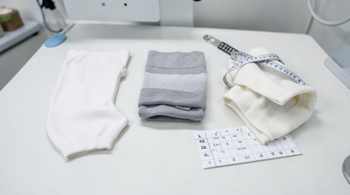
A sleeve should feel supportive without producing numbness, color change, worsening pain, or a sensation that circulation is restricted. The Pharmacy Factory instructions specifically advise selecting the correct size and adjusting the support snugly without restricting circulation; they also advise discontinuing use if irritation occurs. 10 Material sensitivity is another consideration because that product lists latex among its materials, while Old Bones Therapy identifies its construction as 100% latex free. 5 Size charts and material labels should therefore be reviewed before use.
Sleeve or stabilizing brace?
A soft compression sleeve is not interchangeable with a rigid or semi-rigid brace. General clinical guidance summarized in the research indicates that people with carpal tunnel syndrome may need a brace with a rigid stabilizer or removable splint rather than a simple elastic sleeve. 11 The DonJoy Stabilizing Elastic Wrist Brace occupies an intermediate category: it combines conforming elastic compression with a contoured, padded, removable palmar stay and wrap-around adjustment. 8
| Need | Design category to evaluate |
|---|---|
| Light support and dexterity | Seamless or fingerless compression sleeve |
| Adjustable moderate support | Wrap-style elastic brace |
| Motion control during carpal tunnel symptoms | Brace with a rigid or removable splint |
| Wrist and thumb involvement | Targeted wrist-and-thumb sleeve or brace |
Risks, maintenance, and selection limits
Compression products can create problems when the fit is excessive, the material irritates the skin, or the device is used for a condition requiring immobilization. The reviewed instructions emphasize avoiding excessive tightness and stopping if irritation develops. 10 Persistent pain, suspected injury, neurological symptoms, or worsening swelling should not be treated solely as a product-selection issue. Research supplied for this comparison also identifies compression as one component of sprain care, while clinical context distinguishes soft compression from rigid splinting according to the condition. 13 11
Maintenance requirements vary, but machine-washable construction is identified for the Vive sleeves, while the Active support instructions specify hand washing in lukewarm soapy water, thorough rinsing, and air drying. 2 10 Product costs also vary across the reviewed market examples, from £1.80 for the listed Active support to $16.75 for AliMed, $19.99 for OS1st at Holabird Sports, $20.25 for the CopperJoint pair, $23.99 for Vive, $31.98 for DonJoy, and $40 for Old Bones Therapy. 1 2 3 5 7 8 These figures are listed product prices, not a guarantee of current availability or uniform market pricing.
How the leading design types compare
No single sleeve is objectively suitable for every wrist-support need. AliMed emphasizes basic breathable knit construction and four sizes, OS1st adds zoned compression and gel stabilizer areas, Vive specifies a 20 to 30 mmHg range, and CopperJoint sells its sleeves as a pair with low-profile copper-infused knit. 1 2 3 7 Old Bones Therapy includes thumb support and silicone gel padding, while Fortemotus focuses on targeted wrist-and-thumb support for CMC-related concerns. 5 9
- For typing and routine activity, prioritize thin construction, breathability, and preserved dexterity.
- For swelling or fatigue, compare stated compression ratings and graduated zones.
- For thumb-joint symptoms, examine whether the design actually supports the thumb and CMC area.
- For carpal tunnel or injury-related instability, assess whether a clinician-recommended splint or stabilizing brace is more appropriate than a sleeve.
Sources
- AliMed, AliMed Wrist Compression Sleeve
- G.B. Hill Medical Supply, Vive Health Wrist Compression Sleeve
- Holabird Sports, OS1st WS6 Sports Wrist Compression Sleeve
- Old Bones Therapy, Compression Wrist Sleeve
- Medibrace Canada, OS1st WS6 Performance Wrist Sleeve
- CopperJoint, Copper Compression Wrist Sleeves
- SupremeMed, DonJoy Stabilizing Elastic Wrist Brace
- FORTEMOTUS, CMC CozyGrip Wrist and Thumb Compression Sleeve
- Pharmacy Factory, Active Elasticated Wrist Support
- WebMD, Wrist Braces for Carpal Tunnel
- Mayo Clinic, First Aid for Sprains
Authored by 24Trendz team