Early signs of peripheral artery disease: A clinical guide to symptoms and warning patterns
Early signs of peripheral artery disease often appear as leg pain, cramping, heaviness, or fatigue during walking, then improve after resting. These symptoms are easy to attribute to aging, arthritis, or poor fitness, yet they can reflect reduced blood flow caused by narrowed arteries. Some people have no symptoms at all, while others develop less typical signs such as numbness, weakness, coldness, or a change in walking ability. 1
How peripheral artery disease begins
Peripheral artery disease, commonly called PAD, occurs when arteries supplying the legs, feet, or less often the arms become narrowed or blocked. The usual cause is atherosclerosis, in which plaque builds up inside artery walls and reduces the passage available for blood flow. PAD is part of a broader pattern of vascular disease and is associated with increased cardiovascular risk. StatPearls describes PAD as a progressive manifestation of systemic atherosclerosis affecting more than 200 million people worldwide. 5
- Leg arteries are affected more often than arm arteries. 2
- Plaque can reduce the oxygen and nutrients reaching muscles and skin. 3
- Some people remain asymptomatic despite having measurable disease. 2
Walking-related pain is the classic early clue
The most recognized early symptom is intermittent claudication. It usually causes aching, cramping, tightness, heaviness, or fatigue in the calf, thigh, buttock, or foot during activity. The discomfort typically appears after walking or climbing stairs, improves with rest, and may return after a similar distance. The American Heart Association notes that PAD-related pain can be mistaken for ordinary aging or other common causes of leg discomfort. 4
- Calf pain is a frequent location, although the thigh, buttock, or foot may also be affected. 1
- One leg may feel tired or weak before the other. 1
- Repeatedly stopping during shopping or walking can represent a functional change worth discussing with a clinician. 7
Symptoms that do not feel like pain
Not everyone experiences classic cramping. PAD may instead present as generalized leg weakness, tiredness, numbness, or a heavy sensation during exertion. Numbness or tingling can also occur in the feet or toes, and diabetes may complicate recognition because nerve damage can reduce the perception of pain. Yale Medicine reports that many people have no symptoms, while symptomatic patients may notice activity-related discomfort that resolves with rest. 2
- A foot or toe may feel numb, cold, or unusually different from the opposite side. 1
- Reduced walking distance may be more noticeable than pain itself.
- Symptoms can be atypical, particularly when mobility is already limited or sensation is impaired. 7
Coldness, skin, hair, and nail changes
Reduced circulation can produce physical changes in the lower leg and foot. A foot may feel cold, especially compared with the other foot, and the skin may become thin or shiny. Hair loss on the legs, slow-growing or brittle toenails, and changes in skin color are also reported signs of reduced blood supply. These findings are not specific to PAD by themselves, so they require clinical context rather than self-diagnosis. 6
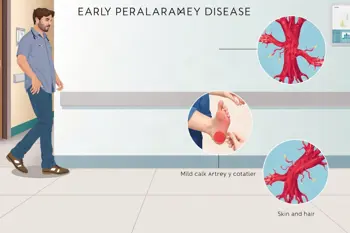
- Cold feet or a clear temperature difference between limbs can be a circulation warning sign. 1
- Shiny skin and hair loss may reflect chronic reduced blood flow. 6
- Pale skin when a leg is elevated or reddish-blue discoloration when it hangs down can indicate more severe ischemia. 5
Wounds and other signs of progression
A sore, blister, or cut on the toe, foot, or lower leg that heals slowly can signal inadequate blood flow. In more advanced PAD, pain may occur at rest rather than only during walking, and ulcers can develop. Yale Medicine identifies constant rest pain, numbness, weakness, ulcers, and gangrene as features of chronic limb-threatening ischemia, a serious stage involving risk to the limb. 2
- Slow-healing wounds should receive medical assessment, particularly in people with diabetes or a smoking history. 4
- A weak or absent foot pulse is a clinical finding assessed by healthcare professionals. 3
- Severe disease may cause tissue death, known as gangrene. 1
Risk factors and clinical evaluation
Smoking and diabetes are described by the American Heart Association as the two dominant risk factors for PAD. Other associated factors include high blood pressure, abnormal cholesterol, obesity, physical inactivity, kidney disease, family history of cardiovascular disease, and a history of heart disease. Because PAD can be silent, the presence of several risk factors or a meaningful change in walking ability supports discussion with a healthcare professional. 4
- Smoking or using tobacco increases the likelihood of PAD and its complications. 1
- Diabetes can impair blood flow and may reduce pain sensation. 3
- Clinical assessment may include examination of the legs and feet and checking arterial pulses. 3
- Symptoms can overlap with arthritis, sciatica, neuropathy, or muscle fatigue, so a diagnosis requires professional evaluation. 7
When symptoms indicate an emergency
A gradual change in walking tolerance warrants medical attention, but sudden severe symptoms are more urgent. If blood flow stops completely, the limb or part of it may become pale or blue, extremely cold, numb, and severely painful. Harvard Health notes that complete blockage, often involving a clot in a narrowed vessel, can progress to gangrene. These findings require urgent medical care rather than observation at home. 1
- Seek urgent assessment for sudden loss of color, warmth, sensation, or movement in a leg or foot.
- Rest pain, non-healing ulcers, or worsening symptoms require prompt clinical evaluation. 2
- PAD is not only a local leg problem because it reflects atherosclerosis associated with heart attack and stroke risk. 4
Sources
- Harvard Health, “Peripheral Arterial Disease”
- Yale Medicine, “Peripheral Artery Disease (PAD)”
- Johns Hopkins Medicine, “Peripheral Vascular Disease”
- American Heart Association, “Is your leg pain actually PAD? Watch for these warning signs”
- NCBI Bookshelf, “Peripheral Arterial Disease”
- Mayo Clinic, “Peripheral artery disease: Symptoms and causes”
- Main Line Health, “Leg pain while walking? When it could be peripheral artery disease”
Authored by 24Trendz team