Overwater Bungalow Resorts: A Data-Led Guide to Destinations, Design, and Risks
Overwater bungalow resorts are associated with glass-bottom floors, private infinity pools, outdoor hammocks, and direct steps into clear tropical water. Those features vary substantially by destination and room category, so the experience depends on lagoon conditions, reef access, construction standards, service model, and the resort’s environmental practices.
Origins and defining characteristics
The modern overwater bungalow concept developed in French Polynesia during the 1960s. The Bali Hai Boys are credited with building the first examples in Moorea in 1967, adapting raised Polynesian structures for tourism. Other historical accounts identify Bora Bora’s Hotel Bora Bora as the site of a first bungalow built in 1960, illustrating why the origin story is associated with both Moorea and Bora Bora. 12
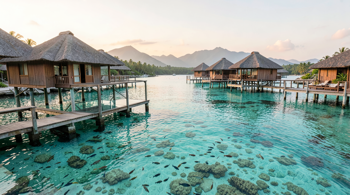
A typical structure is built on stilts above a lagoon or coastal marine area and includes a roofed bedroom, a deck, a bathing area, and stairs or a ladder into the water. Higher room categories may add glass floor panels, outdoor showers, private plunge pools, retractable bedroom roofs, larger living areas, or slides into the lagoon. 3
Where the largest markets are located
The Maldives has the world’s highest concentration of overwater villa resorts, with research describing more than 150 dedicated island properties. One comparison of 127 Maldivian resorts recorded accommodation ranging from approximately $260 to $12,000 per night and identified 106 resorts with pool-equipped villas. These figures describe broad market categories rather than live availability. 45
Bora Bora remains the most recognizable overwater destination because its protected lagoon provides calm, turquoise water suitable for extensive stilted construction. French Polynesia’s market is especially associated with scenic mountain backdrops, traditional architectural references, and a large concentration of competing resorts. The visual appeal, however, does not guarantee identical water clarity, reef conditions, or privacy at every property. 6
Room design and resort features
Room labels can be misleading, particularly in the Maldives. A bungalow is technically smaller and simpler than a villa, but resorts frequently use the terms interchangeably. The specification matters more than the label: floor area, pool or jacuzzi, glass panels, direct reef access, deck orientation, and whether the room faces sunrise or sunset are more useful comparison points. 4
Examples from documented resorts show how wide the design range can be. Conrad Maldives Rangali Island includes villas above water and along beaches, Ithaa, an undersea restaurant five meters below the Indian Ocean, and The Muraka, an underwater residence. Soneva Jani is described with retractable bedroom roofs, private pools, large decks, and selected water slides. 78
Caribbean, Fiji, and other regional alternatives
Overwater accommodation is less common in the Caribbean than in the Maldives or French Polynesia, but it exists in Jamaica, Saint Lucia, Saint Vincent, and Antigua. Documented Sandals properties include resorts in Jamaica, Sandals Grande St. Lucian in Saint Lucia, and Sandals Saint Vincent. The Saint Lucia bungalows are described as nine units positioned over turquoise water, with glass floors, private pools, butler service, and access to an all-inclusive resort system. 910
Fiji’s notable example is Likuliku Lagoon Resort, identified as the first overwater bungalow experience in the region. Mexico also entered the category through El Dorado Maroma on the Caribbean coast. Marriott’s documented portfolio includes Fiji Marriott Resort Momi Bay, The Westin Bora Bora Resort and Spa, The St. Regis Bora Bora Resort, Royalton Antigua, and The St. Regis Langkawi, although participation and room availability can change. 1112
Environmental oversight and maintenance
Overwater construction can affect coral habitats, water circulation, seabed conditions, and coastal ecosystems. Research on the sector emphasizes criticism of marine environmental damage and the need for strict sustainability practices. Construction permits may be required to ensure that structures do not obstruct vital reef circulation, making local planning rules and environmental review important parts of resort development. 1314
Modern sustainability programs may include solar power, desalination, specialized waste management, and coral propagation. These systems reduce some operational pressures but do not eliminate the environmental footprint of transport, construction, wastewater, and energy demand. A responsible assessment therefore requires more than a sustainability label. Relevant questions include whether reef monitoring is public, how wastewater is treated, and how maintenance work is conducted around marine habitats. 15
Practical considerations and market friction
Overwater rooms are generally more expensive than standard beach or ocean-view rooms because they require specialized construction, maintenance, and access infrastructure. The documented Maldives range begins around $260 per night for some entry-level accommodation and rises above $12,000 for the largest luxury retreats. These figures should be treated as category benchmarks, since season, occupancy, transfers, taxes, meal arrangements, and room size can materially alter the total cost. 4
Travelers also need to evaluate safety, weather exposure, privacy, accessibility, and marine conditions. A room directly above water may be unsuitable for guests uncomfortable with stairs, ladders, deep water, or changing currents. Open-ocean settings can have boat traffic and less sheltered water than a lagoon. Family suitability varies, while many resorts are couples-focused, although properties such as Soneva and selected Fiji resorts accommodate families. 816
Sources
- Condé Nast Traveler
- Travel Tourister
- LuxAtolls
- LuxAtolls, Maldives comparison guide
- Visit Maldives
- Tahiti Tourisme
- Conrad Maldives Rangali Island
- LUXGetaway
- Caribbean Magazine
- Caribbean Journal
- Likuliku Lagoon Resort
- Marriott International
- National Geographic
- World Bank
- Soneva
- Best All Inclusive
Authored by 24Trendz team