Best hospitals for cataract surgery in the United States
More than 3.7 million cataract surgeries are performed in the United States each year, making it one of the most commonly performed and statistically successful procedures in modern medicine, with visual improvement success rates exceeding 98%. 1 For patients navigating an ophthalmology landscape that spans more than 4,500 ranked hospitals and dozens of specialized eye institutes, understanding how top facilities are evaluated and what distinguishes elite cataract care centers is essential groundwork before any consultation. 2
How U.S. Hospitals Are Ranked for Ophthalmology and Cataract Care
U.S. News and World Report publishes its annual Best Hospitals report, evaluating more than 4,500 hospitals across 15 specialties and 22 procedures and conditions, of which only 13% receive a Best Hospitals designation. 2 Ophthalmology rankings rely heavily on expert opinion surveys, with nominations from unaffiliated physicians weighted more heavily than those from affiliated colleagues, a methodology designed to reduce institutional bias. Metrics assessed include patient outcomes, access to advanced surgical technologies, and the depth of physician expertise across subspecialties such as anterior segment disease, corneal disease, and complex lens surgery.
Beyond U.S. News rankings, patients and referring physicians use several complementary tools to evaluate surgical facilities. The Centers for Medicare and Medicaid Services (CMS) Care Compare platform provides quality measures for both hospitals and individual clinicians, enabling side-by-side assessments of participating providers. 3 The Leapfrog Hospital Safety Grade assigns letter grades based on independently verified safety data, while The Joint Commission's accreditation directory allows patients to confirm that a given facility meets established structural and clinical standards. 4
Leading Nationally Recognized Institutions for Eye Surgery
Bascom Palmer Eye Institute, affiliated with the University of Miami Health System, has held the number one ranking in ophthalmology from U.S. News and World Report for 22 consecutive years, the longest uninterrupted streak of any specialty hospital in that report's history. 5 The institute trains residents and fellows who subsequently staff programs across the country, and its research output directly influences cataract surgical protocols nationwide. Physicians completing residencies there, such as specialists at Newsome Eye who trained at Bascom Palmer, carry its clinical standards into community and regional practice settings. 6
Additional institutions consistently cited in national rankings include the Wilmer Eye Institute at Johns Hopkins Medicine in Baltimore, which offers advanced diagnostic and surgical services across a full spectrum of cataract complexity. 7 Mass Eye and Ear in Boston, an affiliate of Harvard Medical School, provides specialized cataract care for patients with comorbid conditions such as ocular graft-versus-host disease, with clinicians like Dr. Zhonghui K. Luo holding joint appointments on both the Cornea Service and the Comprehensive Ophthalmology and Cataract Consultation Service. 8 Cleveland Clinic's Cole Eye Institute in Ohio maintains a high-volume cataract program, with board-certified specialists including Dr. Craig See, who completed fellowship training at the University of California San Diego and residency at the Wilmer Eye Institute. 9
Surgical Technologies Found at Top-Tier Facilities
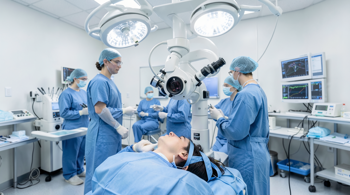
Elite cataract programs in the United States increasingly offer femtosecond laser-assisted cataract surgery (FLACS) alongside traditional phacoemulsification. FLACS uses a computer-guided laser to create corneal incisions, perform the anterior capsulotomy, and pre-soften the lens, producing a circular capsule opening reported to be up to ten times more accurate than is achievable with handheld instruments. 10 Systems in active clinical use at leading centers include the Alcon LenSx, the Catalys Precision Laser System, and the LENSAR Ally femtosecond platform, each offering integrated 3D optical coherence tomography (OCT) imaging to map the anterior segment in real time before any incision is made.
Traditional phacoemulsification, in which ultrasound energy emulsifies the cloudy lens before aspiration, remains the global standard and is performed successfully at the vast majority of accredited surgical centers. For complex cases, some programs offer dropless, no-shot, and no-stitch approaches that reduce post-operative medication burden and shorten recovery timelines. Intraoperative wavefront aberrometry platforms such as ORA technology allow surgeons to verify lens power selection while the patient is on the operating table, a safeguard that improves refractive predictability, particularly in eyes with prior corneal refractive surgery.
Intraocular Lens Options Available at Specialized Centers
The intraocular lens (IOL) selected during cataract surgery is the primary determinant of post-operative visual function. Leading hospitals offer the full spectrum of lens technologies, and the breadth of a center's IOL portfolio is itself an indicator of program maturity. Standard monofocal lenses optimize vision at a single distance, typically far, and remain covered by Medicare for eligible patients. Toric IOLs correct pre-existing corneal astigmatism at the time of cataract removal, reducing dependence on distance glasses.
Premium lens categories available at nationally ranked programs include extended depth-of-focus (EDOF) lenses, which provide a continuous range of quality vision particularly effective at intermediate and distance tasks, and multifocal or trifocal IOLs that distribute incoming light across near, intermediate, and far focal points simultaneously. Light-adjustable lenses by RxSight represent a distinct category: they are the only IOLs that can be non-invasively fine-tuned using UV light treatments applied in the weeks after surgery, allowing the surgeon to optimize refraction based on real-world visual feedback from the patient. 11 Manufacturers whose platforms appear across top programs include Alcon, Johnson and Johnson Vision, and Bausch and Lomb.
Cost Landscape and Insurance Considerations
Cataract surgery costs in the United States vary substantially by geography, facility type, and lens selection. In New York State, for example, negotiated insurance rates place median out-of-pocket costs at approximately $515 per procedure visit, within a self-pay range of $364 to $2,135, against a national average of roughly $888. 12 New York healthcare costs run approximately 22% above the national average, driven by dense urban centers and consolidated hospital systems. In Delaware, average cataract treatment costs have been reported at approximately $4,720 when all facility and professional components are combined.
Medicare covers the facility fee and surgeon fee for standard monofocal cataract surgery when a clinician certifies medical necessity, but premium IOL upgrades, laser-assisted platform fees, and astigmatism-correcting lens differentials are typically billed separately as out-of-pocket expenses. Patients considering care at academic medical centers affiliated with top rankings should verify that their specific insurer has a network agreement, since some elite specialty institutes operate under narrower insurance panels than large general hospitals. The American Academy of Ophthalmology maintains a searchable directory that allows patients to locate board-certified ophthalmologists and accredited facilities by geographic area. 13
Evaluation Criteria Patients Should Apply When Comparing Centers
Volume and experience matter in surgical outcomes research, and cataract surgery is no exception. Surgeons at high-volume programs perform a greater number of complex cases, including those involving small pupils, dense brunescent cataracts, prior vitrectomy, or coexisting corneal disease. When evaluating a center, patients are advised to ask about annual cataract surgical volume, the surgeon's specific experience with premium IOLs, and whether the facility has a dedicated anterior segment subspecialty team rather than a general ophthalmology structure.
Additional factors include the availability of advanced biometry systems for pre-operative lens power calculation, on-site optical coherence tomography for macular evaluation prior to surgery, and a structured post-operative protocol for monitoring complications such as posterior capsule opacification or cystoid macular edema. Leapfrog safety grades, Joint Commission accreditation status, and CMS quality scores provide externally validated benchmarks that operate independently of any hospital's own marketing materials. 4 Patients with systemic conditions including diabetes, autoimmune disease, or prior corneal transplantation should seek evaluation at centers, such as Mass Eye and Ear or Bascom Palmer, where subspecialty teams can manage the full spectrum of ocular comorbidity alongside routine cataract care. 8
Sources
- Miami Eye Institute – Cataract Surgery Statistics: miamieyesurgeon.com
- U.S. News and World Report – Best Hospitals Ophthalmology Rankings: health.usnews.com/best-hospitals/rankings/ophthalmology
- Centers for Medicare and Medicaid Services – Care Compare: medicare.gov/care-compare
- The Joint Commission – Find Accredited Organizations: jointcommission.org/find-services
- Ophthalmology Times – Bascom Palmer Eye Institute Ranked Top Ophthalmology Hospital for 22nd Year: ophthalmologytimes.com
- Newsome Eye – Dr. Akaanksh Shetty, Bascom Palmer Residency Profile: newsomeye.com
- Johns Hopkins Medicine – Wilmer Eye Institute Cataract Surgery: hopkinsmedicine.org/wilmer/services/cataract-surgery
- Mass General Brigham – Dr. Zhonghui K. Luo, Comprehensive Ophthalmology and Cataract Consultation Service: doctors.massgeneralbrigham.org
- Cleveland Clinic – Dr. Craig See, Cole Eye Institute: providers.clevelandclinic.org
- SightMD – Catalys Precision Laser System for Cataract Surgery: sightmd.com
- San Diego Cataract and Lasik – Premium IOL Options Including Light Adjustable Lenses: sandiegocataractandlasik.com
- Momentary Lab – Cataract Surgery Cost in New York: momentarylab.com
- American Academy of Ophthalmology – Find an Ophthalmologist Directory: aao.org
Authored by 24Trendz team