Early symptoms of PCOS: Clinical signs and evaluation guidance
Menstrual changes are often an early clue
Early symptoms of PCOS commonly include irregular, infrequent, or absent menstrual periods because ovulation does not occur regularly. Some people have cycles that are unusually far apart, miss periods for months, or experience unpredictable bleeding. Heavy bleeding can also occur when the uterine lining has built up during a prolonged interval without ovulation. Menstrual irregularity is a key clinical feature, but it can also have other causes. 1
The timing and persistence of cycle changes matter, particularly during adolescence. Periods can be irregular during the first year after menstruation begins and may take several years to settle, so a single irregular cycle does not establish PCOS. Clinical guidance for adolescents emphasizes persistent menstrual irregularity together with clear evidence of androgen excess, while people with only one feature may require longitudinal follow-up rather than an immediate definitive diagnosis. 2
Skin and hair changes reflect androgen activity
Higher androgen activity may produce coarse, dark hair on the chin, upper lip, chest, abdomen, or other areas where terminal hair is not usually prominent. This pattern is called hirsutism. Persistent oily skin and acne, including acne that continues beyond the usual teenage period or appears prominently along the lower face, can also occur. These findings are among the visible early symptoms associated with PCOS, although they are not specific to it. 3
Hair changes can occur in the opposite direction as well. Thinning at the scalp, a widening part, or a pattern resembling male-pattern hair loss may accompany androgen excess. Clinical references identify hirsutism, acne, and female-pattern scalp hair loss as common manifestations. Rapid or severe development of androgen-related changes deserves medical assessment because conditions other than PCOS, including rare androgen-producing tumors, may mimic the syndrome. 4
Weight and skin-fold changes may indicate metabolic involvement
Some people with PCOS gain weight, particularly around the midsection, or find weight management difficult. However, PCOS can occur in people who are not overweight, so body size cannot be used to confirm or exclude the condition. PCOS is linked with insulin resistance and elevated insulin levels, but the presence of weight change alone does not demonstrate that insulin resistance is present. 5
Darkened, thickened, velvety skin on the neck, underarms, groin, or other folds may be associated with insulin resistance and is often described as acanthosis nigricans. It can be an early visible metabolic clue, but it is not unique to PCOS. Associated long-term concerns include prediabetes, type 2 diabetes, abnormal cholesterol, high blood pressure, fatty liver disease, and obstructive sleep apnea, making metabolic assessment relevant even when reproductive symptoms are limited. 6
Fertility changes can reveal irregular ovulation
Difficulty becoming pregnant may be an early sign when PCOS interferes with regular ovulation. A person may not recognize an ovulation problem until attempting pregnancy, especially if periods have seemed only mildly irregular. PCOS is described in clinical sources as a common cause of infertility, but infertility has many possible explanations. Fertility concerns therefore require an evaluation of ovulation and other reproductive factors rather than an assumption that PCOS is responsible. 7
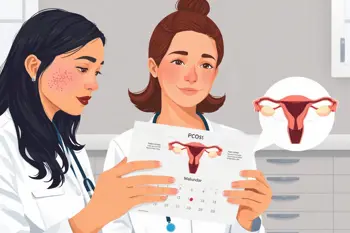
Symptoms can begin around puberty, become clearer during the late teenage years or early twenties, or appear later in adulthood. The pattern varies substantially: one person may have menstrual irregularity without prominent skin findings, while another may have acne or excess hair with relatively regular cycles. Changes during weight fluctuation, stress, or attempts to conceive may make an existing pattern more noticeable, but they do not independently diagnose PCOS. 8
Symptoms do not equal a diagnosis
PCOS is a clinical syndrome rather than a condition defined only by ovarian cysts. Diagnostic frameworks generally consider two of three features: androgen excess, ovulatory dysfunction, and polycystic ovarian morphology, after other causes have been excluded. Androgen excess may be identified through symptoms such as hirsutism or acne, blood tests, or both. The combination of findings and the person’s age and medical history guide interpretation. 4
Polycystic-appearing ovaries on ultrasound are not required for every diagnosis, and the small follicles seen on imaging are not necessarily dangerous cysts. Conversely, an ultrasound finding by itself does not establish PCOS. Thyroid disease, elevated prolactin, medication effects, and other endocrine disorders can produce similar menstrual or androgen-related symptoms. A careful assessment is therefore necessary to avoid both missed diagnoses and overdiagnosis. 9
What a medical evaluation may include
Assessment commonly begins with menstrual history, symptom timing, changes in hair or skin, medications, pregnancy goals, and relevant family or metabolic history. A physical examination may evaluate acne, hirsutism, scalp hair distribution, weight pattern, and darkened skin folds. Blood tests can assess hormone-related findings and help exclude alternative explanations, while pelvic ultrasound may be considered when appropriate. 1
Medical review is particularly appropriate when periods remain very irregular, several periods are missed, androgen-related symptoms are worsening, or pregnancy is desired. Evaluation also provides an opportunity to consider blood pressure, glucose-related risk, cholesterol, and broader mental-health effects associated with PCOS. Treatment decisions depend on the dominant symptoms, metabolic profile, contraindications, reproductive goals, and personal preferences rather than on an ultrasound appearance alone. 2
Why early recognition matters
Recognizing a consistent pattern of irregular ovulation and androgen-related symptoms can help distinguish a potentially chronic endocrine condition from an isolated change in skin, hair, weight, or menstruation. PCOS can affect reproductive health, metabolism, skin, and mental health across the lifespan. The condition is reported to affect approximately 5% to 10% of women in clinical references, although symptoms and severity differ widely among individuals. 6
Early recognition does not mean that every symptom should be attributed to PCOS. The central clinical task is to document persistent features, investigate alternative causes, and monitor relevant metabolic risks over time. This balanced approach is especially important for adolescents, for whom normal pubertal development can resemble PCOS. It also supports care planning based on cycle regulation, symptom relief, fertility, and long-term health protection. 2
Sources
- Acibadem Hospitals Group, “PCOS Symptoms: Possible Causes and When to Seek Care”
- The Journal of Clinical Endocrinology & Metabolism, “Approach to the diagnosis and treatment of polycystic ovarian syndrome in adolescent patients”
- Office on Women’s Health, “Polycystic Ovary Syndrome”
- MSD Manual Professional Edition, “Polyendocrine Metabolic Ovarian Syndrome”
- MedlinePlus, “Polycystic Ovary Syndrome”
- Merck Manual Consumer Version, “Polyendocrine Metabolic Ovarian Syndrome”
- American College of Obstetricians and Gynecologists, “Polycystic Ovary Syndrome”
- National Institute of Child Health and Human Development, “Polycystic Ovary Syndrome”
- Cleveland Clinic, “Polycystic Ovary Syndrome”
Authored by 24Trendz team