Clinical weight management programs price comparison: A data-based market analysis
A clinical weight management programs price comparison must distinguish between a coaching membership, a medical visit, a compounded prescription, and an FDA-approved branded medication. Published US prices span roughly $60 per month for some broader wellness memberships to $448 per month for certain branded telehealth pathways, while medication and laboratory charges may be billed separately. 1
How program categories differ
Clinical weight management is not a single product category. Behavioral programs may provide meal planning, tracking, coaching, and support groups without prescribing medication. Telehealth medical programs add clinician evaluation and prescription management, while hospital or specialty-clinic programs may combine physician oversight, nutrition services, laboratory work, and structured behavioral treatment. The Obesity Medicine Association describes medical management as including nutritional and behavioral components, not medication access alone. 2
Published comparisons also show that some prices describe only membership access. Ro Body has been reported at $145 per month excluding medication, while WeightWatchers Clinic, formerly Sequence, has been reported at $99 per month for clinical access. Noom Med pricing varies by plan and subscription length, and Found membership has been reported from $99 per month. 3
| Program model | Published reference point | Common cost limitation |
|---|---|---|
| Behavioral or coaching membership | About $60 and above per month in selected comparisons | Medication and medical evaluation may not be included |
| Clinical membership | $99 to $145 per month in cited examples | Prescription medication may be billed separately |
| Compounded GLP-1 telehealth | $149 to $299 per month in reported ranges | Product class differs from branded FDA-approved medicine |
| Branded medication pathway | $299 to $448 per month in selected all-in cash examples | Insurance status and dose can change the total |
Published telehealth price ranges
A 2026 review of published telehealth prices reported an all-in cash range of $149 to $448 per month across tracked programs, a 3.0-times spread. The $149 figure represented an entry compounded semaglutide pathway, while the $448 figure represented a branded medication pathway associated with 9amHealth. The same review found that eight tracked programs advertised an introductory figure below their ongoing cost. 4
Medication class and dose explain part of the variation. Reported compounded semaglutide prices began at $149 at entry tiers and about $159 at a flat ongoing rate, while branded Wegovy pathways began around $299 in the cited comparison. Compounded tirzepatide was reported at $199 to $299, compared with branded Zepbound vials reported at $299 to $449 by dose. 5
Why advertised monthly fees can mislead
The meaningful comparison is the recurring treatment cost, not necessarily the intake figure. A published cost analysis defined true monthly cost as the clinical fee plus medication plus laboratory charges. It also noted that membership, intake, medication, and laboratory services may be presented separately, and that maintenance dosing can cost more than an initial titration dose. 6
Contract structure is another material variable. The tracked comparison identified month-to-month programs alongside four-month and twelve-month commitments. WeightWatchers Clinic was described in one comparison as having a twelve-month lock-in, while other programs were listed as month-to-month. A lower monthly number can therefore represent a different financial obligation than a higher month-to-month fee. 7
- Check whether the quoted amount includes the clinical evaluation.
- Separate medication, laboratory, shipping, and membership charges.
- Compare the maintenance dose rather than only the entry dose.
- Review cancellation rules and minimum subscription terms.
Branded and compounded medications
Branded and compounded treatments should not be treated as identical products in a price table. The cited clinical-cost analysis describes compounded medications as pharmacy-made copies rather than FDA-reviewed branded products, while branded Wegovy and Zepbound are presented as separate product classes. A lower compounded-program price may therefore reflect a different product, dispensing pathway, and regulatory context. 8
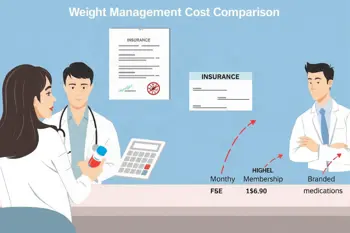
Compounding also introduces a need to verify the prescribing process, dispensing pharmacy, formulation, and information provided about risks. The comparison data describes compounded semaglutide as prepared by a licensed compounding pharmacy under a valid prescription, but not as an FDA-approved finished drug product. Program eligibility still depends on medical evaluation and prescription authorization. 9
Insurance and eligibility effects
Insurance can change the effective cost more than the membership fee. The 2026 telehealth price report estimated that approved prior authorization may reduce a branded medication cost from cash pricing of $299 or more to a copay commonly reported at $25 to $50, although the patient may still owe a program fee. Coverage rules, formularies, eligibility criteria, and authorization requirements differ by plan. 10
Medicare Part B covers intensive behavioral therapy for obesity for eligible beneficiaries, according to the cited Medicare source. This coverage category is distinct from automatic coverage of GLP-1 medication. BMI criteria, associated health conditions, documentation, and the specific benefit design can affect access, so a program price should not be interpreted as a universal out-of-pocket estimate. 11
Long-term maintenance and clinical oversight
Weight management costs often continue beyond the initial treatment period. The available comparisons describe ongoing clinician check-ins, laboratory monitoring, coaching, and medication management as components that may persist after dose escalation. A 12-week specialized clinic program was reported in the research material at roughly $1,500 to $5,000, often including laboratory work and meal replacements, illustrating how intensive in-person models differ from monthly telehealth memberships. 12
Clinical oversight also varies by setting. Cleveland Clinic programs may require formal physician referral, while Mayo Clinic describes a Healthy Weight Program centered on lifestyle modification and medical oversight. These models may involve more structured assessment than a subscription-based telehealth pathway, but the provided data does not establish a single standard fee for either institution. 13
| Cost question | Why it matters |
|---|---|
| Is medication included? | Membership-only prices can materially understate total treatment cost. |
| What happens at maintenance? | Dose-based pricing may increase after titration. |
| Is there a minimum term? | Annual or multi-month commitments change total exposure. |
| What clinical services are included? | Labs, follow-up visits, nutrition, and behavioral support may vary. |
How to interpret a comparison responsibly
The most reliable comparison uses the same time period, medication class, dose, billing assumptions, and contract length for every program. It also records whether the price is an entry rate, an ongoing maintenance rate, or an all-in estimate. Because the cited sources report prices checked during 2026 and note frequent changes, historical figures should be verified against current provider and insurer information before being used for personal budgeting. 14
Price alone cannot establish clinical suitability or value. A responsible review considers medical eligibility, medication status, pharmacy information, monitoring, behavioral support, cancellation terms, insurance requirements, and the practical reality of long-term treatment. The central distinction is whether a number represents access to care, the medicine itself, or the combined cost of both.
Sources
- GLP Chart, GLP-1 Telehealth Price Report 2026
- Obesity Medicine Association
- WeightWatchers, Ro, Found, and Noom source information
- GLP Chart, Compare GLP-1 Programs
- GLP Chart, GLP-1 Telehealth Price Report 2026
- GoodLife Health, The True Monthly Cost of GLP-1 Telehealth
- GLP Chart, Compare GLP-1 Programs
- GoodLife Health, The True Monthly Cost of GLP-1 Telehealth
- BetterNewLives, Semaglutide Program Comparison
- GLP Chart, GLP-1 Telehealth Price Report 2026
- Medicare.gov, Intensive Behavioral Therapy for Obesity
- General clinical weight management research data provided
- Cleveland Clinic and Mayo Clinic program information
- GLP Chart, pricing comparison data
Authored by 24Trendz team