Home Recovery for a Meniscus Tear: Clinical Guidance on Conservative Rehabilitation
Home recovery for a meniscus tear often begins with conservative, non-surgical strategies for reducing pain and swelling while protecting knee function. Minor or stable tears may improve through rest, ice, compression, elevation, activity modification, and a structured exercise program, but an accurate diagnosis is important because tear location, size, stability, and mechanical symptoms influence treatment decisions. 1
What a Meniscus Tear Means for Recovery
The menisci are crescent-shaped cartilage structures positioned between the thigh bone and shin bone. Each knee contains a medial meniscus on the inner side and a lateral meniscus on the outer side. They cushion the joint, distribute weight, reduce friction, and contribute to stability. Tears may follow a sudden planted-foot twist during sport, deep squatting, or pivoting, while degenerative tears can develop gradually with age-related tissue changes. 5
Non-surgical care is most often considered for small, stable tears, many degenerative tears, and injuries that do not cause persistent locking or major instability. Tears near the outer portion of the meniscus have better healing potential because that region has a stronger blood supply, whereas inner-zone tissue has limited capacity to repair itself. MRI findings alone do not determine whether surgery is necessary, since symptoms and knee function also matter. 7
First Home Measures for Pain and Swelling
During the early phase, the RICE approach means rest, ice, compression, and elevation. Rest involves reducing weight-bearing and avoiding movements that worsen symptoms. Ice may be applied for 15 to 20 minutes every two to three hours during the first two to three days, with a cloth barrier protecting the skin. An elastic compression bandage can help control swelling, while elevation above heart level may assist fluid drainage. 2
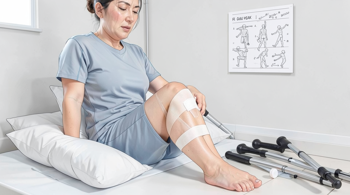
Rest should not become complete immobility for an extended period. Once acute pain and swelling begin to settle, gentle knee movements can help preserve mobility. If walking is painful, crutches may temporarily reduce the load on the injured leg, but their use should match comfort and professional guidance. A compression wrap should not cause numbness, tingling, increased pain, or color change in the foot. 12
Activity Changes and Pain Management
Early recovery generally requires avoiding deep squats, kneeling, twisting, pivoting, and high-impact sports because these actions can irritate the meniscus and increase symptoms. Walking should be kept within a tolerable range, with shorter distances and slower turns when necessary. Swimming and stationary cycling are commonly identified as lower-impact options for maintaining movement and cardiovascular activity, but they should only be used when they do not increase pain or swelling. 8
Over-the-counter nonsteroidal anti-inflammatory drugs are commonly used to manage pain and swelling during meniscus recovery. Medication suitability depends on medical history, other medicines, kidney or stomach problems, and individual risk factors, so label directions and advice from a qualified healthcare professional are important. Pain relief should not be used to justify returning to twisting or impact activities before strength and motion have recovered. 10
Progressive Exercises at Home
Early rehabilitation emphasizes gentle movement and quadriceps activation. Quadriceps sets involve tightening the thigh muscle while the leg is straight and pressing the knee gently toward the floor. Ankle pumps can encourage movement in the lower limb, while heel slides can gradually restore comfortable knee bending. Straight-leg raises may be introduced when the person can keep the knee straight without a painful lag. Exercises should be stopped or modified if significant pain develops. 4
As swelling decreases and movement improves, strengthening can progress to hamstring curls, controlled heel slides, partial squats, and other exercises selected for the individual injury. The quadriceps and hamstrings are important because stronger muscles improve support and stability around the knee. A commonly described early routine includes 10 to 15 quadriceps-set repetitions performed three to five times daily, although exercise volume should be adjusted when symptoms increase. 3
Recovery Stages and Expected Timelines
Rehabilitation is commonly organized into stages: protecting the knee and controlling swelling, restoring range of motion, strengthening the surrounding muscles, and gradually returning to normal activity. The first phase may prioritize limited weight-bearing and quadriceps activation, followed by mobility work and then progressive resistance. This staged approach reduces the risk of treating a painful, unstable knee as though it were ready for sport. 6
Recovery estimates vary substantially. Some minor tears improve with conservative care in approximately six to eight weeks, while other meniscus injuries require three months or longer, particularly when symptoms are persistent or the person is returning to athletic activity. A gradual return is recommended rather than a fixed date. Full range of motion, controlled daily movement, and restored muscle strength should precede running, jumping, cutting, or competitive sport. 14
When Home Recovery Is Not Enough
Medical assessment is important when symptoms persist, worsen, or interfere with walking and ordinary activities. A knee that repeatedly locks, cannot fully straighten, catches because of a loose fragment, or feels significantly unstable may indicate a mechanically important tear. Large unstable injuries, bucket-handle tears, and root tears are among the patterns that may require specialist evaluation rather than home treatment alone. 7
Home care also has limits when swelling repeatedly returns after activity, pain remains substantial despite modification, or rehabilitation cannot restore useful movement. Surgery is not automatically required because an MRI identifies a tear, particularly for many degenerative injuries, but a clinician may consider the tear pattern, age, activity goals, arthritis, examination findings, and response to physiotherapy. Preserving functional meniscal tissue remains an important treatment consideration because the meniscus contributes to long-term joint protection. 1
Practical Safety Checklist
A home plan should be symptom-guided and progressive rather than based solely on a calendar. Mild discomfort during an exercise may be tolerated in some rehabilitation programs, but sharp or significant pain, increasing swelling, or worsening walking ability indicates that the activity should be reduced, replaced, or reviewed. Keeping a simple record of swelling, range of motion, walking tolerance, and exercise response can help identify whether the knee is improving or being repeatedly irritated. 3
- Use rest, ice, compression, and elevation during the acute swelling phase. 2
- Avoid deep flexion, kneeling, pivoting, and impact while symptoms remain active. 9
- Begin gentle range-of-motion and quadriceps exercises within a tolerable limit. 11
- Use crutches temporarily when weight-bearing causes pain or unsafe limping. 12
- Delay sport-specific activity until motion and strength have substantially recovered. 6
Sources
- MSK Doctors, The Complete Guide to Treating a Meniscus Tear at Home
- MSK Doctors, Conservative Care for Meniscus Tears
- Osteo Studio, Meniscus Injury Home Rehab Exercises
- MSK Doctors, Science-Backed Meniscus Tear Exercises
- Mayo Clinic, Torn Meniscus Diagnosis and Treatment
- Cleveland Clinic, Torn Meniscus
- American Academy of Orthopaedic Surgeons, Meniscus Tears
- Johns Hopkins Medicine, Meniscus Tears
- Hospital for Special Surgery, Meniscus Tear
- WebMD, Meniscus Tear Recovery
- Healthline, Meniscus Tear Exercises
- MedlinePlus, Meniscus Tear Care Instructions
- University of Michigan Health, Quadriceps Strengthening
- Verywell Health, Meniscus Tear Recovery Time
Authored by 24Trendz team