Train journeys across the Rocky Mountains: routes, landscapes, and planning considerations
Train journeys across the Rocky Mountains reveal landscapes that road travel can compress into brief stops, including alpine ranges, river corridors, canyons, glacier-fed lakes, and high desert. The main choices are long-distance transportation services such as Amtrak and VIA Rail, and daylight sightseeing journeys operated through the Canadian Rockies and the American Southwest.
Major rail corridors across the Rockies
Amtrak’s California Zephyr operates daily between Chicago and Emeryville, California, with stops including Denver and Salt Lake City. Its published route covers approximately 2,438 miles and takes about 51 hours and 20 minutes, placing the Colorado Rockies and Utah landscapes within a much longer transcontinental itinerary. 1 2
VIA Rail’s Canadian connects Toronto and Vancouver as a transcontinental service that crosses the Canadian Rockies. These two services serve different purposes from dedicated sightseeing trains: they function as long-distance rail links, while the scenery forms part of a broader route rather than the sole organizing principle of the journey. 4
Canadian Rockies scenic journeys
Rocky Mountaineer operates daylight-only sightseeing journeys in western Canada. Its signature routes connect Vancouver with destinations in the Canadian Rockies, including Banff, Lake Louise, and Jasper, with direction determined by the selected itinerary. The operator identifies First Passage to the West, Journey through the Clouds, and Rainforest to Gold Rush as its principal Canadian routes. 3 13
The departure direction changes the sequence of landscapes rather than creating a separate rail network. Eastbound travel begins in Vancouver, while westbound itineraries can depart from Banff, Lake Louise, or Jasper. The progression may move between coastal or interior valleys and more dramatic mountain terrain, making the choice relevant to travelers comparing scenery, overnight arrangements, and access to Canadian Rockies destinations. 13 10
American Rockies and red-rock routes
The Canyon Spirit Rockies to the Red Rocks route links Denver and Salt Lake City, with Moab and Glenwood Springs appearing as itinerary points or overnight locations depending on the journey. The route combines Colorado mountain scenery with Utah’s red-rock country, including canyon landscapes and access to national park areas. 14 15
The Denver section begins at Union Station in Lower Downtown and enters a mountain corridor containing a 13-mile tunnel district with 30 tunnels. The route also passes below Rollins Pass through the 6.2-mile Moffat Tunnel before continuing toward Colorado’s canyons and the Colorado River. 20 The route’s 2026 identity is Canyon Spirit rather than Rocky Mountaineer, which remains the Canadian operator’s name. 16
Landscapes and destination access
Mountain rail travel offers views that are difficult to reproduce from highways. The California Zephyr passes through scenic regions of Colorado and Utah before continuing across the Sierra Nevada, while Canyon Spirit follows remote Colorado canyons and sections of the Colorado River. Official tourism information describes the rail perspective as distinct from Interstate 70 because passengers are not concentrating on driving. 8 9 20
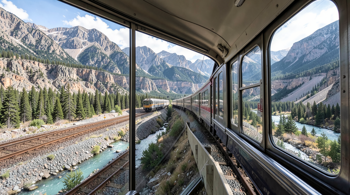
Canadian itineraries commonly connect rail travel with Banff National Park and Lake Louise, while U.S. routes may connect travelers with Moab and Arches National Park. Glacier National Park is served indirectly through Amtrak’s Empire Builder, with stations providing access to the park’s eastern and western approaches. Rail access therefore varies considerably: some destinations are journey endpoints, some are overnight stops, and others require onward ground transportation. 7 6 11
Seasonality, logistics, and operational limits
Rocky Mountain rail travel is highly seasonal. Winter weather, mountain conditions, and limited daylight can affect schedules and reduce the amount of visible scenery. The National Weather Service provides mountain and winter-weather forecasts that are relevant to planning, but forecasts do not remove the possibility of disruption in difficult terrain. 12
Scenic services also differ from conventional overnight trains. Rocky Mountaineer journeys use daylight rail travel with overnight hotel stops rather than onboard sleeping cabins. This arrangement creates practical dependencies involving hotels, station transfers, and ground connections. Long-distance services may offer a different timetable and onboard format, but freight traffic remains a major presence on Canadian rail networks, creating potential scheduling friction. 16 6
How to compare an itinerary objectively
A useful comparison starts with the journey’s purpose. The California Zephyr and VIA Rail Canadian are appropriate reference points for travelers evaluating long-distance rail coverage, while Rocky Mountaineer and Canyon Spirit are structured around daylight viewing and planned overnight stops. Route length, total duration, direction, endpoint access, and the balance between rail time and ground excursions should be assessed together rather than treated as interchangeable features. 1 4 3
There are also information and compliance limits. The supplied research does not establish universal boarding eligibility rules, identification requirements, accessibility standards, or a single regulatory framework for every operator. Those conditions must be confirmed through the relevant carrier and destination authorities. Travelers should also account for weather-related changes, hotel-based overnight arrangements, station locations, and onward transportation, since a scenic rail route does not necessarily place passengers inside a national park or at a trailhead. 12 13 14
Sources
- Amtrak, California Zephyr route information
- Amtrak, California Zephyr route length and timetable information
- Rocky Mountaineer, train routes
- VIA Rail Canada, Toronto to Vancouver Canadian service
- Great American Stations, Denver Union Station
- National Park Service, getting to Glacier National Park
- Parks Canada, Banff National Park
- Colorado.com, Colorado train travel
- Visit Utah, California Zephyr
- Travel Alberta, Rocky Mountaineer
- Visit Montana, Amtrak Empire Builder
- National Weather Service
- Rocky Mountaineer, where to start and end a journey
- Canyon Spirit, destinations
- National Geographic, Canyon Spirit route
- Uncompromised Travel, Rocky Mountaineer 2026 routes guide
- Lonely Planet, Canyon Spirit Rockies to the Red Rocks
- Condé Nast Traveler, Canyon Spirit journey
- Irish Examiner, Canyon Spirit rail journey
- Visit Denver, Canyon Spirit from Denver to Moab and beyond
Authored by 24Trendz team