Average Salary for Registered Nurses in the United States: Comprehensive Market Analysis and Compensation Drivers
National Compensation Overview and Statistical Baseline
The national compensation landscape for registered nurses (RNs) in the United States reflects a complex interplay of regulatory standards, regional demand, and institutional pay structures. According to data from the Bureau of Labor Statistics Occupational Employment and Wage Statistics (OEWS), the national average annual salary for a registered nurse is $101,420 1. While this mean figure provides a broad benchmark, analysts often point to the median annual salary of $97,550 as a more precise indicator of typical earnings, as it mitigates the influence of high-income outliers at the top of the spectrum 1. Based on recent job posting data, hourly compensation averages approximately $44.35, supplemented by annual overtime earnings that can significantly impact total take-home pay 2.
Understanding the full scope of nurse compensation requires looking beyond simple averages and examining the distribution of earnings. The compensation range for registered nurses is notably wide, spanning from a 10th percentile annual salary of $68,940 to a 90th percentile ceiling of $137,470 1. This $69,000 disparity is driven by a combination of professional experience, clinical specialization, and the specific cost-of-living index associated with a nurse's practice location 3. Recruitment strategies in the current climate often anchor competitive offers between the median and the 75th percentile, which equates to an annual range of approximately $97,550 to $112,350 1.
The Impact of Geographic Variability on Earnings
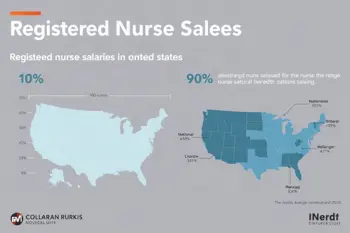
Geography remains the single most significant factor in determining the nominal salary of a registered nurse. State-level data consistently demonstrates that nursing professionals in coastal states, particularly those with higher costs of living and varying collective bargaining environments, command the highest base wages. California currently leads the nation with an average annual salary of $150,280, followed by states such as Washington, Massachusetts, and New York, all of which maintain averages exceeding the $110,000 threshold 1. These figures serve as gross benchmarks that do not account for purchasing power adjustments or state-specific tax burdens 5.
Conversely, states in the southern and midwestern regions often report median annual salaries that fall below the national average. For instance, nursing compensation in states like Florida, Georgia, and Texas, while reflective of their respective local economic conditions, frequently ranges between $90,000 and $96,000 annually 1. It is essential to note that when adjusting for local cost-of-living metrics, the comparative value of these salaries may shift. A salary that appears lower in nominal terms may provide comparable or superior quality of life in regions with lower housing and service costs, a detail often omitted in simplified national salary rankings 5.
Professional Specialization and Advanced Certification
Beyond geographical location, the professional trajectory of a nurse is a primary determinant of earning potential. Registered nurses who pursue advanced certifications or specialize in high-acuity environments generally occupy the upper quartiles of the salary distribution 4. Clinical areas such as critical care, surgical nursing, and emergency medicine often command higher base rates due to the specialized knowledge and increased responsibility inherent to these departments 6. Furthermore, nurses who transition into roles such as Certified Registered Nurse Anesthetists (CRNAs) or Nurse Practitioners (NPs) experience significant upward mobility, with CRNA annual mean wages reaching approximately $248,320 in current reporting cycles 5.
The hierarchy of nursing compensation is also influenced by the attainment of higher-level academic credentials. While an Associate Degree in Nursing (ADN) provides the foundational licensure required to practice as an RN, the acquisition of a Bachelor of Science in Nursing (BSN) or a Master of Science in Nursing (MSN) is frequently linked to broader employment opportunities and tiered pay scales within major hospital systems 6. These credentials not only facilitate entry into specialized departments but also serve as prerequisites for leadership and administrative roles that offer substantial salary premiums compared to generalist staff positions 7.
Employment Setting and Institutional Differences
The environment in which a registered nurse practices serves as a structural mediator of compensation. Hospitals remain the largest employers of RNs, accounting for nearly 60% of the total nursing workforce in the United States 10. Due to the 24-hour nature of hospital operations, these institutions frequently utilize shift differentials to incentivize nurses to work nights, weekends, and holidays. These differentials, which may range from modest hourly premiums to significant percentage-based increases, represent a critical component of total annual compensation for many bedside professionals, even when the base salary remains consistent 10.
Outside of the acute care hospital environment, outpatient surgical centers, home health agencies, and ambulatory clinics offer different compensation structures. In some cases, the absence of the 24-hour shift cycle can lead to a more predictable, though potentially lower, gross annual salary compared to hospital-based roles 7. However, for nurses prioritizing professional autonomy or specific scheduling requirements, these settings provide a viable alternative. Analyzing the total compensation package, which may include benefits, retirement matching, and professional development support, is necessary for a comprehensive understanding of the value of an RN position in any specific setting 9.
Market Trends and Future Workforce Projections
The demand for registered nurses remains robust, driven by the aging demographic of the U.S. population and a sustained need for healthcare services. Projections indicate that employment in the nursing field will continue to grow at a rate faster than the average for all occupations throughout the next decade 10. This supply-demand imbalance has historically placed upward pressure on nursing wages, as healthcare systems compete to retain qualified staff amidst a ongoing national nursing shortage 5. As organizations seek to stabilize their workforce, long-term trends suggest continued growth in baseline compensation metrics 8.
While historical data indicates a consistent increase in the median annual salary for registered nurses, external economic variables-such as inflationary pressures and changes in federal health policy-can influence these trends. Current estimates for 2026 and beyond suggest a compound annual growth rate in nursing compensation as institutions adapt to evolving workforce requirements 8. Prospective and current practitioners should monitor regional shifts in policy, such as the adoption of nursing compact licensure, which may alter the movement of the nursing workforce and subsequently impact localized compensation averages across the country 8.
Summary of Statistical Benchmarks
To assist in the objective evaluation of registered nurse compensation, the following table summarizes the key statistical benchmarks identified in recent industry reporting:
| Metric | Annual Salary/Value |
|---|---|
| National Average Salary | $101,420 |
| National Median Salary | $97,550 |
| 10th Percentile Earners | $68,940 |
| 90th Percentile Earners | $137,470 |
| Projected Growth Rate | 6% (2023-2033) |
These figures represent a snapshot of the U.S. nursing market and should be evaluated in the context of individual experience levels, local cost-of-living adjustments, and specific clinical responsibilities. The nursing profession remains one of the most stable and financially significant sectors of the U.S. economy, with compensation structures that reward both geographic mobility and professional specialization 6.
Sources
- Rippling: Registered nurse salary in the US (2026)
- Indeed: Registered nurse salary in United States (2026)
- Nursing Hakia: Registered Nurse Salary: The Full Picture
- NurseJournal: How Much Money Do Registered Nurses Make?
- The Nursing Directory: Nursing Salary & Career Data 2026
- Nurse.org: Highest-Paying Nursing Specialties
- Drexel University: Nursing Salary Guide
- RNWages: Registered Nurse Salary by State (2026)
- Glassdoor: Registered Nurse Salary Analysis
- Bureau of Labor Statistics: Occupational Outlook Handbook - Registered Nurses
Authored by 24Trendz team