Key differences in assisted living models and their cost impact: Industry analysis and cost structure breakdown
Assisted living costs go beyond the base rate, because care levels, memory care, and extra fees can change the final monthly number compared with what families first hear. Most facilities price housing, meals, and care as separate layers, meaning the advertised base rate is rarely the final monthly total once care assessments and add-on services are applied. 1
Key differences in assisted living models and their cost impact
Assisted living pricing is not a single “sticker price” but a combination of housing charges, care-level fees, and service add-ons that vary by community model. In the U.S., the national median monthly cost is reported around $6,200, but the amount depends on multiple layers rather than on apartment rent alone. 10 1
1) How “model design” changes what is bundled vs charged
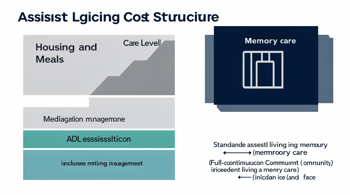
Several sources describe assisted living as a two-part or multi-part billing structure, where a base rate covers housing and standard services, while separate charges apply for care level and specific services. LegalClarity frames this as “three separate layers”: a base rate for housing and meals, a care-level charge tied to personal help needs, and individual fees for services such as medication management. 1 McKnight’s similarly reports operators use distinct revenue streams across community types, with differences in how housing and care plus medication management are monetized. 2
These design differences create an “apples-to-apples” problem. If two communities advertise different base rates but apply different care-level surcharges, the family’s real total can reverse in relative cost once the care plan is applied. Community Care Connect emphasizes that the same phrase, such as “monthly rate,” can refer to very different packages, depending on what is included before and after move-in. 4
Practical cost implications of bundling
Bundling affects total cost predictability when needs change. SilverTech Directory notes that the quoted tour rate often differs from the all-in monthly cost, because many communities use a base rate plus separate fees for care levels and add-ons, and the all-in number can be substantially higher. 5
Within a tiered or add-on model, a resident’s progression in ADL assistance typically increases the care surcharge and can increase medication-related fees. CarePriced reports average add-on costs can add $500 to $1,500 per month on top of the base rate, reinforcing that care intensity changes can translate directly into monthly totals under certain pricing structures. 7
2) Base-rate layer vs care-level and medication-fee layer
LegalClarity describes a base-rate range nationally of $3,500 to $7,000 per month, with variation driven by apartment size, geography, and urban versus rural markets. 1 Care levels are assessed based on the amount of hands-on help a resident needs, which is priced as an additional charge separate from housing. 1
Medication management is frequently treated as a distinct line item rather than as part of the base rate. Care Compass (California) states that the services package is separate from the residence and typically includes medication management, with facilities charging a base level plus add fees by care level (1/2/3) or by a la carte services, and that medication management plus two-person transfer are among the most common surcharges. 12
Medication-fee dynamics differ across community model types
McKnight’s reports a pricing dynamic where care plus medication management fees are lower in full-continuum communities (operators offering independent living, assisted living, and memory care) compared with communities offering only assisted living and memory care. Specifically, average fees for assisted living care plus medication management are 9.2% lower in full-continuum communities at every individual care level, while memory care medication management fees are 13.2% lower at every memory care level. 2
The gap is described as even greater for medication management alone, with assisted living medication management fees averaging 16.2% lower at full-continuum communities compared with assisted living and memory care-only communities, and memory care medication management averaging 18.7% lower. 2 These figures illustrate that “care” and “meds” may not be priced uniformly across model types, even when care levels appear similar on paper. 2
3) Memory care as a separate model and why it tends to raise effective costs
Memory care is often operated as a distinct model or dedicated unit, with specialized staffing and programming. CostPrism summarizes typical monthly ranges with memory care at $5,500 to $8,000 per month, reflecting higher staffing and dementia-specific programming compared with general assisted living levels. 6
In addition to specialized environment requirements, memory care can show up as separate base-rate pricing in multi-model operators. McKnight’s reports memory base rates follow the same pattern as assisted living, with higher base rates at full-continuum communities, including a private room rate average 9.2% higher at a full-continuum community than at an assisted living and memory care-only community. 2
However, medication management fees can diverge in the opposite direction. The same analysis finds that memory care medication management fees average 18.7% lower in full-continuum communities versus assisted living and memory care-only communities. 2 This combination of higher base-rate pricing and lower care and medication fees can shift total monthly cost depending on the resident’s care profile. 2
4) Assisted living vs CCRC and how contract structures can alter lifetime cost
Continuing Care Retirement Communities (CCRCs) are designed to allow residents to move across multiple care levels within one location, such as independent living, assisted living, memory care, and sometimes skilled nursing care or hospice care. WTOP describes the “age in place” purpose, where residents can choose one location and then move to different levels of care within that location depending on needs over time. 11
CCRC cost patterns can differ because of the contract structure and the way future care is bundled. Mercer Advisors describes LifeCare (Type A) contracts as bundling housing, services, and future care into one long-term agreement, with higher upfront entrance fees used to buy predictability and protection from rising healthcare costs. 13 The true cost is described as highly dependent on how long the resident lives in the community, and refundable versus declining refund structures can change which choice is more cost-effective across different time horizons. 13
Risk and maintenance realities of long-term contract pricing
Contract-based models introduce different cost risks than monthly-only billing. Mercer Advisors highlights that refundable contracts often favor shorter to mid-length stays, while declining refunds can win over longer horizons, meaning expected longevity can heavily influence total outcomes. 13 This model friction matters because assisted living needs can increase, and the cost picture may change when moving across levels of care within the same broader contract. 13 11
Separately, regulatory and coverage differences can affect which portions of costs are externally supported. WTOP explains that assisted living emphasizes ADL support with less focus on fulfilling medical needs, whereas CCRCs can cover more levels across time within the same setting. 11 Yet Medicaid and Medicare coverage limitations can still shift out-of-pocket responsibility, even when a facility includes higher levels of care across a continuum. 18
5) A model-by-model cost range picture: independent living, assisted living levels, memory care
CostPrism provides a structured set of monthly cost ranges by care type, which helps illustrate how model intensity can correspond to typical monthly expectations. The table format in CostPrism places independent living at $2,200 to $3,500, assisted living level 1 at $3,500 to $4,500, level 2 at $4,500 to $5,500, and level 3 at $5,500 to $7,000. 6
Memory care is listed at $5,500 to $8,000, while nursing home (skilled) is listed at $8,500 to $11,000. 6 While these are broad national ranges, they support the cost-impact logic that as resident needs increase, model-based pricing typically escalates because additional staff time and specialized services are required. 6
| Care type (national typical range) | Monthly cost range | Reported inclusion emphasis |
|---|---|---|
| Assisted Living (Level 1) | $3,500 to $4,500 | Base services plus minimal ADL help (1 to 2 hrs/day) |
| Assisted Living (Level 2) | $4,500 to $5,500 | More intensive ADL assistance (3 to 4 hrs/day) |
| Assisted Living (Level 3) | $5,500 to $7,000 | High-needs personal care (5+ hrs/day) |
| Memory Care | $5,500 to $8,000 | Secure unit, dementia programming, higher staff ratio |
6) Payment coverage friction: Medicaid services vs room-and-board and why it changes net cost
Coverage limitations can interact with assisted living model design in ways that affect net affordability. LegalClarity explains that Medicaid can help cover care services in assisted living but not room and board. 16 The distinction matters because the room-and-board portion of an assisted living bill often runs $4,000 to $6,000 a month or more. 16 Under these conditions, changing the resident’s care intensity may increase only certain parts of the bill while leaving housing costs as a separate responsibility. 16
LegalClarity also states that Medicaid pays for personal care and health-related services but will not cover utilities, meals, or the cost of the room. 16 This interacts with pricing models that separate base rates and care add-ons, because “covered” services might map onto the care-level layer but not onto the housing layer. 16
Eligibility variability across states and programs
Medicaid access differs because programs and waiver structures vary by state. General information included in the research set points to state-dependent differences for Medicaid coverage and long-term services and supports. 9 Cost Compass (California) provides an example of how waiver programs can cover services portions for eligible members, noting that Assisted Living Waiver covers the services portion for eligible Medi-Cal members in 15 California counties, while Original Medicare does not pay for assisted living services. 12
In practice, this can create “model-to-eligibility mismatch,” where two facilities with similar service packages may produce different net cost outcomes due to certification status and which services align to covered categories. LegalClarity describes that Medicaid pays for the services portion but not the housing portion, which is a repeated source of surprise for families. 16
Sources
- https://legalclarity.org/assisted-living-costs-base-rates-and-care-level-pricing/
- https://www.mcknightsseniorliving.com/news/senior-living-communities-charging-more-for-the-room-less-for-the-care/
- https://postassistedliving.com/how-much-does-assisted-living-cost/
- https://commcareconnect.com/how-to-compare-care-costs-across-assisted-living-communities/
- https://silvertechdirectory.com/guides/what-it-costs/
- https://costprism.com/guides/assisted-living-cost-guide/
- https://carepriced.com/blog/how-much-does-assisted-living-cost-in-2026
- https://californiacarecompass.com/services/assisted-living-services
- https://www.ecdol.org/resources/assisted-living/understanding-assisted-living-costs-and-payment-options/
- https://legalclarity.org/how-assisted-living-works-care-costs-and-coverage/
- https://wtop.com/news/2026/04/continuing-care-retirement-community-vs-assisted-living/
- https://californiacarecompass.com/services/assisted-living-services
- https://www.merceradvisors.com/personal-finance/lifecare-contracts-time-cost-and-long-term-care/
- https://www.cms.gov/medicare/coverage/medicare-coverage-database/view-medicare-coverage?print=true&searchText=assisted%20living
- https://acl.gov/programs/aging-and-disability-networks/long-term-services-and-supports
- https://legalclarity.org/medicaid-assisted-living-services-vs-room-and-board/
- https://www.ecdol.org/resources/assisted-living/understanding-assisted-living-costs-and-payment-options/
- https://www.ecdol.org/resources/assisted-living/understanding-assisted-living-costs-and-payment-options/
Authored by 24Trendz team