Warning signs of endometriosis: Clinical patterns and when evaluation matters
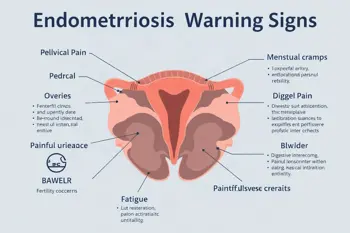
Warning signs of endometriosis often center on period-related pelvic pain, but the condition may also affect sexual health, fertility, bowel function, bladder function, and daily quality of life. Symptoms can occur during menstruation, between periods, or with no consistent cycle pattern, so persistent or worsening symptoms warrant clinical discussion rather than being automatically dismissed as ordinary cramps. 1
Severe or worsening menstrual pain
Dysmenorrhea, meaning painful menstrual cramps, is one of the most recognized warning signs. Suspicion increases when pain begins before bleeding, lasts for several days into the period, interferes with walking, school, work, sleep, or routine activities, or responds poorly to usual pain relief. Pain may feel cramping, stabbing, or aching and can involve the lower abdomen, pelvis, or back. 2
Period pain that progressively worsens over the years is particularly important to report. However, pain intensity does not reliably indicate the extent or stage of disease: some people have substantial pain with limited visible disease, while others have extensive endometriosis and few symptoms. Adolescents with disabling cramps or repeated school absence may also merit evaluation for endometriosis. 3
Pelvic pain outside the menstrual period
Endometriosis-related pain is not always confined to menstruation. Chronic pelvic pain may be constant or intermittent, may occur around ovulation, or may develop between periods as inflammation and scarring affect pelvic structures. Some people describe diffuse pelvic aching, while others report pain concentrated on one side, particularly when an ovarian endometrioma is present. 4
Pelvic floor spasms, lower-back pain, and pain during physical activity can accompany the condition. Symptoms may become more persistent over time, but a cyclical pattern is not required. The absence of severe pain also does not exclude endometriosis, because the condition can be discovered during an infertility evaluation or another procedure in people who report limited discomfort. 5
Pain during sex, bowel movements, or urination
Deep pain during or after vaginal penetration is a clinically significant symptom, especially when it is recurring or linked to the menstrual cycle. The pain may reflect lesions or inflammation near the vagina, uterosacral ligaments, rectovaginal area, or other pelvic structures. Reporting the timing, depth, and duration of pain can help a clinician distinguish it from superficial irritation or other causes. 6
Pain with bowel movements or urination, particularly during a period, can indicate lesions affecting or irritating the bowel, bladder, ureters, or surrounding tissues. Deep infiltrating endometriosis can affect functions such as pooping and peeing and may involve the colon, rectal wall, bladder, or ureters. These symptoms do not prove endometriosis, but recurring cycle-linked changes deserve assessment. 7
Heavy bleeding and digestive changes
Some patients report heavy menstrual bleeding or bleeding between cycles. Heavy bleeding can occur with several gynecologic conditions, so it is not specific to endometriosis, but it becomes more relevant when it appears alongside severe cramps, chronic pelvic pain, pain with sex, or fertility concerns. Recording bleeding duration, cycle timing, and changes from a personal baseline can provide useful clinical information. 8
Digestive symptoms may include bloating, nausea, constipation, or diarrhea, with symptoms often becoming more noticeable around menstruation. Severe bloating can be especially prominent during a period. Because gastrointestinal disorders can produce similar complaints, the cycle relationship is an important detail rather than a diagnostic test. Persistent, worsening, or function-limiting digestive symptoms should not be attributed to endometriosis without professional evaluation. 9
Fertility difficulty and fatigue
Difficulty conceiving may be the first reason some people are evaluated for endometriosis, even when pain is mild or absent. Endometriosis can involve the ovaries, fallopian tubes, peritoneum, and other pelvic surfaces, where inflammation and scarring may affect reproductive function. Infertility is reported in approximately 30% to 50% of women with endometriosis, according to the American Society for Reproductive Medicine. 10
Fatigue is another reported symptom and may occur alongside chronic pain, inflammation, sleep disruption, or the broader effects of living with a long-term condition. Fatigue by itself is not a specific warning sign, but persistent exhaustion combined with cycle-linked pain, heavy bleeding, bowel or bladder symptoms, or fertility difficulty strengthens the case for discussing a broader symptom pattern with a clinician. 11
Why symptoms require careful evaluation
Endometriosis symptoms vary widely and can overlap with primary dysmenorrhea, irritable bowel symptoms, urinary conditions, pelvic floor disorders, adenomyosis, ovarian cysts, or other causes of pelvic pain. Some people are asymptomatic. Consequently, symptom severity alone cannot establish disease stage, and normal-appearing initial findings do not necessarily explain persistent symptoms. 1
Evaluation commonly begins with a detailed symptom and menstrual history, followed by a physical examination when appropriate. Transvaginal ultrasound or MRI may support the diagnosis, while direct visualization and sometimes biopsy through laparoscopy can assist treatment planning, although laparoscopy is not always required before treatment begins. The American College of Obstetricians and Gynecologists emphasizes evaluation of adolescents and adults with symptoms suggestive of endometriosis. 3
Practical symptom documentation and associated risks
A symptom record can document the first day of bleeding, pain before and during menstruation, pain between periods, medication response, bowel and bladder changes, pain during sex, bleeding intensity, fatigue, and effects on work, school, sleep, or mobility. This information helps show whether symptoms are cyclical, progressive, or unrelated to menstruation. It also reduces the risk that disabling symptoms will be normalized as routine menstrual discomfort. 5
Untreated or progressive disease may be associated with inflammation, scarring, organ involvement, chronic pain, reduced quality of life, and infertility, although outcomes differ substantially between individuals. Lesions can occur on the ovaries, pelvic peritoneum, bowel, bladder, ureters, surgical scars, and, more rarely, the lung, pleura, or pericardium. New, worsening, or function-limiting symptoms therefore justify medical review, while self-diagnosis should be avoided because several other conditions can produce similar warning signs. 12
Sources
- Merck Manual Professional Edition, Endometriosis
- Cleveland Clinic, What Does Endometriosis Feel Like?
- American College of Obstetricians and Gynecologists, Diagnosis of Endometriosis
- Acibadem Hospitals Group, Endometriosis Symptoms Explained
- nib, Endometriosis 101: Signs and Symptoms
- Johns Hopkins Medicine, Endometriosis
- Cleveland Clinic, Deep Infiltrating Endometriosis
- NHS, Endometriosis
- Healthline, Endometriosis Symptoms
- American Society for Reproductive Medicine, Endometriosis
- Endometriosis Foundation of America, Endometriosis
- Merck Manual Professional Edition, Endometriosis and Lesion Locations
Authored by 24Trendz team