Natural Remedies for PMS: Evidence, Safety, and Practical Guidance
What PMS symptoms involve
Natural PMS remedies are commonly discussed for symptoms that appear during the one to two weeks before menstruation, including mood changes, bloating, breast tenderness, cravings, headaches, fatigue, and sleep disruption. PMS affects approximately 48% of women of reproductive age worldwide, while about one in five experience functional impairment related to symptoms. The pattern generally improves when bleeding begins, although the underlying sensitivity to normal hormonal fluctuations is not fully understood. 1
Current explanations connect PMS with changing estrogen and progesterone levels and their effects on neurotransmitter systems involving serotonin and GABA. This means that a supplement or lifestyle measure may influence a particular symptom without correcting a supposed hormone imbalance. Severe mood symptoms, especially depression, anxiety, or suicidal thoughts, can indicate PMDD rather than ordinary PMS and require medical assessment rather than self-treatment alone. 1
Calcium has the clearest supplement evidence
Calcium is among the most consistently supported natural interventions for PMS. A multicenter randomized, placebo-controlled trial involving 466 women reported that 1,200 mg of elemental calcium daily reduced total premenstrual symptom scores by approximately 48% over three cycles, compared with about 30% for placebo. Reported improvements included mood symptoms, fluid retention, food cravings, and pain. These results make calcium a prominent option for people seeking one evidence-supported supplement to discuss with a clinician. 6
The commonly studied amount is 1,200 mg of elemental calcium per day, often divided into two doses. Dietary calcium and supplemental calcium are not interchangeable in labeling, so the elemental amount should be checked carefully. Calcium is not automatically appropriate for everyone, particularly when a person has relevant medical conditions or takes medicines that may interact with supplements. A healthcare professional can help determine whether supplementation is suitable and how it fits with dietary intake. 2
Magnesium and vitamin B6 address different patterns
Magnesium is frequently considered for fluid retention, breast tenderness, cramps, sleep problems, and mood changes. Research summaries describe daily amounts in the range of 200 to 400 mg, with some evidence suggesting that magnesium combined with vitamin B6 may be particularly useful for premenstrual anxiety. The evidence is not identical for every symptom or formulation, so results should be tracked across several cycles rather than assumed from a product label. 3
Vitamin B6 is used for irritability, depression, and other emotional symptoms because it is involved in serotonin and dopamine synthesis. Trial-based guidance commonly places B6 at 50 to 100 mg daily, but doses above 100 mg per day should be avoided unless medically supervised because excessive intake can cause nerve damage. Magnesium and B6 can also be obtained through food, and supplement decisions should account for existing dietary intake, medications, and health conditions. 5
Herbal remedies require a cautious reading of the evidence
Chasteberry, also called Vitex agnus-castus, is widely used for PMS and cyclical breast pain. Research summaries report symptom reductions in randomized trials, with benefits often appearing after two or three menstrual cycles. However, “natural” does not mean risk-free, and herbal extracts can differ in concentration and preparation. The National Center for Complementary and Integrative Health identifies Vitex as an herb used for menstrual-related symptoms, but product quality and individual suitability remain important considerations. 4
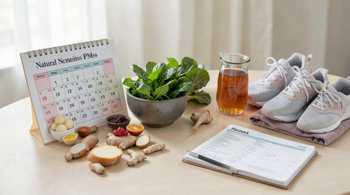
Evening primrose oil is commonly marketed for cyclical breast pain, yet evidence for overall PMS relief remains mixed. Ginger has more specific support for reducing the severity of menstrual cramps when used during the early days of the cycle, although that evidence concerns dysmenorrhea rather than the full PMS symptom cluster. Herbal teas such as ginger or peppermint are traditional approaches for bloating and cramping, but traditional use should not be confused with proof of broad clinical effectiveness. 6 9 11
Exercise, diet, and stress strategies
Regular aerobic exercise is recommended in clinical guidance for PMS because it may improve mood symptoms and reduce stress. The evidence does not require a specific branded program or a single exercise type, and the practical objective is consistency across the menstrual cycle. Coping-skills-based psychotherapy also has meta-analytic support, indicating that behavioral strategies can be relevant when symptoms interfere with work, relationships, or routine activities. 7 1
Dietary measures focus on regular meals, complex carbohydrates, and limiting caffeine and added sugar when these appear to worsen symptoms. Guidance from the Office on Women’s Health also discusses dietary adjustments as part of PMS self-management. These changes are not guaranteed to eliminate symptoms, and individual triggers vary. A symptom diary that records timing, food patterns, sleep, exercise, and emotional changes can help distinguish a recurring premenstrual pattern from symptoms that occur throughout the month. 8
Risks, product quality, and when to seek care
Supplements are not uniformly regulated in the same way as prescription medicines, and “PMS blend” products may contain several ingredients with uneven evidence. A 2025 double-blind randomized trial evaluated a multi-ingredient product called PMSoff containing spirulina, whey protein, calcium citrate, vitamin B1, chamomile, turmeric, marigold, lavender, saffron, valerian, and aftimoon. Of 255 randomized participants, 218 aged 14 to 30 completed the trial, but a single combination study does not establish that every ingredient works independently. 4
Medical advice is appropriate when symptoms consistently disrupt daily life, worsen over time, or include significant depression, anxiety, or suicidal thinking. PMDD is a more severe premenstrual condition and may require treatment beyond natural measures. Before starting calcium, magnesium, B6, Vitex, ginger, or evening primrose oil, a clinician or pharmacist can review pregnancy status, existing conditions, medication interactions, and dose-related risks. Tracking symptoms for at least two cycles also helps evaluate whether an intervention is producing a meaningful change. 1 4 5
Sources
- FeelGoodPal, “Natural PMS Remedies: What the Evidence Actually Shows”
- Mayo Clinic, “Premenstrual Syndrome: Diagnosis and Treatment”
- Cleveland Clinic, “Premenstrual Syndrome”
- National Center for Complementary and Integrative Health, “Vitex”
- Johns Hopkins Medicine, “Premenstrual Syndrome”
- National Library of Medicine, PubMed record on ginger and menstrual cramps
- American College of Obstetricians and Gynecologists, “Premenstrual Syndrome”
- Office on Women’s Health, “Premenstrual Syndrome”
- Mount Sinai Health System, “Evening Primrose Oil”
- WebMD, “PMS Natural Remedies”
- Healthline, “PMS Natural Remedies”
Authored by 24Trendz team