Recognizing early indications of skin cancer: A clinical guide to warning signs
Recognizing early indications of skin cancer starts with noticing changes in a mole, freckle, patch, bump, or sore. Early warning signs can include asymmetry, irregular borders, multiple colors, growth, bleeding, repeated crusting, or a lesion that does not heal. Skin cancer can occur on sun-exposed skin and on less obvious locations, including the scalp, palms, soles, nail beds, and mucous membranes. A self-check can identify changes, but only clinical assessment and, when necessary, biopsy can establish a diagnosis. 1
The ABCDE signs associated with melanoma
The ABCDE framework is used to identify visible features that may warrant evaluation for melanoma. A represents asymmetry, when one half does not resemble the other. B refers to an irregular, scalloped, or poorly defined border. C describes uneven or multiple colors, including shades of brown, black, red, white, or blue. D refers to diameter, often larger than 6 millimeters, although smaller lesions can also be concerning. E means evolution, or a change in size, shape, color, symptoms, or surface. 2
- Asymmetry: the two halves look different.
- Border: the edge is uneven or indistinct.
- Color: more than one shade appears within the lesion.
- Diameter: the spot is enlarging or is larger than a typical pencil eraser.
- Evolution: the lesion changes over time.
Changes that may occur outside a typical mole
Melanoma does not always begin in a long-standing mole. The “ugly duckling” sign describes a mark that looks noticeably different from a person’s other moles. A new lesion, a spot that changes, or a growth that develops unusual symptoms should be assessed rather than judged only by color or size. Melanoma can also be pink, red, or skin-colored, so the absence of dark pigment does not exclude concern. 3
Some locations receive little routine sun exposure but still require attention during a full skin examination. Warning signs may appear under or around fingernails, on the palms, on the soles, in the mouth, around the eyes, or in genital areas. These locations can be overlooked during casual checks, particularly when a person examines only the face, arms, and upper chest. A lesion’s location, appearance, and change over time are all relevant to professional assessment. 4
Non-healing sores, crusting, and bleeding
A sore that does not heal is an important warning sign associated with several forms of skin cancer. Other concerning patterns include a lesion that heals and returns, repeatedly crusts, bleeds, or becomes tender. These findings are not specific to cancer, because injuries and inflammatory skin conditions can produce similar symptoms. However, persistence or recurrence distinguishes a lesion that merits medical review from a temporary mark that follows a clear, uncomplicated injury. 1
Basal cell carcinoma may resemble a shiny or pearly bump, a flesh-colored growth, a pink or reddish patch, or a sore that repeatedly heals and returns. Squamous cell carcinoma may appear as a rough, scaly patch, a wart-like growth, or a firm reddish nodule that can crust or bleed. Because appearances overlap with benign conditions, visual inspection alone cannot confirm or exclude either cancer type. 2
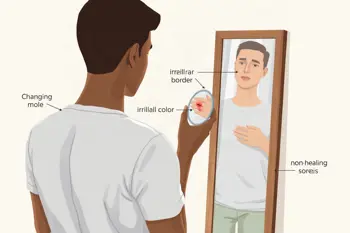
How to conduct a systematic skin self-check
A thorough self-examination is generally performed in a well-lit room after bathing or showering, using a full-length mirror and a hand mirror. The examination should proceed from head to toe rather than focusing only on visible areas. The face, ears, scalp, neck, lips, eyelids, arms, hands, fingers, fingernails, chest, back, legs, feet, soles, and spaces between fingers and toes should be reviewed. Assistance can help with the scalp and back. 3
- Examine the front, back, and sides of the body.
- Check the armpits, buttocks, and genital area.
- Inspect nail beds and the skin around each nail.
- Use a hand mirror for the back of the neck and scalp.
- Record or photograph marks when comparison over time is useful.
Monthly self-checks are described by dermatology education sources as a practical interval for many people, while higher-risk individuals may require more frequent or individualized surveillance. Photographs can help compare size, shape, and color, but they should not replace an examination when a lesion is changing or symptomatic. 4
Risk factors and less typical presentations
Risk is increased by cumulative ultraviolet exposure, intense sun exposure and sunburns, indoor tanning, fair skin, a personal or family history of melanoma or other skin cancer, numerous or atypical moles, and a weakened immune system. Melanoma can occur at any age, and skin cancer can develop in people with darker skin as well as lighter skin. In darker skin, lesions may be more likely to arise in areas such as the palms, soles, and nail regions. 6
Sun exposure is not the only factor relevant to recognition. A lesion may arise in a location that receives little sunlight, and some melanomas have limited pigment. The practical implication is that a complete check should include covered areas and should focus on change, difference from surrounding marks, persistent symptoms, and unusual texture, not simply on whether a spot is dark or located on the face. 11
When professional evaluation is appropriate
Medical evaluation is appropriate for a new or changing spot, an unusual lesion that differs from other marks, a sore that does not heal, or a growth that bleeds, crusts, returns, or develops persistent symptoms. A clinician may inspect the lesion and determine whether monitoring, specialist assessment, or biopsy is warranted. A biopsy is commonly used to determine whether suspicious skin tissue is cancerous, and self-examination cannot provide that diagnostic certainty. 12
Routine clinician screening recommendations are not identical for every population. The U.S. Preventive Services Task Force reports insufficient evidence to recommend for or against visual skin-cancer screening by clinicians in asymptomatic adults. That conclusion does not mean suspicious changes should be ignored. People with a previous skin cancer, substantial sun exposure, many atypical moles, or immune suppression may need individualized surveillance and counseling based on their risk profile. 13
Sources
- Centers for Disease Control and Prevention, “Symptoms of Skin Cancer,” https://www.cdc.gov/skin-cancer/about/index.html
- Mayo Clinic, “Skin cancer: Symptoms and causes,” https://www.mayoclinic.org/diseases-conditions/skin-cancer/symptoms-causes/syc-20377605
- UCLA Health, “Mind your moles: How to check for skin cancer,” https://www.uclahealth.org/news/article/mind-your-moles-how-check-skin-cancer
- Banner Health, “How to Spot Skin Cancer: Warning Signs,” https://www.bannerhealth.com/healthcareblog/teach-me/how-to-spot-skin-cancer
- American Cancer Society, “Detection and Diagnosis,” https://www.cancer.org/cancer/types/skin-cancer/detection-diagnosis-staging/detection.html
- Franciscan Health, “The ABCDEs Skin Cancer Assessment,” https://www.franciscanhealth.org/community/blog/abcde-skin-cancer-melanoma
- American Academy of Dermatology, “What to Look for,” https://www.aad.org/public/diseases/skin-cancer/find/what-to-look-for
- National Cancer Institute, “Melanoma,” https://www.cancer.gov/types/skin
- MedlinePlus, “Skin Cancer,” https://medlineplus.gov/skincancer.html
- Skin Cancer Foundation, “Melanoma,” https://www.skincancer.org/skin-cancer-information/melanoma/
- Cleveland Clinic, “Skin Cancer,” https://my.clevelandclinic.org/health/diseases/10921-skin-cancer
- U.S. Preventive Services Task Force, “Skin Cancer Screening,” https://www.uspreventiveservicestaskforce.org/uspstf/recommendation/skin-cancer-screening
Authored by 24Trendz team