How to exercise after stroke safely: Clinical guidance for gradual, supervised recovery
How to exercise after stroke safely begins with medical guidance rather than a fixed routine. Exercise can support strength, balance, mobility, range of motion, endurance, confidence, and long-term independence, but the appropriate activity differs according to weakness, balance, fatigue, medical conditions, medications, and the stroke’s effects. 1
Begin with medical assessment
A healthcare provider should evaluate a stroke survivor before a new exercise program starts or an existing program becomes more demanding. The assessment may consider heart disease, diabetes, fatigue, blood pressure, medications affecting heart rate or endurance, weakness, balance problems, and other limitations caused by the stroke. An exercise assessment can help clinicians identify current abilities and establish practical goals rather than relying on a general activity prescription. 1
Rehabilitation is individualized according to medical status, functional ability, learning capacity, motivation, coping skills, communication, and the person’s social situation. Physical, occupational, and speech-language professionals may contribute when movement, cognition, speech, or daily activities are affected. Exercise that is safe for one survivor may be unsuitable for another, particularly when comprehension, coordination, vision, or transfers are impaired. 2
Progress intensity gradually
Early sessions generally need to be short and manageable, with progression based on symptoms, recovery, and professional assessment. Duration, frequency, or intensity can be increased progressively as tolerance improves, while rest periods remain part of the plan. A seated pedal device or recumbent bicycle may be considered when balance is limited, but the choice of equipment and exertion level should be determined by the rehabilitation team. 1
Research does not support treating every stroke survivor as unable to tolerate challenging exercise. A 2025 systematic review and meta-analysis found that moderate-to-high-intensity aerobic exercise in appropriately screened people during subacute recovery improved several outcomes, including fastest gait speed, without a statistically significant difference in severe adverse cardiac or cerebral events between groups. The review still recommended physician collaboration, patient selection, and active monitoring. 3
Combine several types of movement
A post-stroke program commonly includes aerobic activity, strengthening, flexibility, balance work, and task-specific practice. Walking, transfers, reaching, standing, and other repeated activities can be selected according to the person’s goals and limitations. Repetitive, goal-directed practice is emphasized in stroke rehabilitation because it connects exercise with everyday function rather than training isolated capacity alone. 6
Muscle-strengthening programs can include resistance exercises selected by a clinician for the affected and unaffected sides. Cochrane evidence reports that people with stroke can safely participate in strength-training programs and may increase muscle strength and improve balance. Combined aerobic and strength programs are also feasible and may produce small improvements in fitness, balance, and walking speed, although results vary among participants. 4 5
Reduce falls and movement risks
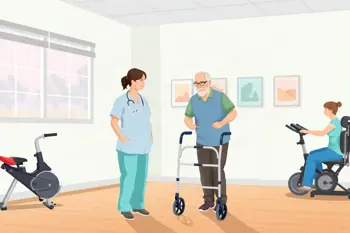
Weakness, spasticity, visual-field loss, incoordination, aphasia, and difficulty walking require specific therapy rather than unsupervised experimentation. A cane, walker, handrail, wheelchair, or other equipment should be used when prescribed. Transfers from bed to chair and sit-to-stand practice are important functional skills, but they should be taught and progressed by a qualified professional when balance or control is poor. 2
Exercises should never force a painful or resisted movement, especially in a weak or poorly controlled limb. During early rehabilitation, passive range-of-motion work may be used for affected joints when directed by the care team. The MSD Manual reports that passive joint movement may be performed three to four times daily in the early period when an affected extremity is flaccid, while positioning support can help protect a vulnerable shoulder. 2
Manage fatigue and monitor symptoms
Post-stroke fatigue can limit both physical performance and concentration, so a session should be scheduled when energy is adequate and should include planned recovery. Shorter, repeated sessions may be more practical than one exhausting workout. The response during exercise and after it matters: clinicians can use perceived exertion, symptoms, heart rate, blood pressure, and recovery time to individualize safe limits, particularly when medications or heart-rhythm conditions make heart-rate targets less reliable. 1
Exercise must stop and urgent medical help is needed for new facial drooping, sudden arm weakness, speech difficulty, abrupt vision or coordination changes, chest pain, severe shortness of breath, or fainting. New stroke-like symptoms remain an emergency even if they improve. The CDC identifies sudden changes involving the face, arm, speech, vision, walking, or balance as warning signs requiring immediate action. 10
Maintain rehabilitation over time
Rehabilitation should begin once the person is medically stable, and recovery can continue beyond the initial hospital phase. The purpose is not only to improve movement, but also to preserve range of motion, muscle strength, bowel and bladder function, cognitive abilities, and independence. Programs may be supervised in inpatient, skilled nursing, outpatient, community, or home settings depending on safety and support needs. 2
Ongoing activity should complement prescribed medical care and rehabilitation rather than replace it. Stroke best-practice recommendations support assessment of physical activity, fitness, mobility, balance, and fall risk, while task-specific repetition helps connect training to daily function. Regular review is needed when symptoms, medications, endurance, equipment, or goals change, because a safe program is an evolving clinical plan rather than a permanent list of exercises. 9
Sources
- Encompass Health, “Exercising after stroke: benefits, safety and recovery tips”
- MSD Manual Professional Edition, “Stroke Rehabilitation”
- Archives of Rehabilitation Research and Clinical Translation, “Safety and Benefits of Moderate to High Intensity Aerobic Exercise During the Subacute Phase of Stroke”
- Cochrane, “Benefits and risks of muscle strength training exercise programmes for people with stroke”
- Cochrane, “Benefits and risks of combined training for people with stroke”
- American Heart Association, post-stroke physical activity guidance
- American Stroke Association, physical activity after stroke
- NHS, stroke recovery and symptoms guidance
- Canadian Stroke Best Practices, physical activity recommendations
- Centers for Disease Control and Prevention, stroke signs and symptoms
Authored by 24Trendz team