Best antifungal cream for nail penetration: A clinical evidence review
The question of the best antifungal cream for nail penetration centers on a practical limitation: ordinary creams designed for skin often do not cross the dense nail plate effectively. Evidence-based treatment therefore depends less on the word “cream” and more on the drug’s formulation, the extent of nail involvement, and whether the infection reaches the nail bed or lunula.
Why nail penetration is difficult
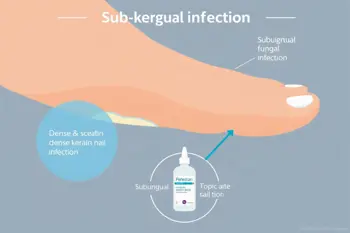
The nail plate is a dense, multilayered keratin barrier. Healthy adult toenails are approximately 0.5 to 0.6 millimeters thick, while infected nails can become 2 millimeters or more because of subungual debris and keratin buildup. This structure protects the tissue underneath but also restricts delivery of topical medication to the organisms beneath the plate. 1
Penetration depends on both the antifungal molecule and the vehicle carrying it. Low surface tension, suitable molecular size, and formulation characteristics can help a medicine move through the nail, while thick creams may remain mainly on the surface or surrounding skin. The principal clinical problem is reaching the subungual space, where infection may persist despite treatment of nearby skin. 2
Are antifungal creams effective for nail fungus?
Common over-the-counter creams containing clotrimazole or terbinafine are generally intended for fungal infections of the skin, including athlete’s foot. Available clinical guidance states that these products are not very effective against fungus established in the hard nail plate, although treating accompanying athlete’s foot can help reduce an ongoing source of reinfection. 3
This distinction explains why a cream may improve scaling or itching around a nail without clearing the discolored, thickened nail itself. Topical products are most suitable when the infection affects less than half of the distal nail plate, remains superficial, or when systemic treatment cannot be used. Even in those situations, diagnosis matters because bacterial disease, trauma, psoriasis, and other nail disorders can resemble onychomycosis. 4
Topical formulations with stronger nail-delivery rationale
Efinaconazole 10% is a prescription topical triazole solution developed specifically for onychomycosis. Its formulation is described as having low surface tension, a property intended to support movement through the nail plate and toward the nail bed. In pooled phase 3 data, adults with mild-to-moderate distal lateral subungual onychomycosis applied efinaconazole once daily for 48 weeks, with outcomes assessed at week 52. 5
Tavaborole 5% is another prescription topical option discussed for nail disease. Its small molecular weight is reported to support penetration through the nail plate more effectively than some older topical agents. Ciclopirox 8% nail lacquer uses a different delivery approach and is indicated for mild-to-moderate infection without lunula involvement caused by Trichophyton rubrum, alongside regular nail management. 6
How ciclopirox differs from a cream
Ciclopirox is applied as a nail lacquer rather than a conventional cream. The product labeling describes daily application, weekly trimming by the patient, and periodic removal of unattached infected nail by a health professional as components of a comprehensive treatment program. These measures reduce excess nail material and help the medication contact affected areas more consistently. 7
The main limitation is adherence over time. Nail treatment commonly requires many months because medication must act while a healthy nail gradually grows out. Ciclopirox is intended for selected mild-to-moderate cases and is not a universal substitute for oral therapy or specialist assessment. Filing should be performed according to product instructions, because aggressive or unsafe filing can injure surrounding skin. 8
When topical treatment may be insufficient
Systemic treatment is considered necessary in proximal subungual onychomycosis and in distal lateral disease involving the lunula region. White superficial onychomycosis and distal disease limited to the end of the nail may be treated with a topical agent. The number of affected nails, the percentage of nail involved, thickness, and proximity to the nail’s growth center all influence the treatment decision. 9
Topical and systemic therapy may be combined in more extensive disease, and combination treatment can increase cure rates according to clinical management references. Oral terbinafine reaches the nail bed through the bloodstream, unlike topical terbinafine cream, which is primarily used for skin infections and has limited effect on nail fungus. Oral therapy requires medical review because drug interactions and liver-related risks must be considered. 10
Nail softening, debridement, and maintenance
Urea, often at a high concentration such as 40%, may be used as an adjunct to soften thickened nail and assist mechanical debridement. Urea itself is not an antifungal cure, but reducing brittle or excess keratin can improve access for a suitable nail medication. It should therefore be viewed as a preparation or supportive measure rather than a replacement for antifungal treatment. 11
Successful management also requires attention to recurrence. Antifungal treatment may continue for 12 to 48 weeks, and visible improvement can lag behind microbiological improvement because the damaged nail must grow out. Any athlete’s foot should be addressed at the same time, while footwear, moisture exposure, and nail-care habits should be reviewed with a clinician when recurrence is frequent. 12
Safety, diagnosis, and practical selection
A nail should ideally be examined and, when appropriate, tested with microscopy, culture, or another laboratory method before prolonged therapy begins. Misidentifying a bacterial infection or a noninfectious nail disorder as fungus can lead to months of ineffective treatment. Medical assessment is particularly important when several nails are involved, the lunula is affected, pain or swelling develops, or the person has diabetes or impaired immunity.
In practical terms, there is no single antifungal cream that reliably provides deep nail penetration for every case. Ordinary creams are more appropriate for surrounding skin, while prescription nail solutions or lacquers are formulated for the nail unit. Efinaconazole offers a penetration-focused topical approach, tavaborole uses a small-molecule strategy, and ciclopirox depends on sustained application and nail reduction. Treatment choice should reflect confirmed diagnosis, severity, risks, and ability to maintain the regimen.
Sources
- The Toenail Clinic NYC, “How Topical Antifungals Penetrate the Nail Plate”
- Dermatology Times, “Improving Topical Delivery to the Nail Unit”
- Drugs.com, “What is the best over-the-counter nail fungus treatment?”
- Medscape Reference, “Onychomycosis Treatment & Management”
- Journal of Drugs in Dermatology, “Topical Efinaconazole 10% for Onychomycosis”
- American Academy of Dermatology, Onychomycosis clinical guidance
- DailyMed, Ciclopirox Topical Solution, 8% label
- Mayo Clinic, “Nail fungus: Diagnosis and treatment”
- Medscape Reference, “Onychomycosis Treatment & Management”
- Michigan Foot Doctors, “Lamisil for Toenail Fungus: Oral vs. Topical”
- National Institutes of Health, PubMed record on urea and nail penetration
- Cleveland Clinic, “Nail Fungus”
Authored by 24Trendz team