Early indicators of migraine disorders: A clinical review of prodromal signs
Early indicators of migraine disorders often appear before the headache phase, sometimes as subtle changes in mood, energy, concentration, sensory tolerance, appetite, or bodily regulation. Research describes this period as the prodrome or premonitory phase, commonly occurring 2 to 48 hours before head pain, although symptom timing and reliability vary between individuals. 1
What the prodromal phase means
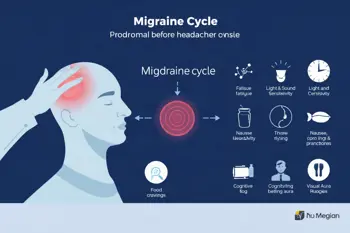
The prodromal phase is an early stage of the migraine cycle that precedes the headache itself. Commonly reported features include fatigue, neck stiffness, sensitivity to light or sound, mood changes, yawning, food cravings, thirst, gastrointestinal changes, and difficulty concentrating. These symptoms do not prove that a migraine will follow, because some may occur during ordinary daily fluctuations or other health conditions. 5
A 2026 longitudinal electronic diary study followed 43 people with episodic migraine who recorded symptoms three times daily for three months. Across 7,061 headache-free observations, at least one prodromal symptom was reported in 52.7% of observations, indicating that early symptoms were common in this sample but were not present before every headache. 1 The study therefore supports symptom tracking as a way to identify personal patterns rather than treating any single sign as a definitive forecast.
Sensory and cognitive warning signs
Increased sensitivity to light and sound is frequently described before migraine pain, while difficulty thinking or concentrating may create a sense of mental slowing or “brain fog.” Blurred vision can also occur during the premonitory period, although visual symptoms must be distinguished from aura and from unrelated eye or neurological problems. 1 The presence, duration, and sequence of these symptoms are clinically more informative than their existence in isolation.
The diary study found that phonophobia, or sound sensitivity, doubled the odds of head pain onset six hours after it was recorded. Nausea, photophobia, and difficulty thinking or concentrating were associated with higher odds of head pain within 24 hours, while blurred vision was associated with higher odds at every evaluated time point. 1 These findings describe statistical associations, not certainty for an individual person.
Mood, energy, and physical changes
Emotional and behavioral changes may precede the pain phase. Reported examples include irritability, anxiety, depression, euphoria, unusual tiredness, frequent yawning, and changes in sleep or activity. Neck and shoulder stiffness are also recognized physical precursors. 5 Because fatigue, mood variation, and muscle tension have many possible causes, a repeated pattern across several attacks is more useful than a one-time occurrence.
Prodromal symptoms may also involve homeostatic functions regulated by appetite, thirst, and elimination. Some people report cravings for particular foods, increased thirst, constipation or diarrhea, and more frequent urination before a migraine. 8 In the longitudinal study, thirst and dizziness were associated with higher odds of head pain 18 to 36 hours before onset. 1 Such symptoms can be relevant clues, but they are not specific diagnostic tests.
Aura compared with early migraine symptoms
Aura is a distinct neurological phase that may occur before or during migraine, rather than simply another name for the prodrome. Visual aura can include temporary disturbances such as flashing lights, blind spots, or altered visual patterns, and aura may also involve sensory or language symptoms. Mayo Clinic material identifies visual aura as a classic precursor that occurs shortly before pain. 6
Clinical descriptions commonly distinguish aura by its transient neurological character and relatively short duration. One pediatric reference states that migraine aura does not last more than 60 minutes. 4 New, severe, prolonged, or one-sided neurological symptoms require medical assessment because migraine symptoms can overlap with other neurological conditions. The available research does not support assuming that every visual change is migraine aura.
What prediction studies show
Electronic momentary assessment provides a more precise view of timing than asking patients to remember symptoms after an attack. In the 43-person study, participants recorded 11 prodromal symptoms during headache-free intervals, allowing researchers to examine several time lags before head pain. 1 The results suggest that different symptoms may have different predictive windows, with sound sensitivity particularly informative close to onset and thirst or dizziness appearing earlier.
A separate multicenter observational study was designed to assess the prevalence, timing, and distribution of prodromal symptoms across migraine subtypes in routine outpatient practice. 2 Its rationale reflects an important limitation in the evidence: reported prevalence varies according to how symptoms are defined, when people are asked about them, and whether data are collected prospectively or retrospectively. A symptom diary can clarify personal sequences, but it cannot independently establish a migraine diagnosis.
Early indicators in children and adolescents
Migraine in childhood may look different from adult migraine. Pediatric attacks are often bilateral or frontotemporal, may last from 2 to 72 hours under pediatric criteria, and can include pallor, nausea, vomiting, photophobia, and phonophobia. 7 Children may communicate early symptoms through behavior, such as stopping play, seeking darkness, becoming unusually quiet, or sleeping, rather than describing a specific prodrome.
Pediatric migraine variants and precursors include infantile colic, benign paroxysmal torticollis, recurrent vertigo, cyclic vomiting syndrome, abdominal migraine, acute confusional migraine, and Alice in Wonderland syndrome. 3 These conditions are episodic and may have a family history of migraine, but other causes must be excluded. Persistent symptoms between attacks, an abnormal examination, or a major change in pattern can alter the clinical assessment.
Limits, risks, and practical interpretation
Prodromal symptoms are useful signals, not guarantees. The strongest evidence in the supplied research comes from a small longitudinal sample, and even within that study symptoms appeared in only 52.7% of headache-free observations. 1 Overinterpreting a single sign can produce false alarms, while dismissing new neurological symptoms as migraine can delay evaluation of another condition.
A structured record can document the date, time, symptom type, intensity, sleep, food, hydration, and subsequent headache without assuming causation. This approach helps distinguish repeated individual patterns from background symptoms. Clinical guidance also emphasizes that childhood migraine is generally diagnosed from history and examination, with imaging not routinely required when the presentation is typical and the examination is normal. 4 Medical review remains important when symptoms are new, unusually severe, persistent, or accompanied by concerning neurological findings.
Sources
- The role of prodromal symptoms in predicting headache onset: A longitudinal electronic momentary assessment study, Headache, DOI: 10.1111/head.70146
- Migraine prodromal symptoms and their clinical manifestations: an observational multicenter study, Confinia Cephalalgica
- Migraine Variants and Precursors in Childhood: Clinical Features, Diagnostic Challenges, and Management Approaches, Pediatric Annals
- Migraine in childhood, MedLink Neurology
- Migraine prodrome, American Migraine Foundation
- Migraine headache symptoms and causes, Mayo Clinic
- Childhood migraine: How to diagnose confidently while recognising red flags, Pulse Today
- Migraine: The premonitory phase, National Headache Foundation
Authored by 24Trendz team