Water aerobics classes for older adults: A reported guide to benefits, formats, and safety
How aquatic exercise changes the workout
Water aerobics uses buoyancy to support the body while water resistance challenges movement. Programs described by the Granite YMCA emphasize strength, mobility, balance, and endurance through controlled exercises involving major muscle groups. The Arlington-Mansfield Area YMCA similarly reports that buoyancy and resistance can support cardiovascular fitness, flexibility, core strength, and muscle conditioning without adding stress to joints. Non-swimmers may be accepted in some formats, although class rules and pool conditions differ by facility. 1 5
For older adults, the principal distinction from land-based exercise is the reduced loading on knees, hips, and back. Blue Cross Minnesota describes water support as a reason many older participants find movement more comfortable, while the Arthritis Foundation identifies water resistance as a way to build muscle without heavy external weights. The available material presents aquatic exercise as adaptable rather than effortless: resistance remains present, and intensity depends on movement speed, water depth, equipment, and individual ability. 6 13
Potential benefits for strength, balance, and mobility
Reported benefits extend beyond aerobic conditioning. The Granite YMCA identifies improved strength, balance, mobility, and endurance as central aims, and Jefferson’s municipal aquatics program lists strength, flexibility, balance, and overall wellness. The National Institutes of Health source supplied for this topic describes aquatic exercise as clinically associated with improved functional mobility and gait stability in geriatric patients. These outcomes matter because functional movement, rather than athletic performance, often determines how comfortably an older person handles routine activities. 1 2 14
Water exercise may also support cardiovascular health, mood, energy, and social connection. Blue Cross Minnesota notes that participants may find everyday tasks such as climbing stairs or carrying groceries easier over time, while the National Council on Aging source identifies water exercise as relevant to fall-prevention strategies. These claims do not mean every participant will experience the same result. Progress depends on attendance, health status, exercise intensity, instruction, and whether the class is appropriate for the person’s functional limitations. 6 15
Class formats found in community programs
Class names often signal differences in depth, intensity, and emphasis. Examples in the supplied program data include shallow-water fitness, classic water aerobics, deep-water cardio abs, water Tai Chi, aqua fitness, aqua kickboxing, aqua Zumba, aqua boot camp, and aquarobics combining aerobic movement with resistance training. Some sessions focus on balance and mobility, while others prioritize core stability or higher-energy conditioning. The label alone is not enough to determine suitability, because instructors may modify exercises for different abilities. 1 3 5 7
Older-adult programming may be organized as a dedicated senior class or included within a broader adult schedule. Jackson, Tennessee, reported a senior aquatics session held Thursdays at 10:15 a.m., with exercise and community time integrated into one gathering. The YMCA of the Jersey Shore lists aqua fitness among its active-older-adult offerings alongside land-based senior fitness, strength, stretch, and balance classes. This range means that age-specific instruction, mixed-age participation, and exercise goals can vary substantially from one pool to another. 4 3
Scheduling, fees, and access patterns
Published schedules show that aquatic classes are commonly arranged in sessions lasting approximately 45 minutes to one hour. Jefferson lists 45-minute classes on Tuesday afternoons and Thursday mornings, while Catawba Valley Health System lists repeated 45-minute aquarobics sessions across several weekdays. A Chicago senior class described in local reporting operated for one hour and attracted roughly 30 students on typical days, with some sessions drawing about twice that number. Capacity, registration, and attendance practices therefore require local confirmation. 2 7 5
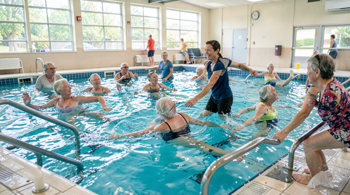
Access models also differ. Some programs are tied to membership, some allow daily participation or multi-visit packages, and some are organized through municipal recreation or community centers. Jefferson reports an $8 daily fee and listed visit packages, while Catawba Valley reported an $8 guest class and a five-visit punch card. Kangasala Uimahalli in Finland describes a maximum of 25 participants per guided session and an additional €4.90 water-aerobics charge beyond admission. These figures are examples of published program structures, not universal prices or current availability. 2 7 9
What older adults should assess before participating
Appropriate preparation includes identifying the class level, water depth, entry method, equipment, and instructor qualifications. Blue Cross Minnesota recommends beginner classes for people new to aquatic exercise, comfortable swimwear, and water shoes for additional grip. It also advises telling the instructor about joint pain, balance concerns, or other health issues so movements can be adjusted. The Arlington-Mansfield Area YMCA states that participants can work at their own ability level and that instructors provide encouragement across fitness levels. 6 5
Health history is particularly relevant after surgery, during rehabilitation, or when mobility is limited. The American Physical Therapy Association source identifies aquatic physical therapy as an intervention used after hip or knee arthroplasty, but a therapeutic program is not identical to a general water-aerobics class. Older adults should distinguish medical rehabilitation from recreational group exercise and establish whether a clinician’s guidance is needed. Pool temperature, changing-room access, handrails, lifts, flooring, and emergency procedures are practical safety factors that can affect participation. 18 6
Social participation and ongoing realities
Group identity is a documented part of many senior aquatic programs. WBBJ reported that Jackson participants used their weekly pool session for both physical activity and community time. In Chicago, participants ranging from 60 to 90 described the class as helpful for staying active, managing arthritis symptoms, and meeting people after retirement. The AARP source supplied for this topic also identifies aquatic social groups as a way community centers may address isolation while supporting physical activity. Social benefits remain individual and depend on continuity, accessibility, and group culture. 4 8 19
Availability is not permanent or uniform. Chicago reporting documented a popular senior class that faced cancellation before being extended for an additional week, leaving its future uncertain. Local programs can change because of pool maintenance, staffing, seasonal schedules, registration limits, facility priorities, or demand. Participants may therefore encounter waitlists, altered timetables, registration requirements, or interruptions even when a program has operated previously. The most reliable information comes from the relevant recreation department, health facility, YMCA, or pool’s published schedule and administrative staff. 8 9
Sources
- Granite YMCA, Water Exercise Classes in New Hampshire
- City of Jefferson, Water Aerobics and Fitness
- YMCA of the Jersey Shore, Active Older Adults
- WBBJ, Senior Aquatics Program in Jackson
- Arlington-Mansfield Area YMCA, Water Aerobics
- Blue Cross Minnesota, Make a Splash with Water Aerobics
- Catawba Valley Health System, Aquarobics
- New Haven Register, Golden Swimmers
- Kangasalan Uimahalli, Water Workouts and Pool Reservations
- Healthline, Water Aerobics
- YMCA, Group Exercise
- SilverSneakers, Fitness Programs
- Arthritis Foundation, Water Exercises
- National Institutes of Health, Aquatic Exercise Research
- National Council on Aging, Water Exercise
- Verywell Fit, Water Aerobics
- National Recreation and Park Association, Water Exercise
- American Physical Therapy Association, Aquatic Physical Therapy
- AARP, Water Workouts
Authored by 24Trendz team