How to exercise after hernia surgery safely: A clinical recovery timeline
How to exercise after hernia surgery safely begins with understanding that activity can resume gradually, but not immediately at full intensity. Walking is commonly encouraged within the first days, while light activity may return around week four and heavy lifting or gym work often requires at least six weeks and specific surgical clearance. Feeling well does not necessarily mean that deeper tissues and mesh-supported repairs are fully healed. 1
Why early movement matters
Early movement is different from exercise training. Short, gentle walks are encouraged because they support circulation, reduce stiffness, help bowel function, and lower risks associated with prolonged inactivity. One clinical recovery guide recommends gentle walking around the house during days one through three, followed by walks lasting 20 to 30 minutes daily by days four through seven, provided symptoms remain controlled. 2
Walking should remain comfortable and controlled rather than competitive. During the first week, the repair site may be sore, swollen, or sensitive, and the objective is mobility without abdominal strain. Gradually increasing distance during weeks two and three is generally more appropriate than adding speed, hills, or resistance. Pulling, tugging, or increasing discomfort indicates that activity should be reduced and discussed with the surgical team. 1
A typical week-by-week progression
Recovery schedules vary according to the hernia, surgical approach, pain level, general health, and healing progress. The following framework summarizes milestones reported in the supplied clinical guidance, but it is not a substitute for individualized postoperative instructions. Activity should advance only when the previous level is comfortable and the incision is healing normally. 3
| Recovery stage | Commonly described activity | Important limitation |
|---|---|---|
| Days 1 to 7 | Short walks and gentle breathing | Avoid straining and lifting over 10 pounds |
| Weeks 2 to 3 | Longer walks and, after approval, low-resistance stationary cycling | Gym training and forceful core work remain restricted |
| Weeks 4 to 6 | Gentle stretching, low-impact activity, and selected bodyweight movements | Stop if pain, pulling, or swelling develops |
| After 6 weeks | Progressive lifting, running, or sport when cleared | High-impact and contact activity may require longer |
Open repair versus laparoscopic repair
Laparoscopic repair often permits a quicker return to light daily activity than open repair because the incisions are smaller, although deeper tissues still require healing. One timeline describes light walking during the first week, stationary cycling during weeks two and three, light gym activity around week four, and full gym or sport activity from approximately week six when the surgeon agrees. These milestones remain general rather than automatic permissions. 6
Open repair can involve a slower progression, with one specialist guide advising that milestones may be shifted by roughly one week. It places greater emphasis on symptoms and the condition of the repair rather than on a fixed calendar date. Full lifting and high-impact sport may be delayed to around eight weeks after open surgery, while some patients need additional time because of the hernia's complexity or slower healing. 3
How to reintroduce low-impact exercise
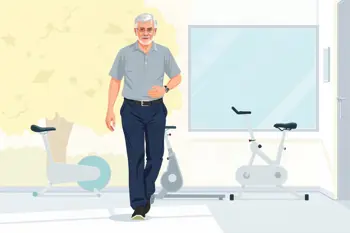
After the initial walking phase, low-impact exercise is generally the next category considered. Stationary cycling at low resistance, gentle stretching, and controlled daily movements can be introduced when they do not cause pain or abdominal pressure. Swimming and selected bodyweight movements appear in some recovery plans during weeks four through six, but wound healing and the surgeon's instructions determine whether pool activity is appropriate. 2
Core rehabilitation should be gradual and should not begin with maximal abdominal work. Suggested early movements include diaphragmatic breathing, pelvic tilts, and leg slides, which are intended to restore movement without overload. Later plans may introduce bridges, modified planks, or other controlled exercises. Traditional sit-ups, explosive movements, and exercises that provoke bearing down are specifically identified as activities to avoid during early recovery. 4
Lifting, running, and sport
Heavy lifting is one of the clearest sources of concern because bearing down and breath-holding can increase abdominal pressure. Several supplied guides describe avoiding loads above 10 pounds during the first week or weeks, with gradual increases such as less than 5 kilograms around week two, less than 10 kilograms during weeks three and four, and heavier lifting only after further healing and clearance. These figures are examples of clinical guidance, not universal prescriptions. 3
Running and sport should return in stages. Light jogging is described as potentially possible around weeks three or four when there is no pain or pulling, while light racket sport may appear around week five in some laparoscopic recovery schedules. Broader guidance places full activity after hernia repair within approximately six to 12 weeks, and contact sports may be restricted for eight to 12 weeks or longer depending on the repair and individual assessment. 7
Warning signs and safe decision-making
Exercise should stop if it produces sudden or increasing pain, a pulling sensation, visible swelling, a new bulge, or a feeling that the repair is giving way. Fever, redness, wound discharge, nausea, vomiting, or a firm bulge that cannot be reduced requires medical assessment rather than continued exercise. These symptoms can indicate a complication and should not be interpreted as ordinary training soreness. 3
Preventing strain also includes managing constipation, because forceful bowel movements increase pressure on the abdominal wall. Hydration and a high-fiber diet are identified as measures that can reduce this problem during recovery. The final return-to-exercise decision should account for whether the operation was open, laparoscopic, or robotic, the type of hernia, the patient's health, and the surgeon's examination of the healing site. 9
Sources
- Dr. Rajeev Premnath, Can You Exercise After Hernia Surgery?
- Torrance Hernia Center, Exercise After Inguinal Hernia Repair with Mesh
- Dr. Vanesha Varik, Exercise and Lifting After Hernia Surgery
- Midlands Clinic, Hernia Surgery Recovery Exercises
- Gleneagles Hospitals, How Long Does Hernia Surgery Recovery Take?
- Gleneagles Hospitals, Return to Lifting and Exercise After Laparoscopic Hernia Repair
- Cardiff Hernia Clinic, Returning to Sport After Hernia Repair
- Hernia Specialists of Mexico, When Can I Exercise After Hernia Surgery?
- Richmond University Medical Center, Hernia Repair Recovery Timeline
Authored by 24Trendz team