Warning signs of breast cancer: A clinical guide to changes that warrant evaluation
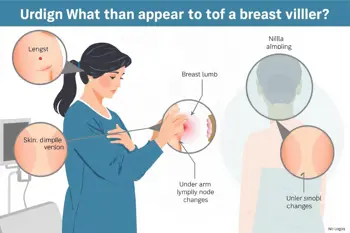
Warning signs of breast cancer can include a new lump, changes in breast size or shape, skin dimpling, nipple changes, unusual discharge, or pain. These findings can also result from noncancerous conditions, but a new, persistent, or unusual change should be assessed by a healthcare professional rather than judged by appearance alone. 1
New lumps and thickened areas
A new lump or mass in the breast or underarm is among the most recognized warning signs of breast cancer. A lump may be hard or soft, smooth or irregular, painless or tender, and it may occur in breast tissue or nearby lymph nodes. The physical feel alone cannot establish whether a lump is cancerous. Most breast lumps have other causes, including cysts, fibrocystic breast changes, infections, hormonal effects, or benign tumors, but a newly discovered lump still requires professional assessment. 2
- Noticeable thickening in one area of the breast.
- A hardened area that feels different from surrounding tissue.
- A lump under the arm or a new swelling near the collarbone.
- A change that remains after a menstrual cycle or does not match the other breast.
Changes in breast size, shape, or swelling
Breast cancer may produce a visible change in the size, shape, contour, or symmetry of a breast. Swelling can affect part of the breast or the entire breast and may occur without a clearly defined lump. A sudden difference between breasts, a new feeling of heaviness or fullness, or persistent enlargement is therefore relevant when assessing changes from a person’s usual appearance. Such findings are not diagnostic, because injury, infection, hormonal variation, and other benign conditions can also alter the breast. 3
| Observed change | Why it matters |
|---|---|
| New one-sided enlargement | Represents a change from the person’s usual breast pattern. |
| Localized swelling | Can occur with several conditions and should be evaluated if persistent. |
| Altered contour or shape | May occur with a mass or other breast tissue change. |
Skin texture, color, and surface changes
Changes in the skin over the breast or nipple area may include dimpling, puckering, redness, rash, scaling, thickening, or an orange-peel texture. These signs can reflect changes beneath the skin and are especially important when they are new or localized to one breast. Skin that appears inflamed, discolored, warmer than usual, or persistently irritated can also have infectious or inflammatory causes. Because visual changes are not specific to cancer, examination is needed to determine the underlying explanation. 4
- Dimpling or puckering that becomes more visible when the arm is raised.
- Thickened skin with an orange-peel appearance.
- Persistent redness, scaling, crusting, or a rash around the nipple.
- An ulcer on the breast, nipple, or areola.
Nipple changes and abnormal discharge
A nipple that newly turns inward, pulls to one side, or changes direction can be a warning sign, particularly when the change is not longstanding. Other findings include nipple pain, crusting, scaling, redness, or an ulcer involving the nipple or areola. Discharge unrelated to breastfeeding also warrants evaluation, especially when it is clear or bloody, comes from one breast, or occurs without squeezing. Discharge can have noncancerous causes, but its color, timing, and source provide information for clinical assessment. 5
- New nipple inversion or retraction.
- Clear, reddish, or bloody discharge.
- Persistent soreness or a visible change in the nipple area.
- Discharge that is not breast milk and is not explained by breastfeeding.
Pain, lymph nodes, and less obvious symptoms
Breast or nipple pain can occur with breast cancer, although pain is more commonly linked to benign breast conditions. Persistent pain in one location, particularly pain that does not follow a person’s usual menstrual pattern, should be discussed with a healthcare professional. Enlarged lymph nodes in the armpit or near the collarbone may also occur when disease affects nearby lymph tissue. These findings are not proof of cancer, since infections and other conditions can enlarge lymph nodes. 6
Some breast cancers cause no noticeable symptoms at all. Screening mammography can identify many early-stage cancers before warning signs appear, which is why screening decisions should follow applicable clinical recommendations and personal risk factors. Everyone has breast tissue, so breast cancer can affect men as well as women, although it is much less common in men and may be diagnosed later because awareness is lower. 7
What to do after noticing a change
Knowing how the breasts normally look and feel can make it easier to recognize a meaningful difference, but self-examination cannot determine whether a change is cancer. A healthcare professional may consider the person’s age, symptoms, medical history, and examination findings before deciding whether further testing is appropriate. No single symptom, including a lump or pain, provides a diagnosis without clinical evaluation and, when indicated, diagnostic imaging or biopsy. 8
Medical evaluation is appropriate for any new or unusual breast or underarm change, including a persistent lump, swelling, skin alteration, nipple retraction, or abnormal discharge. Delaying assessment because a symptom is painless, because there is no family history, or because the person is younger can lead to uncertainty. At the same time, evaluation should not be interpreted as confirmation of cancer: the cited clinical sources consistently note that many breast changes arise from conditions that are not malignant. 2
Sources
- Centers for Disease Control and Prevention, Symptoms of Breast Cancer, https://www.cdc.gov/breast-cancer/symptoms/index.html
- Mayo Clinic, Breast cancer: Symptoms and causes, https://www.mayoclinic.org/diseases-conditions/breast-cancer/symptoms-causes/syc-20352470
- MD Anderson Cancer Center, Breast Cancer Symptoms and Signs, https://www.mdanderson.org/cancer-types/breast-cancer/breast-cancer-symptoms.html
- Susan G. Komen, Warning Signs of Breast Cancer, https://www.komen.org/breast-cancer/signs-symptoms/warning-signs/
- Froedtert & MCW, Breast Cancer Symptoms and Warning Signs, https://www.froedtert.com/breast-cancer/symptom-warning-signs
- National Cancer Institute, Breast Cancer Symptoms, https://www.cancer.gov/types/breast/breast-cancer/symptoms
- National Health Service, Breast Cancer Symptoms, https://www.nhs.uk/conditions/breast-cancer/symptoms/
- Cleveland Clinic, Breast Cancer Warning Signs, https://my.clevelandclinic.org/watch/breast-cancer-warning-sign
Authored by 24Trendz team