Warning signs of breast cancer: A clinical overview of symptoms and diagnostic importance
Recognizing the warning signs of breast cancer is a critical component of proactive health management for individuals of all genders 1, 5. While many breast changes are attributed to non-cancerous conditions such as cysts, hormonal fluctuations, or infections, identifying subtle shifts in breast tissue or appearance remains a fundamental practice for early detection 4, 9. Early discovery significantly enhances the range of available treatment options and, in many cases, improves survival outcomes 4, 7. This article provides an objective summary of physical indicators, the role of self-awareness, and the clinical processes involved in evaluating potential malignancy.
The Role of Breast Awareness and Self-Monitoring
Modern clinical guidance emphasizes breast self-awareness over rigid, monthly manual examinations, which have been shown to yield high rates of false positives in average-risk populations 8. Breast self-awareness involves becoming familiar with how one’s breasts typically look and feel, establishing a personal baseline that makes it easier to notice new or persistent changes 4, 8. For those who menstruate, monitoring breast changes approximately one week after the end of a cycle is often recommended due to fluctuations in hormonal levels, while others are advised to select a consistent date each month to conduct a brief check 4.
Developing this awareness ensures that individuals can distinguish between their normal anatomy and potentially concerning developments. While the presence of a mass or thickening is the most widely recognized symptom, it is not the only indicator 2, 9. Any deviation from one’s personal baseline, such as sudden changes in breast contour, texture, or skin sensitivity, should be reported to a healthcare provider for a professional evaluation 4, 9. Objective clinical assessment is the only method to definitively rule out malignancy when new symptoms appear 9.
Common Physical Indicators of Potential Concern
The most frequently reported sign of breast cancer is the emergence of a new lump or mass in the breast, chest, or armpit area 2, 6. These masses can vary significantly in their characteristics; some may feel hard, irregular, and immobile, while others might be soft or even painful 5, 8. The lack of pain does not exclude the possibility of cancer, as many malignant growths remain asymptomatic or painless in their early stages 5. Therefore, any unexplained thickening or persistent lump requires medical attention regardless of whether it causes discomfort 5.
| Symptom Category | Specific Presentation |
|---|---|
| Physical Lumps | New or thickened mass in breast or underarm |
| Skin Changes | Dimpling, puckering, rash, or redness |
| Nipple Abnormalities | Inversion, flattening, or directional changes |
| Fluid Discharge | Spontaneous leakage, especially if bloody |
| Structural Shifts | Noticeable change in breast size or shape |
Beyond palpable lumps, structural and superficial changes are essential indicators to monitor. These include visible dimpling or puckering of the skin, which may sometimes resemble the texture of an orange peel, a condition clinically noted as peau d'orange 2, 6. Swelling of all or part of the breast, even in the absence of a distinct, contained lump, can also indicate underlying pathology that necessitates imaging or clinical examination 5, 6. The key for patients is to look for changes that are new, one-sided, or persistent over time 9.
Nipple and Skin Abnormalities
Changes in the appearance or function of the nipple are significant warning signs that warrant immediate investigation 9. Nipple retraction, where the nipple appears flattened, turned inward, or pulled toward the chest, is a recognized symptom of potential underlying malignancy 2, 6. Additionally, any spontaneous discharge from the nipple-particularly if it is bloody or occurs when an individual is not pregnant or breastfeeding-must be evaluated by a medical professional 2, 9.
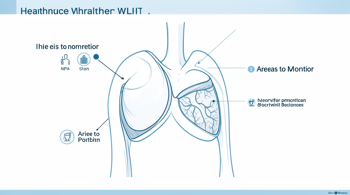
Skin texture and coloration around the nipple and the broader breast area also provide diagnostic clues. Conditions such as scaling, flaking, or persistent irritation and redness of the breast skin can be indicative of various conditions, including rare forms of breast cancer like inflammatory breast cancer 2, 5, 6. Inflammatory breast cancer is particularly notable because it often develops rapidly and may present as heat or redness rather than a traditional lump 6. Any thickening, unusual warmth, or persistent skin texture change requires a professional consultation to determine the underlying cause 5, 9.
Epidemiological Context and Risk Factors
In the United States, breast cancer is the second most common cancer in women, and it represents a significant public health focus 3. While prevalence is highest in middle-aged and older individuals, breast cancer can occur at any age 2, 5. Furthermore, while the majority of cases occur in those assigned female at birth, it is important to recognize that men can also develop breast cancer, though the incidence is significantly lower 1, 3. Symptoms and diagnostic protocols remain consistent across genders, although men frequently present at a later clinical stage 3.
Demographic data underscores the importance of screening, with incidence and mortality rates varying across different racial and ethnic populations. For instance, while lung cancer is the leading cause of cancer death among women overall, breast cancer is the leading cause of cancer death among Black women, who are statistically more likely to succumb to the disease than other groups 3. Understanding these broader epidemiological trends, combined with personal symptom monitoring, assists individuals in engaging more effectively with healthcare providers during routine check-ups and screenings 1, 5.
Diagnostic Processes and Medical Evaluation
When an individual presents with suspected breast symptoms, healthcare providers typically follow a structured diagnostic pathway. This often begins with a clinical breast exam to assess the nature and location of the reported changes 9. Based on the findings, doctors will likely utilize imaging techniques such as mammography or ultrasound to visualize the internal structure of the breast tissue 3, 9. These tools are vital for differentiating between benign conditions, such as fluid-filled cysts or dense fibrocystic tissue, and potentially malignant growths 8, 9.
If clinical findings or imaging remain inconclusive or show signs of concern, a biopsy is typically performed to obtain tissue for histological analysis 3. This remains the definitive method for diagnosing breast cancer. The objective of this process is to secure an accurate diagnosis as early as possible, as early-stage breast cancer is often highly treatable and carries a significantly higher survival rate than cases identified after the disease has spread beyond the breast tissue 7. Patients are encouraged to maintain open communication with their primary care providers regarding any new or unusual breast sensations or visual changes to ensure timely assessment 4, 9.
Sources
- Memorial Sloan Kettering Cancer Center, Breast Cancer: Signs & Symptoms, Causes & Prevention
- Cancer Research UK, Symptoms of breast cancer
- Merck Manual Professional Edition, Breast Cancer
- NHS Essex, Breast screening and breast cancer symptoms
- MercyOne, Breast cancer: Signs, symptoms and risks
- Prevent Breast Cancer, Breast Cancer Signs and Symptoms
- Prevention, 5 Sneaky Signs of Breast Cancer Beyond a Lump
- Sharecare, Symptoms of breast cancer you shouldn’t ignore
- Acibadem Hospitals Group, Breast Cancer Signs and Symptoms Guide
Authored by 24Trendz team