Prostate Health Supplements: Evidence, Safety, and Clinical Context
What prostate supplements are intended to do
Prostate health supplements are commonly marketed for stronger urinary flow, fewer nighttime bathroom trips, bladder emptying, and general prostate support. The global market has been estimated at approximately $3 billion annually, reflecting widespread interest in nonprescription approaches to benign prostatic hyperplasia, or BPH. BPH is noncancerous enlargement that can narrow the urethra and contribute to weak stream, urgency, frequency, and incomplete emptying. 1
These products are dietary supplements rather than prescription medicines. The U.S. Food and Drug Administration does not approve dietary supplements for safety or effectiveness before marketing, and label claims are not equivalent to evidence from a completed clinical trial. The American Urological Association guideline context is therefore important: supplements should not be treated as replacements for established treatments when symptoms are moderate, severe, progressive, or associated with complications. 2 3
Saw palmetto: popularity exceeds consistency
Saw palmetto is among the most recognizable ingredients in prostate formulas, usually promoted for urinary symptoms associated with BPH. Research findings are inconsistent. The National Center for Complementary and Integrative Health reports that studies have not established a reliable benefit, and differences in extract preparation, dose, trial design, and outcome measurement make comparisons difficult. Traditional use and biological plausibility do not establish that a product improves clinically meaningful symptoms. 4
Two large, rigorous U.S. trials provide particularly important context. The STEP trial in 2006 and the CAMUS trial in 2011 found no meaningful advantage over placebo, including when saw palmetto was tested at up to three times the commonly used 320 milligram daily dose. These findings contrast with some earlier, smaller studies and explain why saw palmetto is often described as promising in marketing but uncertain in modern evidence reviews. 5
Beta-sitosterol and pygeum compared
Beta-sitosterol has the most consistent randomized-trial evidence among the principal prostate supplement ingredients discussed in the supplied research. A Cochrane review involving 519 men reported an average 4.9-point improvement in the International Prostate Symptom Score and a 3.91 milliliter-per-second improvement in peak urinary flow compared with placebo. The studies generally used approximately 60 to 130 milligrams of active beta-sitosterol daily, with follow-up lasting roughly four to 26 weeks. 6
Pygeum africanum may provide modest relief, but its evidence base is older, smaller, and methodologically weaker. The available reviews describe possible improvements in urinary symptoms and flow, yet no modern, large, high-quality trial comparable to contemporary regulatory or guideline standards has established its long-term value. Neither beta-sitosterol nor pygeum has been shown in the supplied evidence to shrink the prostate, prevent prostate cancer, or replace medicines such as tamsulosin or finasteride. 7 8
| Ingredient | Evidence signal | Important limitation |
|---|---|---|
| Saw palmetto | Inconsistent | Large U.S. trials found no placebo advantage |
| Beta-sitosterol | Modest symptom and flow improvement | Long-term evidence remains limited |
| Pygeum | Possible modest symptom benefit | Older and weaker studies |
Other ingredients on supplement labels
Stinging nettle and rye grass pollen extract are frequently included in combination formulas for lower urinary tract symptoms, but the supplied evidence does not establish the same level of support reported for beta-sitosterol. Stinging nettle is often combined with other herbs, making it difficult to determine which ingredient accounts for an observed effect. Combination formulas also create a practical evidence problem because the exact blend and dose may not match any published trial. 9
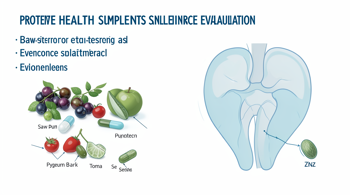
Zinc, selenium, and lycopene are common additions because of their links to prostate biology and antioxidant mechanisms. However, the SELECT trial involving more than 35,000 men found that selenium and vitamin E did not prevent prostate cancer, while vitamin E increased risk by 17 percent. A Cochrane review found insufficient quality evidence to determine whether lycopene prevents prostate cancer. These nutrients are not substitutes for cancer screening or diagnostic evaluation. 10 11
Safety, interactions, and quality control
Supplement use can create risks even when ingredients are described as natural. Saw palmetto may interact with medicines affecting blood clotting, and herbal products may also overlap with therapies used for urinary symptoms or hormonal conditions. Medical review is particularly important before combining supplements with blood thinners, alpha-blockers, or other BPH medicines. Product labels may not predict the full interaction profile of a multi-ingredient formula. 12
High-dose zinc requires special caution. A Harvard study of 46,974 men associated supplemental zinc above 100 milligrams daily with more than double the risk of advanced prostate cancer, while excessive zinc can contribute to copper deficiency. Independent certification from organizations such as USP, NSF, or ConsumerLab can help verify identity, potency, and contamination controls, although certification does not prove that a product improves symptoms. 13 14
When urinary symptoms require medical evaluation
Urinary changes should not automatically be attributed to BPH or managed solely with supplements. Frequency, weak stream, urgency, painful urination, blood in the urine, retention, and incomplete emptying can have multiple causes. Medical evaluation is necessary to distinguish BPH from infection, medication effects, bladder conditions, or prostate cancer. The Mayo Clinic specifically cautions that relying on saw palmetto without assessment can delay diagnosis of a condition requiring different treatment. 15
A practical evidence-based approach is to identify the symptom, review the complete Supplement Facts panel, check the actual dose of each active ingredient, and discuss interactions with a qualified clinician. Beta-sitosterol has the clearest modest evidence for urinary symptoms, while saw palmetto remains uncertain and pygeum has dated supporting data. No supplement in the supplied research prevents prostate cancer or reliably reduces prostate volume, so expectations should remain limited and follow-up should be based on symptoms and clinical findings. 1 3
Sources
- Urology and Men's Health, “Top 3 Prostate Supplements: Urologist Evidence Review,” https://urologyandmenshealth.com/prostate-supplements-evidence-review/
- U.S. Food and Drug Administration, “FDA 101: Dietary Supplements,” https://www.fda.gov/consumers/consumer-updates/fda-101-dietary-supplements
- TheAlphaRx, prostate supplement evidence methodology and AUA-SUFU guideline discussion, https://thealpharx.com/mens-health/prostate-supplements-men-40-plus-2026-saw-palmetto-beta-sitosterol-pumpkin-seed-oil-pygeum-lycopene-aua-cochrane-nih-ods/
- National Center for Complementary and Integrative Health, “Saw Palmetto,” https://www.nccih.nih.gov/health/saw-palmetto
- Urology and Men's Health, saw palmetto STEP and CAMUS trial summary, https://urologyandmenshealth.com/prostate-supplements-evidence-review/
- Supplement for Prostate, beta-sitosterol evidence summary, https://www.supplementforprostate.com/blog/best-beta-sitosterol-supplements
- Cleveland Clinic, “Prostate Health Supplements,” https://my.clevelandclinic.org/health/drugs/18260-prostate-health-supplements
- Urology and Men's Health, pygeum evidence review, https://urologyandmenshealth.com/prostate-supplements-evidence-review/
- WebMD, “Stinging Nettle,” https://www.webmd.com/vitamins/ai/ingredientmono-664/stinging-nettle
- Urology and Men's Health, “Zinc, Selenium, Lycopene: Do They Help The Prostate?,” https://urologyandmenshealth.com/zinc-selenium-lycopene-prostate-evidence/
- Prostate Cancer Foundation, “Supplements for Prostate Health: What You Need to Know,” https://www.pcf.org/c/supplements-prostate-health-what-you-need-to-know/
- Memorial Sloan Kettering Cancer Center, saw palmetto interactions, https://www.mskcc.org/cancer-care/integrative-medicine/herbs/saw-palmetto
- Harvard Health Publishing, “Supplements for Prostate Health,” https://www.health.harvard.edu/mens-health/supplements-for-prostate-health
- Consumer Reports, supplement quality and certification guidance, https://www.consumerreports.org/health/supplements/what-you-need-to-know-about-supplements-a7570417931/
- Mayo Clinic, “Saw Palmetto and Enlarged Prostate,” https://www.mayoclinic.org/diseases-conditions/benign-prostatic-hyperplasia/expert-answers/saw-palmetto/faq-20057866
Authored by 24Trendz team