All Inclusive Cruises in Turkey: A Report on Gulet Routes, Port Calls, and Included Services
All Inclusive Cruises in Turkey generally describe two different travel formats: intimate, multi-day gulet journeys along the southern coastline and larger Mediterranean cruises that call at Turkish ports. The first emphasizes swimming, coastal ruins, and onboard meals, while the second connects Turkey with destinations such as Greek islands and other Eastern Mediterranean ports. The term all-inclusive is not standardized, so inclusions require careful examination. 11
Two distinct types of Turkey cruise
Traditional Blue Cruises, also called mavi yolculuk, operate on wooden gulets, broad-beamed vessels associated with Turkey’s Turquoise Coast. Routes commonly last from three to seven nights and involve short coastal passages, repeated anchorage stops, swimming, snorkeling, meals prepared onboard, and visits to historic settlements. An independent guide describes the experience as closer to a floating swim holiday than a conventional hotel-style cruise, with cabins that can be compact and air-conditioning schedules that vary by vessel. 5
Large-ship itineraries use Turkey as one part of a wider Eastern Mediterranean route. Istanbul provides access to Hagia Sophia, the Blue Mosque, Topkapi Palace, the Grand Bazaar, and the Bosphorus, while Kusadasi is associated with shore visits to Ephesus and the House of the Virgin Mary. Bodrum and Antalya represent additional coastal calls, although the exact ports and shore programs depend on the sailing schedule. 11
Gulet routes and notable coastal stops
The Fethiye to Kekova circuit is a representative seven-night journey. Published itineraries identify Fethiye, Gemiler Island, Ölüdeniz, Yeşilköy, Kaş, Kekova, and nearby Lycian sites among the principal stops. The Sunken City of Kekova is viewed from the water, while Simena Castle, St. Nicholas Island, Butterfly Valley, and the Blue Lagoon add archaeological and natural interest. Swimming bays and evening anchorage are central parts of the daily rhythm. 1
Shorter itineraries connect Fethiye, Olympos, and the Demre or Kekova area. A four-day, three-night route can include the Sunken City, Simena Castle, Kaş, Butterfly Valley, Ölüdeniz, and St. Nicholas Island. Published examples list meal service and onboard water, but note that beverages and some activities may be separate. Optional activities mentioned in route descriptions include paragliding and scuba diving, which are not automatically part of the base package. 7
What “all-inclusive” commonly covers
On a shared-cabin gulet cruise, the standard package often combines the cabin, crew, breakfast, lunch, dinner, and afternoon tea. One published seven-day Fethiye to Kekova itinerary specifies double, twin, triple, private, or shared cabins, ensuite bathrooms, onboard Wi-Fi, air-conditioning, and the three main daily meals. These details describe a particular package rather than a universal industry rule, because operators differ over drinks, transfers, port charges, and air-conditioning hours. 2
Private charters require a different reading of the price structure. The boat and crew may form the base cost, while food, fuel, transfers, marina charges, and other services are itemized. A checklist for Turkish gulet travel identifies water, tea, and coffee as commonly included, while soft drinks and alcohol are frequently charged through the onboard bar. Tips are customary in some charter contexts and are generally not built into the quoted amount. 10
| Item | Typical treatment described in the research |
|---|---|
| Meals | Breakfast, lunch, dinner, and sometimes afternoon tea are commonly included on cabin cruises. |
| Beverages | Water and hot drinks may be included; alcoholic and soft drinks often cost extra. |
| Cabin | Shared or private air-conditioned cabins with ensuite bathrooms may be available. |
| Excursions | Site visits and optional activities may involve separate charges. |
Accommodation, onboard routine, and comfort
Gulet travel is structured around outdoor living rather than extensive indoor facilities. Days normally begin with breakfast, followed by a short passage and a stop in a bay for swimming or snorkeling. Lunch is served onboard, and afternoons may combine another swim, a walk ashore, or an archaeological visit. Dinner and overnight anchorage usually take place in a coastal bay or harbor. This schedule makes the vessel’s deck, shade, and access to the sea more important than large public rooms. 4
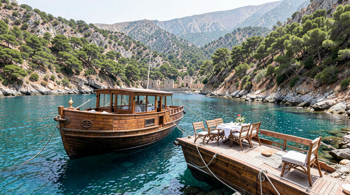
Cabin standards vary considerably. Published descriptions mention private bathrooms, air-conditioning, twin and double configurations, and premium gulets, but independent guidance cautions that cabins can be snug and plumbing may be basic on smaller boats. Air-conditioning may operate for only part of the day, whereas some luxury vessels provide longer coverage. Travelers sensitive to heat, limited space, or motion should verify the exact vessel and cabin category rather than relying on the general term gulet. 5
Seasonality, schedules, and route uncertainty
Blue Cruise guidance identifies April through October as the main season. June and September are described as periods associated with warm water, calmer coves, and fewer boats, while July and August can bring greater heat and congestion in popular anchorages. These observations concern general travel conditions, not a guarantee for a particular departure. Weather can alter the route, the overnight mooring location, and the timing of shore visits. 5
Published schedules show that departures can be fixed to particular weekdays. Turkey Adventure lists several seven-day routes departing on Saturdays, while a Bodrum Gökova itinerary records Friday and Saturday departures. The Bodrum route is structured as seven nights and eight days and includes Orak Island, Çökertme, the Seven Islands, Karacasögüt, Sedir Island, Paradise Bay, Longöz, and other bays. Such schedules can change by operator and season, so an official itinerary remains the controlling document. 6
Port-entry rules and practical risk checks
Travelers arriving at Turkish ports must assess passport validity and visa eligibility according to nationality, itinerary, and purpose of travel. Turkey’s Ministry of Foreign Affairs publishes country-specific visa information, while the official electronic visa portal explains eligibility and application conditions. Some cruise passengers may qualify for a limited port-visit exemption when arriving by sea and remaining within defined conditions, but that status should be confirmed with Turkish authorities and the cruise operator. 1213
The main commercial risks involve ambiguous inclusions, weather disruption, cabin mismatch, and extra spending onboard or ashore. Documentation should state whether gratuities, alcohol, specialty dining, shore excursions, Wi-Fi, fuel, transfers, marina fees, and entrance tickets are included. Medical preparation and destination health guidance also matter, particularly because a gulet may spend nights away from major ports. Independent travel and government guidance should be reviewed alongside the operator’s terms. 102021
How larger luxury cruises differ
Luxury cruise lines including Regent Seven Seas, Silversea, Seabourn, Windstar, and Ponant list Turkey among selected Mediterranean or European destinations. Their itineraries may combine Istanbul, Kusadasi, Bodrum, or other Turkish calls with Greek islands and broader regional ports. These ships generally offer a more formal hotel environment, larger cabins, and structured shore-excursion programs than a gulet, but the meaning of an inclusive fare still depends on the individual sailing and fare conditions. 141516171819
Comparison should therefore focus on the actual service specification rather than the label. A gulet prioritizes access to secluded bays, Turkish meals, and a small-group atmosphere, while a large ship prioritizes extensive facilities and multiple international ports. Neither format removes logistical friction: port calls can be altered, shore excursions may be optional, and entry requirements can apply even when passengers remain on a ship. Cruise availability and included benefits change by season and sailing. 1122
Sources
- TurkeyTour, Fethiye Kekova Fethiye Blue Cruise All Inclusive
- Turkey Adventure, Fethiye Kekova Fethiye 7 Day
- HappyToVisit, Sail Turkey Fethiye Kekova Fethiye Mix Age Gulet Cruise
- Turkey Adventure, Blue Cruise Turkey
- Explore Lycia, Blue Cruise Turkey Guide
- TurkeyTour, Bodrum Gökova Bodrum Blue Cruise
- HappyToVisit, Sail Turkey Fethiye to Olympos Gulet Cruise
- Turkey Adventure, Olympos to Fethiye Blue Cruise
- The Antalya Guide, Lycian Coast Cruise Tour
- YourTourKey, What’s Included on a Gulet Cruise in Turkey
- GoTürkiye, Cruise Destinations
- Republic of Türkiye Ministry of Foreign Affairs, Visa Information for Foreigners
- Republic of Türkiye e-Visa Portal
- Celestyal Cruises, Turkey Destinations
- Windstar Cruises, Turkey
- Ponant, Mediterranean Turkey
- Seabourn, Turkey Cruises
- Regent Seven Seas Cruises, Turkey
- Silversea, Turkey
- U.S. Department of State, Türkiye Travel Information
- Centers for Disease Control and Prevention, Turkey Traveler’s Health
- Cruise Critic, Turkey Cruise Coverage
Authored by 24Trendz team